2001 in Tech, Early 2008 in Credit
Week of November 16, 2026. Issue No. 15.
ArcStone View
Looking past the individual headlines, the technology market reminds us of 2001 and the credit market of early 2008. The US 10-year yield rose 29bp to 5.15% after October CPI came in hot and Governor Waller said the Fed should consider a 50bp hike in December, which is now fully priced. In the same week, global oil inventories rose 52 million barrels in October, the first increase since June, and the IEA now expects a surplus this quarter. Our view is that central banks are tightening into an oil shock that is already reversing, and that the hikes priced for 2027 are a mistake. In technology, Nvidia's founder resigned as CEO, and because Nvidia has been one of the largest financiers of the AI build-out, we expect those arrangements to come under review. Anthropic's IPO, sized at $58 to $64 billion, prices on Wednesday and starts trading on Thursday, the day before monthly options expiry.
Since last issue: what actually moved
- Rates. Markets went from about 75% to fully pricing a December Fed hike. The 2-year yield rose about 35bp to 4.88%.
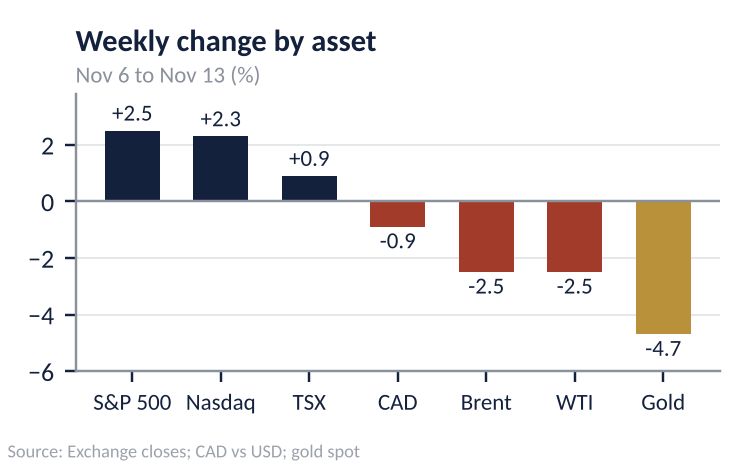
- Gold. Last week's 4.6% gain reversed, with gold down 4.7%. We read this as selling tied to higher rates, and we think that pressure has further to run.
- Oil. Brent fell 2.5% to $95.84, its second weekly decline, after the IEA moved its fourth-quarter forecast to a surplus. Our structural view for 2027 is unchanged.
- Nvidia. Down 12.75% for the week. Other chip stocks rallied until Friday and then sold off. On Sunday the Financial Times reported that the founder is considering a return.
- Ukraine and Canada-US. The Abu Dhabi talks ended with a prisoner exchange and no ceasefire. Washington says trade talks with Canada have resumed. Both stay open.
- Weekend and Monday. Bitcoin hit about $62,000 over the weekend, its lowest since mid-July, on more than $2 billion of liquidations. Before Monday's open, Nasdaq futures were down about 1%, Nvidia almost 4% and crypto-linked stocks 5% to 8%. Brent held near $95.50 after fresh attacks in the Middle East, and gold touched a new low for the year. Canada's October CPI held at 3.1%, below forecasts.
- Infrastructure outages. On Friday afternoon the FAA halted all departures in the mainland US for 4 hours and 21 minutes, the longest national stop since 9/11, after old telecommunications routers overloaded during maintenance. More than 4,700 flights were cancelled and airline stocks fell. We expect air traffic control funding to move up Congress's agenda, with Thanksgiving travel just ahead. Separately, Microsoft 365 services including Outlook, Teams and Copilot were down in more than 70 countries from November 12 to 14, with no sign of a cyberattack. The outage shows how much business activity depends on a few US cloud providers, and it supports Europe's case for its own alternatives.
Market snapshot
US equities rose on the week while oil, gold and the Canadian dollar all fell. The common driver was rates: a fully priced December hike and a stronger dollar pulled down everything that competes with yield.
| S&P 5007,561.67+2.5% on the week | Nasdaq25,136+2.3% on the week | US 10-year5.15%+29bp on the week | Dec Fed hike~100%priced, from ~75% |
| Brent$95.84-2.5% on the week | WTI$88.56-2.5% on the week | Gold~$3,884-4.7% on the week | USD/CAD1.4266CAD -0.9% on the week |
Levels are as at the close on Friday, November 13, 2026 unless stated. The gold level is approximate. The December hike odds are market-implied from futures pricing and approximate, not an ArcStone estimate. Canada's October CPI and Monday pre-market moves are as of 8:30 a.m. ET on Monday, November 16, 2026.
How our view changed this issue
| Theme | Change this issue | Why |
|---|---|---|
| Near-term oil | New this issue: we expect the war premium to fade into early 2027 | IEA surplus, physical cargoes priced below futures, Saudi output near prewar, and an OPEC+ meeting on November 29 that we expect to favour market share. |
| Structural oil view | Unchanged, on a longer timeline | Depleted inventories, strategic reserves that need refilling and years of underinvestment. The surplus has to move into storage first. |
| Fed path in 2027 | New this issue: we expect hikes priced beyond December to come out | Lower oil reaches headline CPI in the first quarter and removes the case for tightening into a supply shock that is already reversing. |
| Bank of Canada, December 9 | New this issue: we expect a hold | October CPI held at 3.1% with core under 2%, after three months of job losses. A hike would defend the currency, and the economy does not need it. |
| AI semiconductor sector | New this issue: leadership and financing risk now treated as sector-wide | The sell-off spread to peers on Friday, and a record listing has to be funded from somewhere. |
| Vendor financing in the AI build-out | New this issue, monitoring | New management with no reason to defend the arrangements, congressional attention, and a public market price for a large investment once it lists. |
| Rotation, debasement and credit-unwind scenarios | Unchanged | Tested against the 2001 and 2008 comparisons below. The credit scenario will be revisited in the month-end review. |
The entries above describe how ArcStone Financial Pulse's own house view changed between issues. They are not ratings, recommendations, or price targets in respect of any security, and none should be inferred from them.
On the calendar
| Date | Event | Why it matters |
|---|---|---|
| Mon Nov 16 | Canada October CPI (released): 3.1% | Below the 3.2% consensus; core under 2% |
| Tue Nov 17 | Nvidia Q3 results, after the close | First report under an interim CEO |
| Wed Nov 18 | Anthropic IPO pricing; FOMC minutes | 825m shares at a proposed $70-78 range |
| Thu Nov 19 | Anthropic first trade (Nasdaq: ANT) | Second-largest IPO on record if priced in range |
| Fri Nov 20 | Monthly options expiration | Put-heavy positioning rolls off |
| Sun Nov 29 | OPEC+ ministerial | 2027 quotas set off the new capacity audit |
| Fri Dec 4 | US November payrolls | Last jobs report before the Fed |
| Wed Dec 9 | FOMC and Bank of Canada | Fed hike priced; we expect the Bank of Canada to hold |
| Dec 14-15 | G20 summit, Miami | Putin attendance still unconfirmed |
On our radar
1. Central banks are hiking into an oil surplus
We think central banks are raising rates into an oil shock that has already started to reverse. A December Fed hike is effectively done. Our concern is the further hikes priced for 2027.
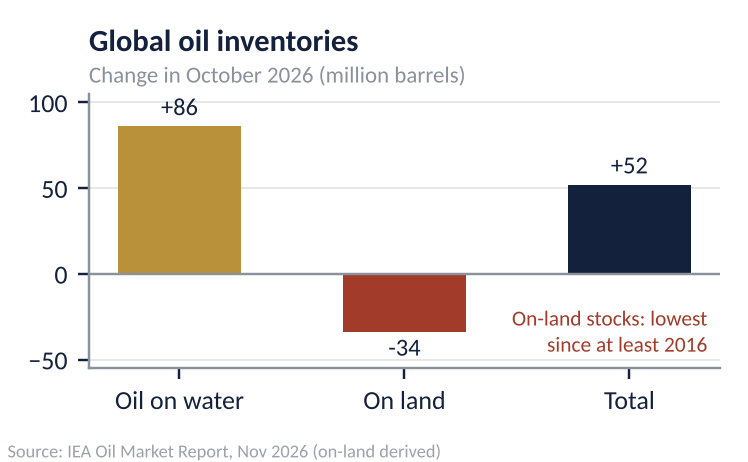
What the physical market is showing. Oil futures still price a tight market, but physical trading has weakened. In its November report the IEA said supply exceeded demand for the first time since the Iran war began. Global inventories rose 52 million barrels in October, and the agency changed its fourth-quarter forecast from a deficit to a surplus of about 1.7 million barrels a day, with a larger surplus of about 3.8 million expected in 2027. Dated Brent, the price for physical cargoes, traded more than $30 above futures in early October and was about $2 below them by November 9, with North Sea cargoes going unsold. Tanker rates have come down from their October highs. All of this is happening while Iran's exports are close to zero under the US blockade.
The surplus may also be larger than the IEA expects. Its forecast assumes Gulf exports are still about a quarter below prewar levels, while Treasury Secretary Bessent has said Hormuz traffic, excluding Iran, is back to pre-conflict levels. We have not been able to verify that claim. If it is right, more oil is reaching a market that already has too much.
Saudi Arabia's choice. Saudi output rose 26% in October to 10.56 million barrels a day, close to prewar levels and just above its quota. During the war, Asian refiners found other suppliers, including record Canadian volumes through Trans Mountain and more crude from the US, Guyana and Brazil. We doubt many of those contracts are reversed when the war ends. This is consistent with our view that Hormuz is mainly an Asian and European problem and that North American producers benefit either way. When Saudi Arabia has lost market share in the past, in 1986, 2014 and 2020, it responded by raising output, and in 2014 prices halved. The OPEC+ meeting on November 29 sets 2027 quotas using a new capacity audit, and we will be watching for signs that Riyadh uses it to justify higher production.
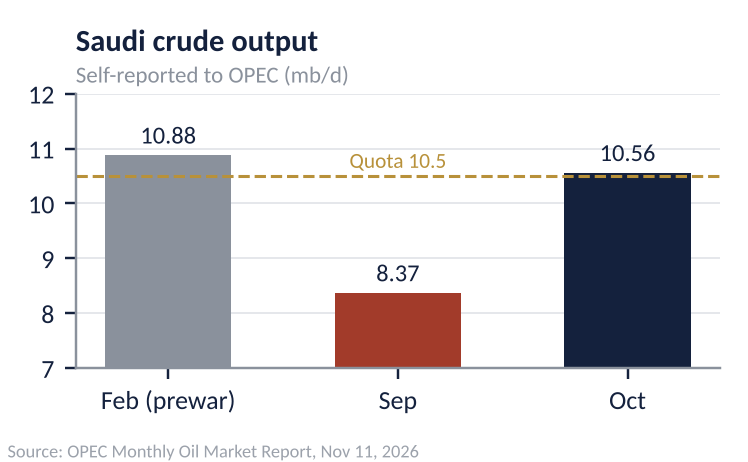
How this fits our structural oil view. Our longer-term constructive view on oil and the near-term surplus run on different timelines. All of October's inventory increase was oil at sea, up 86 million barrels, while onshore stocks fell to their lowest level since at least 2016. Global inventories are still about 462 million barrels lower than in March. We expect the surplus to take the war premium out of prices into early 2027. The longer-term view rests on depleted inventories, strategic reserves that need refilling and years of underinvestment, and we expect it to come back into focus once the extra supply has moved into storage. Near term, our expectation is for lower prices into year-end; the longer-term view is unchanged.
The policy error. The Fed raised rates to 3.75-4.00% in September, and a December hike became fully priced this week after core CPI rose 0.3% for a third straight month. Governor Waller said a quarter point might not be enough. The Bank of England raised its rate to 4% on November 5, and the Bank of Canada raised to 2.50% on October 28 into a weakening job market. The front end of the US curve has moved most.
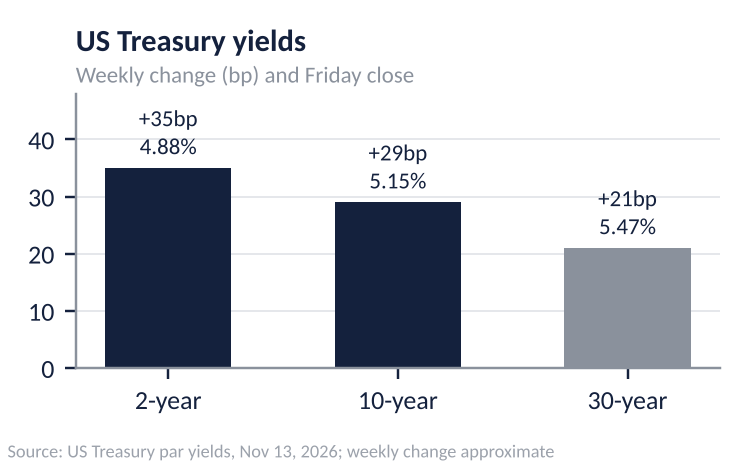
We can understand a December hike, given how persistent core inflation has been. Our disagreement is with the path for 2027. Part of the strength in services inflation comes from energy costs passed through transport and freight, and lower oil prices will reverse some of that. Once lower oil shows up in headline CPI in the first quarter, further hikes will be harder to justify. We see two outcomes. Either the Fed recognises this and stops, which is one of the changes logged above, or it keeps raising rates until something in credit breaks, which is the 2027 scenario we have described before, with Europe most exposed. Either way we expect the debasement thesis to come back, because the dollar's strength this month depends on rate hikes we think will be reversed.
Gold and crypto. Gold has been hurt by this in the short term. It fell 4.7% this week to below $3,900 as the dollar reached a 19-month high. We see it as rate-driven selling similar to 2008, when gold fell roughly 30% between March and October as funds sold whatever still had a bid to meet margin calls, then more than doubled over the next three years. While the dollar rally runs, carrying gold means absorbing that rate-driven selling; our longer-run view on it depends on the rate path reversing, which is the argument above.
Crypto sold off over the weekend for the same reasons. Bitcoin fell 5.7% on Saturday and reached about $62,000 in Asian trading on Sunday, its lowest since mid-July, before recovering to around $65,000. More than $2 billion of leveraged positions were liquidated, US spot bitcoin ETFs have had a week of outflows, and rate markets now largely price a January hike on top of December. Crypto is highly leveraged and very sensitive to liquidity, so it is often the first market to fall when the dollar and real yields rise together. There is some irony in it. Bitcoin's white paper came out in October 2008 as a response to the bank bailouts, and this weekend it traded like a leveraged bank stock from that year.
2. The AI build-out: a leadership change, vendor financing and a record listing
We think Nvidia's leadership change is negative for the AI sector as a whole, mainly because of Nvidia's role in financing it. The founder's resignation as CEO was announced on Thursday following a board investigation, and CFO Colette Kress is serving as interim CEO. The stock fell 12.75% for the week to $162.85, taking its market value below $4 trillion.
The selling spread to the rest of the group. From Monday to Thursday, investors bought Nvidia's competitors on the view that they would win business from it, and two large rival chipmakers each rose more than 18% for the week. That changed on Friday, when one of them fell nearly 9% and other hardware names also declined. The market is now treating Nvidia's problems as a risk to the whole sector, and we agree.
Customer financing. Over the past two years Nvidia has become a major source of funding for its own customers. It reports $99 billion of equity investments, many of them in customers, with another $25 billion committed, and its commitments include up to $10 billion in Anthropic. It has agreed to buy up to $6.3 billion of a cloud provider's unused capacity through 2032 and to guarantee up to $125 billion of a $500 billion lending facility for its customers. Receivables rose to $63.1 billion last quarter, and days sales outstanding increased from 45 to 60 in one quarter as Nvidia gave longer payment terms on large projects. We pointed to that increase in September. A customer-by-customer breakdown belongs in a company-level piece, not a macro issue, so this stays at the mechanism level on purpose.
Some investors will reach for accounting-scandal comparisons. We think the closer comparison is 2000, when the large telecom equipment makers lent to and invested in the carriers buying their equipment. Nvidia discloses these arrangements in its filings, and we have seen no evidence of improper accounting. The risk is the same one those companies faced. When a supplier finances its customers, its revenue can overstate underlying demand, and that only becomes clear when the financing stops. In 2001 many carriers ran out of cash and the vendor loans were written off.
We expect much closer scrutiny of these arrangements now. The founder put most of these deals together, and new management has little reason to defend them. Congress is also involved, as the founder has agreed to testify. In addition, once Anthropic is listed, one of Nvidia's investments will have a public market price that feeds into Nvidia's results. If financing tightens, the AI cloud companies Nvidia supports will feel it first, followed by their suppliers of memory, networking equipment and power. Both of this issue's new entries on the AI build-out in the change log come from this mechanism.
The press reports and Tuesday's results. On Sunday the Financial Times reported that the founder is considering a return, and that his allies are organising to lobby the board and the White House while the board's investigation continues. Treasury Secretary Bessent has since said publicly that Nvidia should look outside the company for its next CEO, and the Financial Times reports the board has already approached the chief executive of another technology company. We have not confirmed these reports. A quick return would probably lift chip stocks sharply and support the market into the Anthropic listing. We would treat that as a short-term move. A founder coming back over the objections of the board that accepted his resignation would raise more questions about governance and about Washington's involvement, not fewer.
There is a case against our view. Hyperscaler budgets drive demand, supply remains tight, and a change of CEO does not cancel orders. Tuesday's results will be the first test, and we will pay more attention to what the interim CEO says about financing commitments, payment terms and receivables than to the quarterly numbers.
The listing and options expiry. Anthropic prices its IPO on Wednesday and begins trading on Thursday. Monthly options expire on Friday. Anthropic is selling 825 million shares at a proposed range of $70 to $78, listing on Nasdaq. That would raise $58 to $64 billion before any overallotment, second only to SpaceX's $75 billion in June. A $26 billion private placement priced alongside it brings the total to as much as $90 billion. Count SpaceX's $75 billion in June and SK Hynix's $26.5 billion in July, and the AI trade has asked investors for more than $185 billion of new stock in five months. We have no view on the stock itself. Our focus is the effect of a deal this size on the rest of the market.
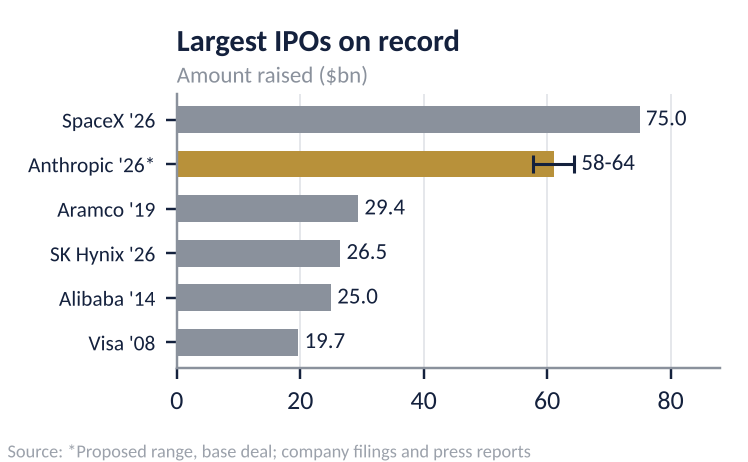
Record listings have a habit of turning up near tops. AT&T Wireless raised $10.6 billion in April 2000, then the largest US IPO ever, seven weeks after the Nasdaq peaked. Visa set the record at $19.7 billion in March 2008, the same week Bear Stearns was sold. This year's record holder, SpaceX, was down about half from its post-listing peak by late July. None of those deals caused what followed. They showed what the market was still willing to pay for.
Into the listing. The issuer, the underwriters and investors who own other AI names all benefit from a strong week. We would not describe that as anyone running the market, but the incentives point the same way, and options positioning adds support. Index options are weighted heavily toward puts, and a large amount expires on Friday. Dealers who sold those puts hedged by selling the market, and they tend to buy back those hedges as expiry approaches.
After the listing. Three mechanisms point the other way once the deal is done:
- Funding. Investors will pay for most of up to $90 billion of new stock, including the private placement, by selling existing holdings. AI megacaps facing leadership questions are the most likely source.
- Precedent. Facebook began trading in May 2012 on an options expiry Friday and fell below its offer price within days. Alibaba listed on an expiry Friday in September 2014, and the S&P 500 hit a high that day and fell sharply into mid-October.
- Rates. A 10-year yield of 5.15% makes high valuations across the market harder to support.
Our house view is that support from positioning fades once the deal is done and the funding pressure remains. The first day matters less for its size than for its shape: a strong open that fades into the close usually means allocations ran ahead of real demand, which would tell us how much more AI equity supply the market can absorb.
3. Canada: rate pressure from Washington
The Canadian dollar hit a 19-month low of 1.4331 on Thursday as the gap between US and Canadian 2-year yields widened to 147bp. Over the week, the market-implied odds of a Bank of Canada hike on December 9 rose from 40% to 66%. We think the market is pricing a hike to support the currency rather than because the economy needs one. Canada has lost jobs for three straight months, and inflation has been mostly an energy story.
Monday's October CPI backs that view. Headline inflation held at 3.1%, below the 3.2% consensus, and rose 0.2% on the month. Excluding energy, prices rose 2.0%, and the Bank's preferred core measures came in at 1.8% for CPI-trim and 2.0% for CPI-median. Gasoline is still up about 31% on the year but fell 2.5% in October, and the oil surplus should take more out by spring. Markets went into the release pricing roughly 60% odds of a December hike. We think that is too high, and a hold is the outcome we expect.
Oil is a second source of pressure. Western Canada Select traded $26.60 below WTI on Thursday, about twice the September spread, after reaching $31.60 on November 3, the widest since 2018.
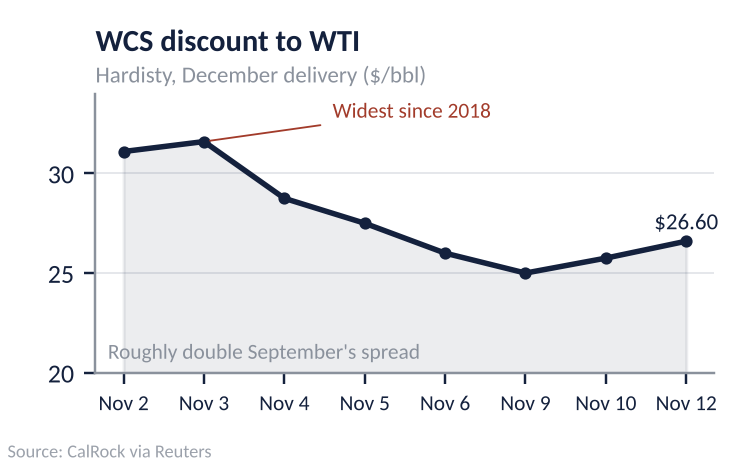
On the positive side, Canada is keeping the Asian market share it won during the war through Trans Mountain. Trade is the one area showing progress. Washington has confirmed talks have resumed, and we think a signed deal would do more for the Canadian dollar than anything the Bank decides on December 9.
The house framework, reassessed
This week's headline comparison is that technology looks like 2001 and credit looks like early 2008. In technology, the company at the centre of the AI build-out has lost its CEO, the financing that supported its customers' demand is likely to be reviewed, and five months after the largest IPO on record, the market is being asked to absorb the second largest. In credit, the headline numbers look fine. High-yield spreads were 320bp on Thursday and narrowed over the week. The stress is in the lower-rated end, where CCC spreads are close to their widest level of the year at about 1,320bp, and several evergreen private credit funds have limited redemptions in 2026. The listed BDCs, which trade every day, are the place to watch, since their discounts to NAV show where private loan marks are heading before the funds report them.
The parallels are close enough to be uncomfortable. In 2000 Cisco was the most valuable company in the world, selling network gear to telecom carriers and lending them the money to buy it. The carriers were called CLECs. Today they are called AI clouds, and the lender is the world's largest chipmaker. In August 2007 BNP Paribas froze three funds because it could no longer value what was in them. This year the funds limiting withdrawals are the ones sold to wealth clients as a steadier alternative to public credit. In 2007 Washington told us subprime was contained. Nobody has said that about private credit yet, which is about the only thing missing.
| Scenario | Weighting this issue | What this week did to it |
|---|---|---|
| Rotation | Base case, unchanged | The 2001 comparison supports it. In 2001 and 2002 the Nasdaq fell sharply while value stocks, small caps and gold held up much better. |
| Credit unwind | Unchanged, placed in 2027 | The 2008 comparison relates here. CCC spreads near their widest of the year and private credit redemption limits keep it live. To be revisited in the month-end review. |
| Debasement | Unchanged | Near-term rate-driven selling in gold, but the dollar's strength rests on hikes we expect to be reversed. |
The timing question is about the rate path. The main difference from both periods is the Fed. In 2001 it cut rates eleven times, and in January 2008 it cut by three quarters of a point between meetings. This Fed is raising rates and the market expects more in 2027, which is at least a new approach. That is why we think the risk lies in the rate path, and why we see both comparisons as more relevant to 2027 than to the next few months. Neither comparison changes our weightings. We are leaving them where they are, and a full recap follows at month-end.
The weightings above are ArcStone Financial Pulse's own house view as at the publication date. They are not market-implied probabilities, forecasts of any particular outcome, or targets.
What is still open
- Nvidia's leadership. Whether the founder returns, as the Financial Times reports he is considering, or the board appoints an outside CEO. Neither report has been confirmed.
- Tuesday's results. What the interim CEO says about financing commitments, payment terms and receivables.
- The Anthropic listing. Final pricing against the proposed range, and how the first day trades into Friday's options expiry.
- OPEC+ on November 29. Whether Riyadh uses the capacity audit to justify higher 2027 output.
- The size of the surplus. Whether Gulf exports are a quarter below prewar levels, as the IEA assumes, or back to pre-conflict levels outside Iran, as Treasury Secretary Bessent has said. We have not verified his claim.
- Private credit. Whether redemption limits spread beyond the evergreen funds, and what listed BDC discounts to NAV signal ahead of the funds' own marks.
- December 9. Whether the Bank of Canada holds against currency pressure, and whether the Fed signals anything beyond December.
- Ukraine and Canada-US trade. No ceasefire after the Abu Dhabi talks, and no signed trade deal yet.
- G20 in Miami. Putin's attendance on December 14-15 is still unconfirmed.
Disclosures
ArcStone Financial Pulse Inc. is owned by the same parent entity (ArcStone Securities and Investments Corp.) that owns ArcStone Securities, LLC. This common ownership, together with the joint operating relationship between ArcStone Securities, LLC and Kingswood Capital Partners, LLC under the ArcStone Kingswood DBA OSJ banner, represents a structural conflict of interest. Issuers referred to in ArcStone Financial Pulse content may be current or former clients of ArcStone or any of its subsidiaries and affiliates. Where ArcStone or its subsidiaries and affiliates have received or have been promised consideration for services provided to such an issuer, such consideration may include cash, stock, stock options, warrants, and/or Restricted Stock Units (RSUs) for the provision of corporate advisory, investor relations, digital media, or capital markets consulting services. This relationship represents a potential conflict of interest. The principals, directors, officers, employees, and related entities of ArcStone and its affiliates may, from time to time, own, buy, or sell securities or derivatives of such issuers or their affiliates.
The information contained herein is provided by ArcStone Financial Pulse Inc. ("ArcStone Financial Pulse"), a subsidiary of ArcStone Securities and Investments Corp. ("ArcStone"), for informational purposes only. It is not, and under no circumstances should it be construed as, an offer to sell or a solicitation of an offer to buy any securities or other financial instruments in any jurisdiction. This content is not a research report within the meaning of FINRA Rules 2241 or 2242 and does not constitute a research report under any applicable securities laws.
Certain statements contained herein may constitute "forward-looking statements" within the meaning of applicable Canadian and U.S. securities laws. Forward-looking statements are based on current expectations, estimates, and assumptions that involve known and unknown risks and uncertainties which may cause actual results or developments to differ materially from those expressed or implied. These statements often include words such as "anticipate," "believe," "expect," "intend," "may," "plan," "project," "should," "target," or similar expressions. Readers are cautioned not to place undue reliance on such statements, which speak only as of the date made. Except as required by law, ArcStone undertakes no obligation to update or revise any forward-looking information.
This content is not intended as investment advice or a recommendation to buy or sell any security and does not take into account the investment objectives, financial situation, or needs of any individual. Investors should consult their own professional advisors before making any investment decisions.
ArcStone Securities and Investments Corp. is not a registered broker-dealer and does not provide investment advice or recommendations. All registrable activities in the United States are conducted through ArcStone Securities, LLC (CRD# 306029) and/or Kingswood Capital Partners, LLC (CRD# 288898), both FINRA-registered broker-dealers, members SIPC. ArcStone Canada Inc. is not registered as a dealer in any Canadian jurisdiction; registrable dealing activities in Canada are conducted through appropriately registered affiliates.
ArcStone Kingswood is a DBA Office of Supervisory Jurisdiction (OSJ) of Kingswood Capital Partners, LLC (Member FINRA/SIPC) under which registered representatives of ArcStone Securities, LLC (Member FINRA/SIPC) and registered representatives of Kingswood Capital Partners, LLC conduct joint capital markets and investment banking activities. ArcStone Securities, LLC and Kingswood Capital Partners, LLC are parties to a written agreement governing the sharing of fees on transactions in which registered representatives of both firms participate. All securities transactions and investment banking services conducted by ArcStone are conducted exclusively through ArcStone Securities, LLC and/or Kingswood Capital Partners, LLC; "ArcStone Kingswood" itself is not a registered broker-dealer or separate legal entity.
Subject matter. This issue discusses monetary policy at the US Federal Reserve, the Bank of Canada and the Bank of England following October 2026 inflation data, including the December 2026 Fed and Bank of Canada decisions and the rate path priced for 2027; the global oil balance following the IEA's November 2026 Oil Market Report and OPEC's November 11, 2026 Monthly Oil Market Report, including Saudi output and the OPEC+ ministerial of November 29, 2026; the Western Canada Select discount to WTI; gold and crypto assets in a rising-rate, strong-dollar environment; the leadership change at Nvidia and vendor financing in the AI build-out; the proposed Anthropic initial public offering and its timing relative to monthly options expiry; high-yield and private credit conditions; and historical comparisons with 2000 to 2001 and 2007 to 2008.
Independence. The views in this issue are the editorial views of ArcStone Financial Pulse Inc. They have not been influenced by any investment banking, advisory or other business relationship of ArcStone Financial Pulse Inc. or its affiliates, and no part of the compensation of anyone who prepared this issue is tied to the views expressed in it.
No ratings. ArcStone Financial Pulse Inc. does not operate a rating system, does not maintain a coverage universe and does not publish a distribution of ratings. The entries in the section 'How our view changed this issue' and the scenario weightings in the section 'The house framework, reassessed' are ArcStone Financial Pulse's own house view about macro regimes and themes as at the publication date. They are not ratings, recommendations or price targets in respect of any security. No view is expressed on the securities of any company named in this issue, including the proposed Anthropic offering.
Affiliate sector exposure. Affiliates of ArcStone Financial Pulse Inc., including ArcStone Securities LLC and ArcStone Canada Inc., may have, or may seek, advisory or capital markets mandates with issuers in sectors discussed in this issue, including crude oil and Western Canadian energy, semiconductors and AI infrastructure, and credit and private lending.
Third parties cited. This issue cites the International Energy Agency (Oil Market Report, November 2026, including its fourth-quarter 2026 surplus of about 1.7 million barrels a day and its 2027 surplus of about 3.8 million barrels a day); OPEC (Monthly Oil Market Report, November 11, 2026); public remarks by Federal Reserve Governor Waller and US Treasury Secretary Bessent; reporting by the Financial Times; CalRock via Reuters for the WCS discount; and the consensus forecast of 3.2% for Canada's October CPI. Market-implied odds for Fed and Bank of Canada decisions reflect futures pricing as reported in the source material and are not ArcStone estimates.
Price basis. Market levels are as at the close on Friday, November 13, 2026 unless stated. The WCS discount is as at Thursday, November 12, 2026. Canada's October CPI and Monday pre-market moves are as of 8:30 a.m. ET on Monday, November 16, 2026, and weekend crypto levels are approximate. The gold level and the weekly changes in Treasury yields are approximate. All levels were carried from the source document and have not been independently re-verified by ArcStone Financial Pulse Inc.
Charts. Figure 1 plots weekly percentage changes from November 6 to November 13, 2026 for the S&P 500, Nasdaq, TSX, the Canadian dollar against the US dollar, Brent, WTI and gold spot, using exchange closes. Figure 2 plots US Treasury par yields for the 2-year, 10-year and 30-year at the November 13, 2026 close with approximate weekly changes. Figure 3 plots the October 2026 change in global oil inventories from the IEA's November 2026 Oil Market Report; the on-land figure is derived from the IEA data rather than reported directly. Figure 4 plots the largest IPOs on record by amount raised, from company filings and press reports; the Anthropic entry is a proposed range for the base deal before any overallotment, not a completed pricing. Figure 5 plots the daily WCS discount to WTI at Hardisty for December delivery from November 2 to November 12, 2026, from CalRock via Reuters. Figure 6 plots Saudi crude output as self-reported to OPEC for February, September and October 2026 against its quota, from OPEC's November 11, 2026 report. No chart contains an ArcStone estimate.
As-reported figures. Nvidia's equity investments, commitments, capacity purchase agreement, loan guarantee, receivables and days sales outstanding are as reported in Nvidia's disclosures, as described in the source material. Anthropic's offering terms (share count, price range, deal size and the accompanying private placement) are as proposed in filings and press reports and may change at pricing. Historical IPO sizes, IEA inventory and surplus figures, OPEC production figures, Canadian CPI figures, high-yield and CCC spread levels, and the FAA and cloud outage details are as reported by their sources and are not ArcStone calculations.
Unverified claims. The Financial Times reports that Nvidia's founder is considering a return and that the board has approached an outside chief executive are press reports that ArcStone has not confirmed. Treasury Secretary Bessent's statement that Hormuz traffic, excluding Iran, is back to pre-conflict levels has not been independently verified. Reports that several evergreen private credit funds have limited redemptions in 2026 are as reported. Historical comparisons in this issue are illustrative and are not forecasts.
No company named in this commentary is a current or former client of ArcStone or any of its subsidiaries and affiliates, and no consideration has been paid or promised to ArcStone or any of its subsidiaries or affiliates in connection with this commentary. Companies are named only to report their own scheduled reporting dates or publicly observable market data, and no view is expressed on their securities.
Sources: International Energy Agency, Oil Market Report, November 2026; OPEC, Monthly Oil Market Report, November 11, 2026; US Department of the Treasury, daily par yield curve rates, November 13, 2026; Exchange closing levels for the S&P 500, Nasdaq, TSX, Brent and WTI, gold spot and USD/CAD, close of November 13, 2026; Fed funds and Bank of Canada futures-implied odds, as at November 13 and November 16, 2026; CalRock via Reuters, WCS discount to WTI at Hardisty, December delivery, November 2 to November 12, 2026; Canada October 2026 Consumer Price Index, released 8:30 a.m. ET, November 16, 2026; Financial Times reporting on Nvidia's leadership, November 15, 2026; Nvidia public disclosures, most recent reported quarter, as described in the source material; Anthropic IPO filings and press reports on offering terms, as at November 13, 2026; Company filings and press reports for historical IPO sizes, as at November 13, 2026; Public remarks of Federal Reserve Governor Waller and US Treasury Secretary Bessent, as reported through November 16, 2026; FAA ground stop, November 13, 2026, and Microsoft 365 outage, November 12 to 14, 2026, as reported.
© 2026 ArcStone Financial Pulse Inc. All rights reserved. May be redistributed in full and unaltered with attribution.