AI Financing Reaches the Bond Market, and Small Caps Pay
Week of September 28, 2026. Issue No. 8.
ArcStone View
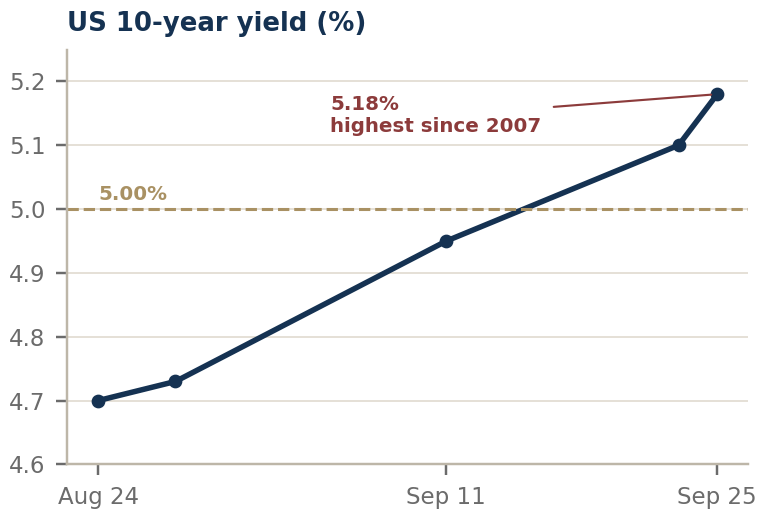
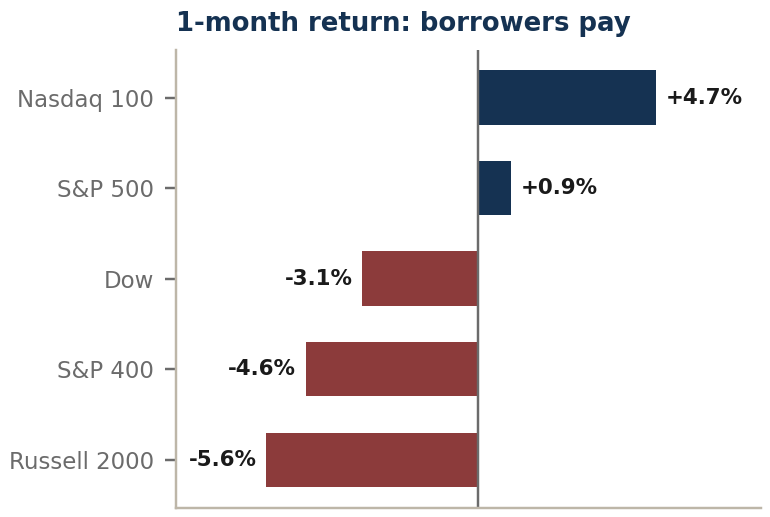
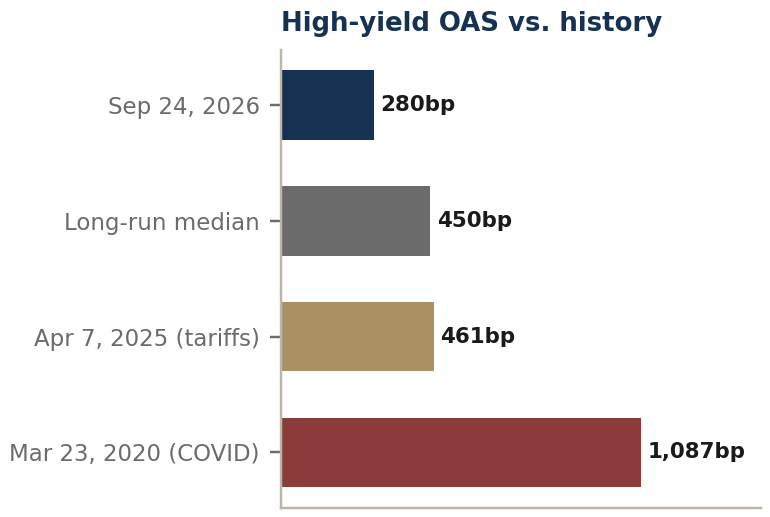
We flagged AI financing as the risk in August. This month it reached the bond market, and the rest of the tape is paying. The US 10-year closed Friday at 5.18%, the highest since 2007, as hyperscaler debt, Treasury supply and $100 oil all bid for the same dollar. Over the past month the Russell 2000 fell 5.6% while the Nasdaq 100 rose 4.7%: smaller borrowers feel the cost of capital first. High-yield spreads, at 280bp, are still in the richest decile on record, and the 2000 and 2008 tops both showed up in credit first. Credit reads this as a warning. So do we, though not yet as the start of a crash. In oil, supply is beating the war premium: WTI fell 8% on the week per Reuters, and Washington wants it lower still before November 3.
Since last issue: what actually moved
- 10-year at 5.18%. Through 5% for the first time since 2007. The 5-year crossed 5% intraday on Wednesday, September 23.
- Nasdaq 100 +2.1% on the week, Russell 2000 -5.6% on the month. The gap between those two is the story of this issue.
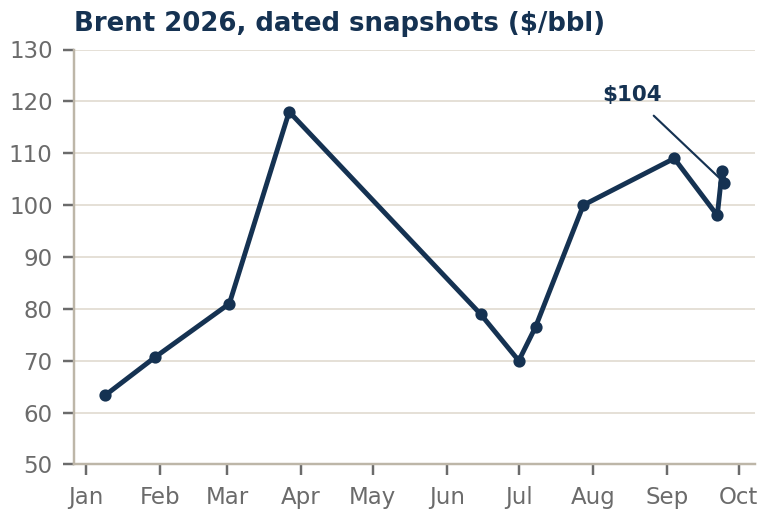
- WTI down 8% to $92.41, Brent roughly flat at $104.32. A $12 gap between the two benchmarks, and more Gulf barrels moving than the market had priced.
- USD/CAD at 1.414. Through the top of the 1.37-1.40 range we had been working with. That range assumption is revised this issue.
- Reassessed, unchanged: rotation, debasement and European gas. Gold's slide to $4,285 is a real-yield move and says nothing new about debasement.
Market snapshot
The 10-year's break through 5% is the move the rest of this issue follows from.
| S&P 5007,743+0.6% on the week; all-time high 7,817 in August | Nasdaq 100+4.7%1-month return | Russell 2000-5.6%1-month return |
| US 10-year5.18%Highest since 2007; 5-year crossed 5% Wednesday | HY OAS280bpAs at September 24 | IG OAS79bpAs at September 24 |
| VIX14.9Friday close | Brent$104.32Up less than 1% on the week | WTI$92.41Down 8% on the week |
| Gold$4,285Spot; real yields up, debasement view unchanged | USD/CAD1.414Above the prior 1.37-1.40 range | Fed / BoC3.75-4.00%BoC 2.25%; US-Canada 10-year gap 124bp |
Levels are as at the Friday, September 25, 2026 close unless stated. Credit spreads are as at Thursday, September 24. Weekly and one-month returns run to the September 25 close. No figure on this dashboard is an ArcStone estimate.
How our view changed this issue
| Theme | Change this issue | Why |
|---|---|---|
| Rotation scenario (Axis 1) | Reassessed, weighting held | This month's leadership cuts against it and credit still backs it. The full case is in On our radar. |
| Debasement scenario (Axis 2) | Unchanged | Gold fell on rising real yields, the rates channel we keep apart from the structural thesis. |
| CUSMA | Unchanged | Weightings carried from the prior issue. The agreement remains in limbo. |
| European gas | Unchanged | TTF eased to about 72 on Iran headlines. Winter is still the test. |
| USD/CAD | Revised, range assumption moved higher | The Fed is hiking, the BoC is at 2.25% and the 10-year gap is 124bp. Brent at $104 should be helping the loonie and isn't. |
| Oil into the US midterms | New this issue, monitoring | Gulf supply is returning faster than priced, and Washington is pushing for lower pump prices before November 3. |
| Oil through 2027 | New this issue, monitoring | Rebuilding the inventories drawn down this year could tighten the market again during 2027. |
The entries above describe how ArcStone Financial Pulse's own house view changed between issues. They are not ratings, recommendations, or price targets in respect of any security, and none should be inferred from them.
On the calendar
| Date | Event | Why we care |
|---|---|---|
| Mon Sep 28 | BoJ September minutes; Dallas Fed manufacturing | Two dissents last meeting; USD/JPY 157 |
| Tue Sep 29 | RBA (25bp hike to 4.60% expected); Canada July GDP; JOLTS | Another central bank tightening into the same oil shock |
| Wed Sep 30 | US August PCE (0.4% m/m expected); ADP; German flash CPI | The inflation print the long end is waiting on |
| Thu Oct 1 | ISM manufacturing; jobless claims; Canada manufacturing PMI | Strong activity is now bad news for yields |
| Fri Oct 2 | September payrolls (100K, 4.2% expected); euro area flash CPI (3.5%) | A soft print is the fastest route to relief below 5% |
| This week | Micron earnings | The first hard AI demand read since the yield break |
| Sun Oct 4 | OPEC+ ministerial; Brazil election | Supply response to returning Gulf barrels |
| Wed Oct 7 | FOMC minutes | How committed the committee is to another hike |
| Tue Nov 3 | US midterms | The date behind our near-term oil view |
| November | US-China tariff truce expires | The Trump-Xi summit produced no extension |
On our radar
1. AI financing reaches the bond market
We've argued since August that the risk in the AI buildout sits in how it's financed. This month that risk showed up, and it largely missed the AI names. It hit everyone else. We read it as a warning sign, not the start of a crash.
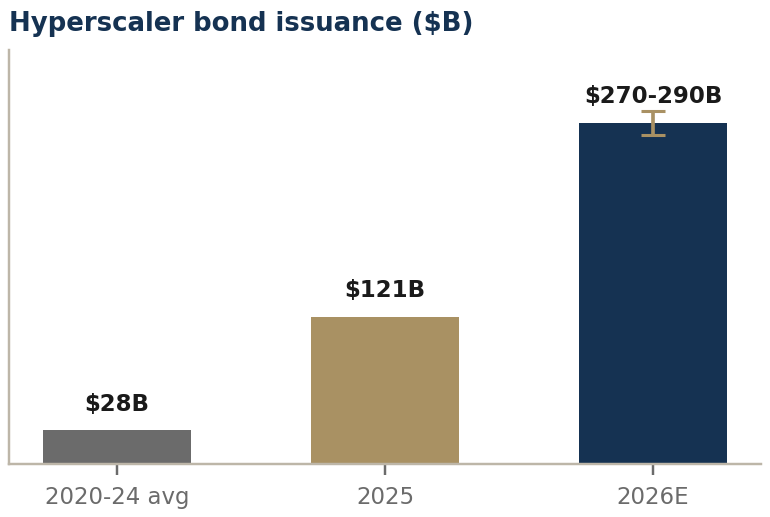
Start with supply. UBS expects $270-290B of hyperscaler bonds this year, against $121B in 2025 and an average of $28B a year from 2020 to 2024. Most of it is long-dated, sized to the life of a data center. Nearly 80% of hyperscaler bonds sold since early 2025 now trade wider than where they priced, according to Bloomberg data reported in September. The paper is getting absorbed, at a discount.
Then stack it. That supply lands on a Treasury market carrying debt of roughly 101% of GDP, beside a Fed that hiked to 3.75-4.00% earlier this month. Fed Governor Barr said on Wednesday, September 23, that further adjustments are likely in his base case. The same day, the S&P Global flash PMI showed US activity growing at its fastest pace in more than five years, with fuel and freight driving input costs higher. The 10-year added about 15bp in a session and closed the week at 5.18%.
The transmission is what we'd watch. Over the past month the Nasdaq 100 is up 4.7%. The Dow is down 3.1%, mid caps 4.6% and the Russell 2000 5.6%. The AI leaders borrow at AA spreads and can sit through a 5% 10-year. Regional banks, small industrials and anyone rolling floating-rate debt can't. The 30-year mortgage is back above 7% and Michigan sentiment fell to 48.1, a four-month low. That's how an AI financing story becomes a broad-market one.
The crash case has serious backers. Capital Economics, above consensus on stocks since 2023, now calls this a late-stage bubble: it sees the S&P 500 rising further into year-end, then falling substantially by the end of 2027. Ruchir Sharma has written that a decisive break above 5% on the 10-year would mark a new era of tight money for AI mega-projects. We take both seriously. Look at the timing in the first one, though: even the new bear has the peak ahead of us. And the market that would have to confirm a crash is quiet. High-yield spreads are 280bp against a long-run median near 450bp, investment grade is 79bp and the VIX closed at 14.9.
Where the stress does show. CCC spreads are at 11.12%, the top of their post-2023 range, while the broad high-yield index barely moves. The weakest borrowers repricing first is how tightening cycles usually start. It's why we call this a warning.
What would change our mind. These are thresholds for revisiting our own view, not forecasts.
- High-yield OAS through 350bp. Past that we'd stop calling this a rates problem.
- The 10-year holding above 5.25% for more than a couple of weeks. A 5.18% close that eases on one oil headline doesn't meet Sharma's own test.
- Jumbo hyperscaler deals pricing with wider concessions, or one getting pulled.
- Micron's results this week showing any softening in AI memory orders.
For the rotation scenario, this month is the one that argues against us. Mega-cap tech led and the cyclical side fell, which is what the narrow tape of a top looks like. We read it as the cyclical side absorbing a rate shock it's more exposed to, and with credit this calm we're holding the base case. We'll revisit once Q3 earnings are in, in early November. If the narrowing survives them, weight moves toward the valuation-top leg.
Where the money goes next
Jensen Huang spent part of a recent interview with Ezra Klein on the layers above his chips. He describes AI as a five-layer cake: energy, chips, infrastructure, models, applications. He also said it only became useful in the last six months. Our read is that spending now moves toward the top layer, where AI gets put to work inside the companies paying for it.
The largest AI labs have already moved in that direction. In May, two of them each set up a deployment venture with outside backers, both built to put engineers inside client companies to make the software work. Gartner's read is that many enterprises are stuck in pilots because they don't have the in-house expertise to go further. An issuer-by-issuer breakdown belongs in a company-level piece, not a macro issue, so this stays at the mechanism level on purpose.
The mechanism is what ties it back to rates. That layer carries little balance sheet and gets paid when the client sees the savings, so it is less exposed to a 5% 10-year than the capital-heavy layers beneath it.
2. Oil: cheaper into November, tighter into 2027
Our summer view was that supply would come back faster than the war premium implied. It's happening. We now think the White House pushes hard to get pump prices down before November 3 and mostly succeeds, and that the damage done to inventories this year sets up a larger spike through 2027.
More barrels than priced. JPMorgan put Middle East oil flows at 17 million barrels a day, more than 70% of the 2025 average. CBA has argued that 50-60% of pre-war volumes would be enough to revive the oversupply story. We're past that mark. The IEA's September report still had more than 10 mb/d of Gulf output shut in during August and pushed a full recovery into 2027, so the market has been pricing a slower return than the tankers are showing. WTI fell about 8% in the week to September 25.
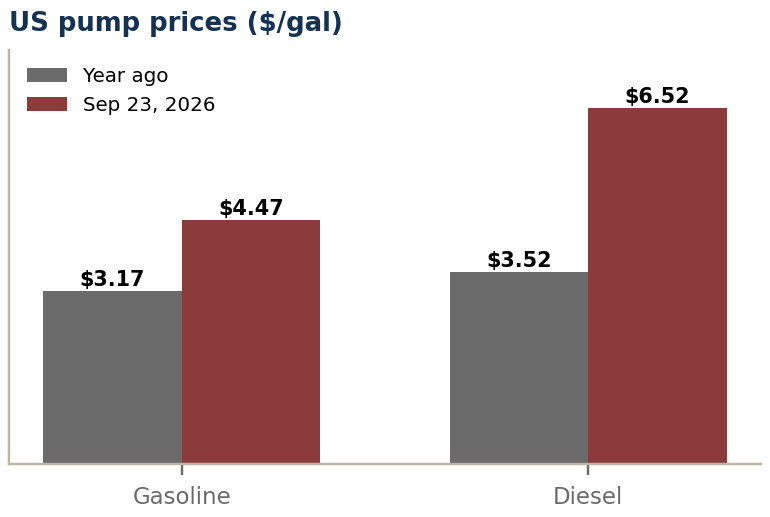
The politics point the same way. Gasoline averages $4.47 and diesel a record $6.52, nearly $3 above a year ago. President Trump said on Tuesday, September 22, that he'd asked his team to hold diesel at home, and Republican senators from Iowa and Alaska want a temporary embargo. US and Iranian negotiators are working a phased deal on the sidelines of the UN: Iran reopens Hormuz, the US lifts its blockade of Iranian ports. The White House says it's in no hurry. Five weeks from the midterms, we think it signs something.
Watch the gap between the benchmarks. WTI at $92 against Brent at $104 says the US barrel is already partly insulated. A diesel export ban would widen that gap, and Rapidan and the Dallas Fed both expect it would raise prices on the coasts. Our near-term view rests on Iranian barrels, not an export ban.
The inventory hole. The IEA's September report has production rebounding 8 mb/d in 2027 against a 2.6 mb/d demand recovery. That's a surplus on paper, and we think it's too optimistic. It needs Hormuz flows, field restarts across several sovereign producers and Gulf refineries all back on schedule, and this year hasn't kept one schedule. It also has a hole to fill: the IEA put the cumulative supply deficit at about 900 million barrels by September, including a 400-million-barrel coordinated strategic release, and estimated that rebuilding those stocks takes roughly an extra 1 mb/d. Governments refilling reserves turn into buyers just as the market expects slack. If the Gulf recovery slips a few quarters, the surplus disappears and the rebuild drives prices. That's why we weight it at roughly even odds. It's also a physical-inventory view, separate from the oil leg of the debasement scenario.
For Canada, the near-term leg stings. A softer WTI plus a 124bp gap in 10-year yields is a poor mix for the loonie while CUSMA sits in limbo. WCS prices off WTI, so a weaker US barrel lands on Canadian heavy crude on top of the discount pressure we flagged in Issue No. 4. The 2027 leg is kinder to Canadian heavy-oil production with a coastal export outlet.
What breaks the near-term view. Iran talks collapsing the way the June memorandum did, or the Houthis landing a hit on Yanbu, the Red Sea terminal at the end of the East-West pipeline we covered in Issue No. 7. Saudi forces intercepted six missiles aimed there and at Taif on Thursday, September 24. OPEC+ meets October 4.
The house framework, reassessed
This is the month-end reassessment of the standing scenarios. The two axes are independent and do not sum together.
| Axis 1 scenario | Weighting | Reading this issue |
|---|---|---|
| Continued rotation | 60% | Base case, held. This month's leadership cuts against it; calm credit still supports it. |
| Valuation top | 25% | Weight moves here if the narrowing in leadership survives Q3 earnings in early November. |
| Credit unwind | 15% | Stress is visible in CCC spreads, not yet in the broad high-yield index. |
Axis 2, the debasement tail, is unchanged at a 25-30% weighting on an 18-month clock. It describes a regime of sharply higher gold and oil prices. Gold's fall to $4,285 this month came through rising real yields, the rates channel we keep separate from the structural thesis, so it does not move the weighting.
Other standing scenarios. CUSMA: extension or deal 25%, standoff 55%, termination 20%, unchanged. European gas: we continue to weight TTF staying elevated through Q1 2027 as more likely than not, unchanged. Oil, new this issue: we weight a softer US barrel into the November 3 midterms as more likely than not, and a renewed tightening during 2027 as inventories rebuild at roughly even odds. Section 899-style forced repatriation remains a watch item without a weighting.
The weightings above are ArcStone Financial Pulse's own house view as at the publication date. They are not market-implied probabilities, forecasts of any particular outcome, or targets.
What is still open
- The inflation and jobs prints. Whether August PCE on September 30 and September payrolls on October 2 give the long end any relief below 5%.
- AI demand. What Micron's results this week say about AI memory orders, and whether jumbo hyperscaler deals keep clearing at current concessions.
- Leadership. Whether the narrowing in equity leadership survives Q3 earnings in early November, which is when we revisit the rotation weighting.
- Credit. Whether the CCC repricing spreads into the broad high-yield index.
- Gulf supply. The OPEC+ response on October 4, whether a US-Iran phased deal is signed before November 3, and whether Yanbu stays out of reach.
- US fuel policy. Whether diesel export restrictions move beyond statements, and what that does to the Brent-WTI gap.
- Trade. CUSMA remains in limbo, and the US-China tariff truce expires in November with no extension from the Trump-Xi summit.
- The 2027 inventory path. Whether the Gulf recovery keeps to the IEA's schedule or slips, which decides whether the 2027 surplus survives the stock rebuild.
Disclosures
ArcStone Financial Pulse Inc. is owned by the same parent entity (ArcStone Securities and Investments Corp.) that owns ArcStone Securities, LLC. This common ownership, together with the joint operating relationship between ArcStone Securities, LLC and Kingswood Capital Partners, LLC under the ArcStone Kingswood DBA OSJ banner, represents a structural conflict of interest. Issuers referred to in ArcStone Financial Pulse content may be current or former clients of ArcStone or any of its subsidiaries and affiliates. Where ArcStone or its subsidiaries and affiliates have received or have been promised consideration for services provided to such an issuer, such consideration may include cash, stock, stock options, warrants, and/or Restricted Stock Units (RSUs) for the provision of corporate advisory, investor relations, digital media, or capital markets consulting services. This relationship represents a potential conflict of interest. The principals, directors, officers, employees, and related entities of ArcStone and its affiliates may, from time to time, own, buy, or sell securities or derivatives of such issuers or their affiliates.
The information contained herein is provided by ArcStone Financial Pulse Inc. ("ArcStone Financial Pulse"), a subsidiary of ArcStone Securities and Investments Corp. ("ArcStone"), for informational purposes only. It is not, and under no circumstances should it be construed as, an offer to sell or a solicitation of an offer to buy any securities or other financial instruments in any jurisdiction. This content is not a research report within the meaning of FINRA Rules 2241 or 2242 and does not constitute a research report under any applicable securities laws.
Certain statements contained herein may constitute "forward-looking statements" within the meaning of applicable Canadian and U.S. securities laws. Forward-looking statements are based on current expectations, estimates, and assumptions that involve known and unknown risks and uncertainties which may cause actual results or developments to differ materially from those expressed or implied. These statements often include words such as "anticipate," "believe," "expect," "intend," "may," "plan," "project," "should," "target," or similar expressions. Readers are cautioned not to place undue reliance on such statements, which speak only as of the date made. Except as required by law, ArcStone undertakes no obligation to update or revise any forward-looking information.
This content is not intended as investment advice or a recommendation to buy or sell any security and does not take into account the investment objectives, financial situation, or needs of any individual. Investors should consult their own professional advisors before making any investment decisions.
ArcStone Securities and Investments Corp. is not a registered broker-dealer and does not provide investment advice or recommendations. All registrable activities in the United States are conducted through ArcStone Securities, LLC (CRD# 306029) and/or Kingswood Capital Partners, LLC (CRD# 288898), both FINRA-registered broker-dealers, members SIPC. ArcStone Canada Inc. is not registered as a dealer in any Canadian jurisdiction; registrable dealing activities in Canada are conducted through appropriately registered affiliates.
ArcStone Kingswood is a DBA Office of Supervisory Jurisdiction (OSJ) of Kingswood Capital Partners, LLC (Member FINRA/SIPC) under which registered representatives of ArcStone Securities, LLC (Member FINRA/SIPC) and registered representatives of Kingswood Capital Partners, LLC conduct joint capital markets and investment banking activities. ArcStone Securities, LLC and Kingswood Capital Partners, LLC are parties to a written agreement governing the sharing of fees on transactions in which registered representatives of both firms participate. All securities transactions and investment banking services conducted by ArcStone are conducted exclusively through ArcStone Securities, LLC and/or Kingswood Capital Partners, LLC; "ArcStone Kingswood" itself is not a registered broker-dealer or separate legal entity.
Subject matter. This issue of the ArcStone Macro Pulse is general macro commentary on: the rise in the US 10-year Treasury yield through 5% in September 2026 and the financing of AI infrastructure through hyperscaler bond issuance, alongside US Treasury supply and Federal Reserve tightening; the divergence between large-cap technology and small- and mid-cap US equity indices; high-yield and investment-grade credit spreads; the recovery of Gulf oil flows, US gasoline and diesel prices and US energy policy ahead of the November 3, 2026 US midterm elections, and the 2027 oil inventory rebuild; USD/CAD, the US-Canada 10-year yield gap and CUSMA; Western Canadian heavy crude pricing; and European gas.
Independence. The views in this issue are the house view of ArcStone Financial Pulse Inc. They have not been influenced by any investment banking, advisory or other business relationship of ArcStone Financial Pulse Inc. or its affiliates, and no part of any preparer's compensation is tied to the specific views expressed.
No ratings. ArcStone Financial Pulse Inc. does not operate a rating system, maintain a coverage universe, or publish a distribution of ratings. The scenario weightings in 'How our view changed this issue' and 'The house framework, reassessed', and the qualitative weightings on oil and European gas in 'On our radar', are the house view of ArcStone Financial Pulse Inc. on macro scenarios as at the publication date, not assessments of any security. The high-yield spread and 10-year yield thresholds under 'What would change our mind' are conditions for revisiting the house view, not forecasts or targets.
Affiliate sector exposure. Affiliates of ArcStone Financial Pulse Inc., including ArcStone Canada Inc., which contracts many Canadian advisory mandates, may have or may seek advisory or other business relationships with companies in sectors discussed in this issue, including energy (crude oil, Western Canadian heavy oil and natural gas), resources, and enterprise AI services. Readers should treat this as a potential conflict of interest.
Third-party forecasters cited. Forecasts and estimates in this issue are attributed to their authors: UBS (2026 hyperscaler bond issuance estimate); Capital Economics (S&P 500 outlook through 2027); Ruchir Sharma (the 10-year yield level he describes as marking an era of tight money for AI projects); JPMorgan (Middle East oil flows); CBA (the share of pre-war volumes needed to revive the oversupply case); the IEA (September 2026 Oil Market Report figures on shut-in Gulf output, 2027 production and demand, the cumulative supply deficit, the coordinated strategic release and the stock rebuild); Rapidan and the Federal Reserve Bank of Dallas (the price effect of a US diesel export ban); and Gartner (enterprise AI adoption). Remarks attributed to Federal Reserve Governor Barr and to Jensen Huang are reported as publicly described. ArcStone Financial Pulse Inc. has not independently verified any third-party forecast.
Price basis and as-of date. Market levels are as at the Friday, September 25, 2026 close unless stated. High-yield and investment-grade option-adjusted spreads are as at September 24, 2026, and US pump prices are as at September 23, 2026. Weekly and one-month returns run to the September 25 close. Levels were carried from the source document compiled for this issue from Trading Economics, Reuters, CNBC, ICE BofA via FRED and AAA, and were not independently re-verified by ArcStone Financial Pulse Inc.
Chart methodology. The chart grid's source line lists Trading Economics, Reuters and CNBC dated closes, ICE BofA via FRED, BofA and UBS, Reuters, CNBC and IEA, and AAA. The one-month return chart shows returns for the Nasdaq 100, S&P 500, Dow, S&P 400 and Russell 2000 over the month to the September 25, 2026 close. The US 10-year yield chart plots dated closes between August 24 and September 25, 2026, joined by straight lines, with a 5.00% reference line. The high-yield spread chart compares the ICE BofA high-yield option-adjusted spread on September 24, 2026 with an approximate long-run median and the readings of April 7, 2025 and March 23, 2020. The hyperscaler issuance chart shows the 2020-2024 annual average and the 2025 total from BofA, and a 2026 range that is a UBS estimate, not a settled figure. The Brent chart plots dated price snapshots through 2026 from Reuters, CNBC and IEA reporting, joined by straight lines; it is not a continuous daily series and may miss intra-period highs and lows. The pump price chart compares AAA gasoline and diesel averages on September 23, 2026 with year-earlier levels; the year-ago diesel figure is approximate. No chart in this issue contains an ArcStone estimate.
As-reported figures and unverified items. The following are reported as published by third parties rather than calculated by ArcStone: hyperscaler bond issuance (BofA, UBS); the share of hyperscaler bonds trading wider than issue (Bloomberg data as reported in September 2026); the S&P Global US flash PMI; US federal debt of roughly 101% of GDP; the 30-year mortgage rate above 7%; University of Michigan consumer sentiment of 48.1; CCC spreads of 11.12%; the weekly WTI decline of about 8% (Reuters); Middle East oil flows (JPMorgan); and the IEA figures noted above. The US-Canada 10-year yield gap of 124bp and the roughly $12 Brent-WTI gap are differences between reported levels. The Bloomberg figure and the characterisations of the Capital Economics and Ruchir Sharma views are as reported and have not been independently verified. The status of US-Iran negotiations and of any US diesel export restriction reflects public statements as at September 25, 2026.
No company named in this commentary is a current or former client of ArcStone or any of its subsidiaries and affiliates, and no consideration has been paid or promised to ArcStone or any of its subsidiaries or affiliates in connection with this commentary. Companies are named only to report their own scheduled reporting dates or publicly observable market data, and no view is expressed on their securities.
Sources: Trading Economics, market levels and one-month returns, as at September 25, 2026 close; Reuters and CNBC, dated market closes including the US 10-year yield, August 24 to September 25, 2026; Reuters, weekly WTI move, week to September 25, 2026; ICE BofA high-yield and investment-grade option-adjusted spreads via FRED, as at September 24, 2026, with historical readings of April 7, 2025 and March 23, 2020; BofA, hyperscaler bond issuance, 2020 to 2025; UBS, 2026 hyperscaler bond issuance estimate, as cited in September 2026; Bloomberg data on hyperscaler bonds trading wider than issue, as reported in September 2026; S&P Global, US flash PMI, September 23, 2026; Federal Reserve Governor Barr, remarks, September 23, 2026; IEA, Oil Market Report, September 2026; Reuters, CNBC and IEA, Brent dated price snapshots, January to September 2026; AAA, US average gasoline and diesel prices, September 23, 2026 and one year earlier (year-ago diesel approximate); JPMorgan, CBA, Rapidan, Federal Reserve Bank of Dallas, Capital Economics, Ruchir Sharma and Gartner, as cited in this issue; publication dates not stated in the source document; University of Michigan consumer sentiment, latest reading as cited in this issue; Jensen Huang, interview with Ezra Klein, as cited in this issue; Economic calendar and consensus expectations, as at September 25, 2026.
© 2026 ArcStone Financial Pulse Inc. All rights reserved. May be redistributed in full and unaltered with attribution.