Credit Climbs the Ratings Ladder While Oil Holds December Up

Week of October 19, 2026. Issue No. 11.
ArcStone View
AI credit stress climbed the ratings ladder this week, from the data-center borrowers into the lowest-rated corners of high yield. We read it as the first clear signal of the credit problem we expect in 2027. It has not reached investment grade, and that is the line we are watching. CCC spreads are at a multi-year high while BBB has barely moved, and equities rotated rather than broke. Oil near $110 is keeping a December Fed hike priced, which keeps the pressure on gold and silver. On the midterms, our house view differs from the consensus that Democrats win big on November 3.
Since last issue: what actually moved
- Credit. CCC spreads hit a multi-year high. CoreWeave's bonds traded at distressed levels and Oracle's default swaps set a record.
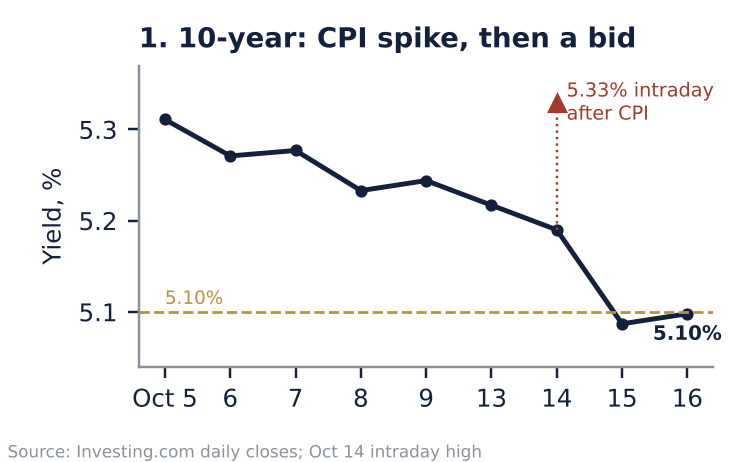
- Rates. A hot CPI print (3.7%) sent the 10-year to 5.33% intraday. It closed Friday at 5.10%, against 5.24% last issue. October hike odds hit 47%, then fell to 13%.
- Commodities. Brent $109.86, from $104.72. Gold about $4,166, from about $4,200. Silver about $57, down 5% on the week.
- FX. USD/CAD 1.4154, from 1.427 last issue, after testing 1.43. USD/JPY touched 159.
- House view. Standing weightings unchanged. The credit tail is held at 20%, closer to an increase. The gold view is held. Silver is new this issue, as a monitoring item.
Market snapshot
The week turned on Wednesday's CPI print: 3.7%, with gasoline up 7.1% in a month. The 10-year spiked to 5.33% intraday, then fell through the rest of the week as credit stress did some of the Fed's work for it, closing at 5.10%.
| US 10Y5.10%5.33% intraday Wed | Oct hike odds13%December 74% | CCC spread~1,050bp+134bp in 4 weeks | Brent$109.86Highest settle since May |
| Gold~$4,166Support held | Silver~$57-53% vs January record | USD/CAD1.41541.43 tested Wed | Trump approval33%Record low, Oct 9-13 poll |
Levels are as at the Friday, October 16, 2026 close unless stated. The 10-year intraday high and the USD/CAD test of 1.43 are from Wednesday, October 14. The CCC spread is an approximate level as at October 15, per Penn Mutual AM. Gold and silver levels are approximate. Hike odds are market-implied, not ArcStone estimates. Levels are carried from the source document and were not independently re-verified.
How our view changed this issue
| Theme | Change this issue | Why |
|---|---|---|
| Rotation scenario (Axis 1, near-term) | Unchanged | The Dow rose and the Nasdaq fell 4.5% in the week AI credit cracked. A market top would have taken both down. |
| Credit tail (Axis 1) | Weighting held at 20%, closer to an increase | The trigger for an increase is BBB spreads moving. So far BBB has widened 7bp in four weeks. |
| Debasement scenario (Axis 2, 18-month horizon) | Unchanged | The fiscal stimulus of a Republican sweep would reinforce it. |
| Gold into year-end | Unchanged, under more pressure | The view survived the CPI shock. It firms only if December hike odds fall under 50%. Choppy trading into November 3 would not surprise us. |
| Silver | New this issue, monitoring | The 2026 low held, but the downtrend is intact. We revisit the view once December hike odds are under 50% and the downtrend breaks. |
| USD/CAD, 1.39 to 1.43 working range | Unchanged | The pair tested the top of the range and turned lower as Brent neared $110. |
The entries above describe how ArcStone Financial Pulse's own house view changed between issues. They are not ratings, recommendations, or price targets in respect of any security, and none should be inferred from them.
On the calendar
| Date | Event |
|---|---|
| Mon Oct 19 | Canada CPI; Alberta referendum |
| Tue Oct 20 | France's first budget vote |
| Fri Oct 23 | Moody's review of France |
| Oct 27 to 30 | FOMC (hold about 87% priced), Bank of Canada, ECB, Bank of Japan |
| Tue Nov 3 | US midterm elections |
| Wed Dec 9 | FOMC (hike about 74% priced) |
| Fri Jan 1, 2027 | US 50% tariff on Canadian autos, parts and steel |
On our radar
1. Credit is climbing the ratings ladder
We have flagged AI credit since Issue No. 9. This week the stress spread, from the data-center borrowers into the lowest-rated corners of high yield. We read it as the first clear signal of the credit trouble we expect in 2027. The event itself is still ahead of us, and the gap between the signal and the event is what this issue is about.
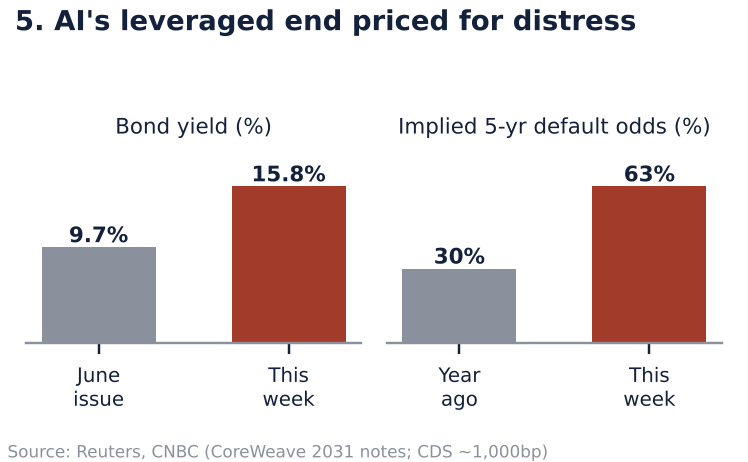
The spark was the CPI print. With the 10-year at 5.33% and October hike odds briefly at 47%, the data-center borrowers' own debt broke first. CoreWeave's 2031 notes, sold at 9.675% in June, were yielding about 15% by Thursday, and its default swaps, at about 1,000 basis points, implied a 63% chance of default within five years, against 30% a year ago. Oracle's default swaps also hit a record. The market's message was simple: AI debt without cash flow behind it is getting hard to fund.
Then the stress climbed the ladder. CCC spreads reached about 1,050 basis points, a multi-year high, up 134 in four weeks. Single-B widened 35. The mechanism is refinancing: money borrowed cheaply in 2020 is now rolling with the 10-year above 5%. Private credit is showing the same strain in slow motion, with heavy redemption requests at a US manager's technology fund and a redemption freeze at an Australian private credit manager. An issuer-by-issuer breakdown belongs in a company-level piece, not a macro issue, so this stays at the mechanism level on purpose.
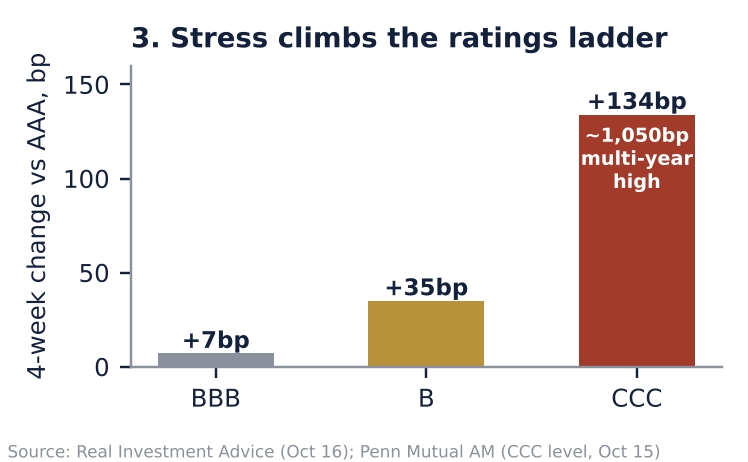
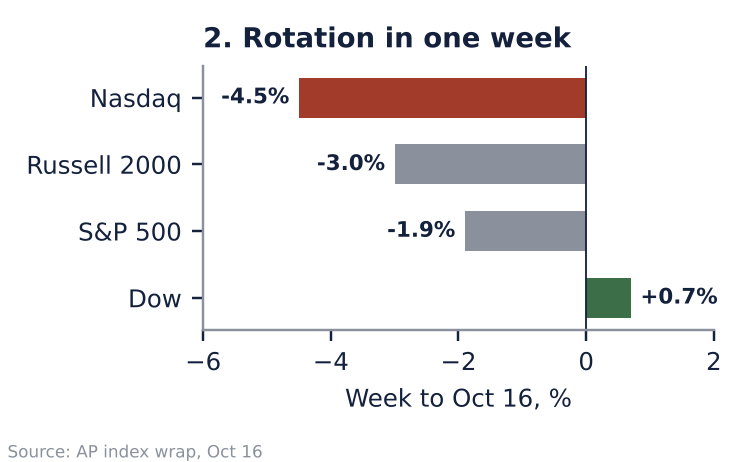
It has not reached high grade, and that is our line. BBB moved 7 basis points, and the big banks called credit steady this week, though at least one large lender's provisions are up about half on the year. So the credit tail stays at 20%. Equities agreed: the Nasdaq fell 4.5% while the Dow rose 0.7%, with the Russell 2000 down 3.0% and the S&P 500 down 1.9%. That is rotation, not a top. A top would have taken the Dow down as well. The day BBB moves is the day we raise the tail.
In the meantime, credit did the Fed's work. The 10-year closed at 5.10%, Warsh refused to prejudge anything in Bangkok, and October hike odds fell to 13%. Goldman now sees one last hike in December. We have said since Issue No. 9 that today's stress is controllable and that 2027's probably will not be. This week brought 2027 into view.
2. Oil holds December up, and gold and silver wait on it
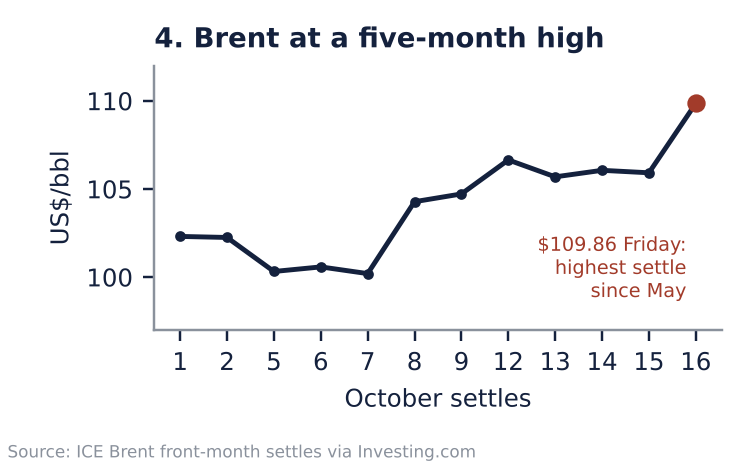
If credit took October off the table, oil keeps December on it. Brent settled at $109.86 on Friday, its best close since May, with the G7's 100-million-barrel release already in the market. Hormuz had its worst week of the war: at least 10 ships hit and two sunk. The IRGC also says a supertanker hit a mine on Saturday, a claim that has not been independently confirmed. With diesel at $6.18 and Brent above $100, we do not expect December's 74% hike pricing to slip under 50%.
For Canada, oil did its usual job. The loonie had its first weekly gain in six, closing at 1.4154 after touching 1.4299. Our 1.39 to 1.43 working range held, right at the top.
Gold and silver both held up on the charts this week. Neither has turned, and both are waiting on December.
Gold passed its stress test, narrowly. It dropped $60 in fifteen minutes on the CPI print, slipped under the prior week's low and recovered to about $4,166. Support held, but gold is still below its major moving averages. What would firm our view: the 10-year back under 5%, Brent off $110, a softer dollar and December hike odds under 50%. Choppy trading into the vote would not surprise us. Gold sagged into the 2014 and 2022 midterms and bottomed around them, though history is no guide to any particular outcome.
Credit is the bigger driver in our gold view. Every turn wider in junk spreads makes a December hike harder to deliver, and if the stress reaches BBB we think the policy answer is coordinated intervention, with commodities gapping higher and gold leading. Central banks bought about 63 tonnes in September, on early estimates. In Canadian dollars, gold is near C$5,900.
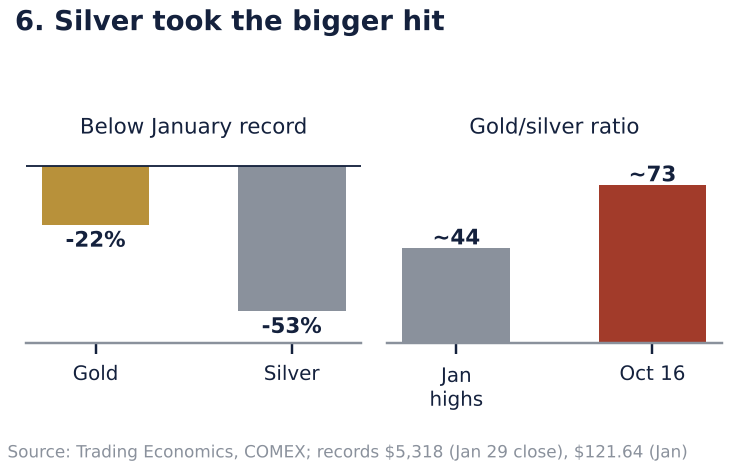
Silver held its 2026 low, with less room to spare. It has made lower highs since January's $121.64 record, and the gold-to-silver ratio hit 74 during the week, against about 44 at January's highs. The ratio is wide, but silver is exposed to the same credit stress through industrial demand. Jim Curry's cycle work at Gold Wave Trader sees one more low into early November before a year-end rally. We have added silver to the change log as a monitoring item: our view does not move until December hike odds are under 50% and the downtrend breaks. Until then, carrying silver exposure means carrying the same rate and credit risk described throughout this issue.
3. The midterms: our view differs from the blowout consensus
To be clear up front: a Democratic blowout on November 3 is the consensus, not the Macro Pulse house view. We think the result surprises a lot of people. What follows is an analysis of polling and its market implications, not a political endorsement.
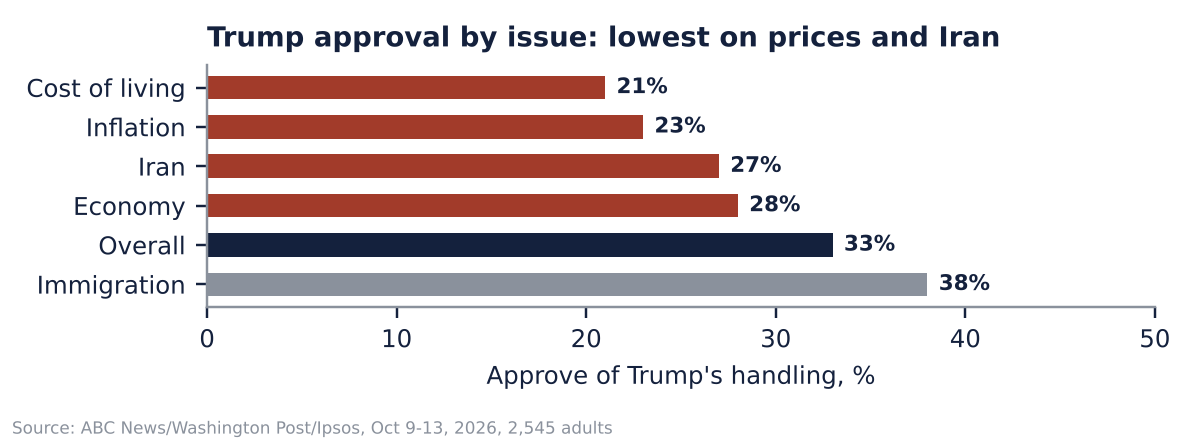
The consensus case is easy to make. Kalshi gives Democrats a 90% chance at the House and 63% at the Senate, and the Silver Bulletin has them up almost 9 on the generic ballot. Trump's approval just hit 33% in the ABC News/Washington Post/Ipsos poll. Seventy-one percent of voters call gas unaffordable, up from 28% in February, and the Iran war and tariffs are not helping him either.
We think the polls are overstating it. They measure dislike of Trump more than enthusiasm for Democrats, whose own party is underwater at 44% favourable. Polls overstated Democrats by between 2.7 and 4.6 points in each of the last three presidential cycles, and in the 37 tightest House seats Emerson has Democrats up just 2. Even Democratic pollster Celinda Lake thinks this year's leads may be inflated.
The closing issues lean Republican. Crime is the one area where voters trust Republicans more, and immigration is a draw. Weeks of street clashes in Paris may sharpen the law-and-order contrast for some voters. If gas gets cheaper or a peace deal lands before the vote, we think independents could drift back. In fairness, midterm polls have been far more accurate than presidential ones, and Trump is not on the ballot. So the House still leans Democratic, but we would put the Senate much closer to a coin flip than 63% suggests.
If Republicans beat the polls, markets get continuity: tariffs, energy permitting and deregulation stay on track, and rates move first. The table maps how we would expect that to transmit. It describes mechanisms by area, not a view on any security.
| Area | What changes | Mechanism |
|---|---|---|
| Treasuries and the dollar | A hotter fiscal path: tax relief extended, household payments, a gas-tax holiday | Higher long-end yields and a firmer dollar, with the Fed leaning toward more hikes |
| Leveraged credit | Stronger growth on paper | Higher rates make CCC, single-B and neocloud refinancing harder, and we would raise the credit tail weighting |
| Energy | Permitting and domestic production stay favoured | Policy helps; price may not. The likeliest path to an upset runs through lower pump prices or a peace deal |
| Financials | Lighter regulation continues | A lighter regulatory load, set against provisions that are already rising at at least one large lender |
| Small and mid caps | Domestic cyclicals gain from deregulation and fiscal support | Offset by higher rates. The Russell 2000 fell 3% this week on exactly that |
| AI infrastructure | Less federal resistance to the data-center buildout | The binding constraint is financing cost, and a hotter fiscal path raises it |
| Defense and healthcare | Spending priorities hold | Less policy pressure, including on managed care, than under a Democratic sweep |
| Gold | No direct policy effect | Higher rates weigh in the near term; wider deficits feed the debasement scenario on its longer horizon |
| Canada | Tariff policy unchanged under executive authority | The CUSMA standoff and the January 1 auto tariff stand. The loonie loses if a peace deal pulls oil lower |
History helps either way. The S&P 500 has been higher a year after the midterms in 32 of 38 cycles since 1874, with most of the gain coming three to six months out, though past patterns are no guide to any particular outcome. The risk we think is underpriced is a Republican sweep. Proposed $5,000 household payments and a gas-tax holiday on top of 3.7% inflation mean more Fed hikes and a higher long end, which hurts leveraged credit now and supports the debasement scenario later. Tariffs barely change either way, since they run on executive power. For Canada, the CUSMA standoff runs straight through the vote.
The White House playbook: pump prices and two peace deals. We think the White House spends the time before the vote on pump prices and peace. The Russian diesel deal, about 300,000 tonnes now and more by year-end, will not move prices much, and it cost Washington with Europe and Kyiv. Paying that price for that little diesel tells you how worried they are.
On Ukraine, Witkoff and Kushner took a ceasefire package to Miami on October 9 and may go to Moscow this month. The first energy truce collapsed within days, but sanctions relief and the midterm calendar give Putin a reason to deal. Iran is harder. Vance has softened the enrichment demand and Tehran has offered to reopen Hormuz within seven days in exchange for sanctions relief, but Trump says he does not expect that war to end before the vote. Ukraine is the likelier deal.
A deal on either front pulls the risk premium out of Brent. That is the fastest route to December hike odds under 50%, the condition our gold and silver views are waiting on, and it would pull oil and the loonie lower. It is also the Republicans' best closing argument. A peace deal and a sweep tend to travel together: the first helps gold into year-end through lower rates, and the second feeds the debasement scenario in 2027.
The house framework, reassessed
| Axis 1 scenario | House weighting | What would move it |
|---|---|---|
| Rotation, not a market top (near-term) | Unchanged from last issue | The Dow and the Nasdaq falling together. This week the Dow rose 0.7% as the Nasdaq fell 4.5%. |
| Credit tail | 20%, held, closer to an increase | BBB spreads widening. BBB moved 7bp in four weeks while CCC moved 134bp. |
Axis 2. The debasement scenario runs on an 18-month clock and is unchanged this issue. A Republican sweep's fiscal path, with household payments and a gas-tax holiday on top of 3.7% inflation, would reinforce it. Higher rates are the near-term offset, which is why it sits on the longer clock.
The framework held this week, but the credit tail is closer to an increase than at any point since we introduced it. The distinction that matters is where on the ladder the stress sits. Stress at the bottom, in CCC and single-B, is the refinancing problem we have described since Issue No. 9 and is still controllable. What changes the framework is investment grade. That is why BBB, not CCC, is the trigger.
The weightings above are ArcStone Financial Pulse's own house view as at the publication date. They are not market-implied probabilities, forecasts of any particular outcome, or targets.
What is still open
Japan and France: the next two lines. Our view is that Europe's credit cracks first and Japan follows, and both edged toward their lines this week. USD/JPY hit 159, Katayama warned again, with 160 seen as the trigger, and Ueda said the BoJ will keep hiking, with December 75% priced. Washington is still leaning on Tokyo to defend the yen with rates, the template we have described since September.
France's spread eased to about 137 basis points. We would not get used to it. The budget's first vote is on Tuesday, Moody's reviews its rating of France on Friday, Lecornu has no majority, and the protests have not stopped. The EU summit also failed to agree on using frozen Russian assets, so Ukraine's 2027 bill means more EU borrowing and more bond supply.
Kyiv. Zelensky says he feels betrayed by the diesel deal, and refinery strikes are back on. Diesel stays tight into winter.
Canada. Still in the weaker half of our range, with the January 1 auto tariff as the trigger. CPI lands Monday.
Alberta. Polls show 70% voting to remain on Monday. Not a market event at those numbers, though most Albertans expect the issue to come back.
What we are watching this week. BBB spreads, first thing every morning. Then Canada's CPI and the Alberta vote on Monday, France's budget vote on Tuesday, Moody's on France on Friday, and whether Brent holds $100.
Disclosures
ArcStone Financial Pulse Inc. is owned by the same parent entity (ArcStone Securities and Investments Corp.) that owns ArcStone Securities, LLC. This common ownership, together with the joint operating relationship between ArcStone Securities, LLC and Kingswood Capital Partners, LLC under the ArcStone Kingswood DBA OSJ banner, represents a structural conflict of interest. Issuers referred to in ArcStone Financial Pulse content may be current or former clients of ArcStone or any of its subsidiaries and affiliates. Where ArcStone or its subsidiaries and affiliates have received or have been promised consideration for services provided to such an issuer, such consideration may include cash, stock, stock options, warrants, and/or Restricted Stock Units (RSUs) for the provision of corporate advisory, investor relations, digital media, or capital markets consulting services. This relationship represents a potential conflict of interest. The principals, directors, officers, employees, and related entities of ArcStone and its affiliates may, from time to time, own, buy, or sell securities or derivatives of such issuers or their affiliates.
The information contained herein is provided by ArcStone Financial Pulse Inc. ("ArcStone Financial Pulse"), a subsidiary of ArcStone Securities and Investments Corp. ("ArcStone"), for informational purposes only. It is not, and under no circumstances should it be construed as, an offer to sell or a solicitation of an offer to buy any securities or other financial instruments in any jurisdiction. This content is not a research report within the meaning of FINRA Rules 2241 or 2242 and does not constitute a research report under any applicable securities laws.
Certain statements contained herein may constitute "forward-looking statements" within the meaning of applicable Canadian and U.S. securities laws. Forward-looking statements are based on current expectations, estimates, and assumptions that involve known and unknown risks and uncertainties which may cause actual results or developments to differ materially from those expressed or implied. These statements often include words such as "anticipate," "believe," "expect," "intend," "may," "plan," "project," "should," "target," or similar expressions. Readers are cautioned not to place undue reliance on such statements, which speak only as of the date made. Except as required by law, ArcStone undertakes no obligation to update or revise any forward-looking information.
This content is not intended as investment advice or a recommendation to buy or sell any security and does not take into account the investment objectives, financial situation, or needs of any individual. Investors should consult their own professional advisors before making any investment decisions.
ArcStone Securities and Investments Corp. is not a registered broker-dealer and does not provide investment advice or recommendations. All registrable activities in the United States are conducted through ArcStone Securities, LLC (CRD# 306029) and/or Kingswood Capital Partners, LLC (CRD# 288898), both FINRA-registered broker-dealers, members SIPC. ArcStone Canada Inc. is not registered as a dealer in any Canadian jurisdiction; registrable dealing activities in Canada are conducted through appropriately registered affiliates.
ArcStone Kingswood is a DBA Office of Supervisory Jurisdiction (OSJ) of Kingswood Capital Partners, LLC (Member FINRA/SIPC) under which registered representatives of ArcStone Securities, LLC (Member FINRA/SIPC) and registered representatives of Kingswood Capital Partners, LLC conduct joint capital markets and investment banking activities. ArcStone Securities, LLC and Kingswood Capital Partners, LLC are parties to a written agreement governing the sharing of fees on transactions in which registered representatives of both firms participate. All securities transactions and investment banking services conducted by ArcStone are conducted exclusively through ArcStone Securities, LLC and/or Kingswood Capital Partners, LLC; "ArcStone Kingswood" itself is not a registered broker-dealer or separate legal entity.
Subject matter. This issue discusses the widening of US leveraged credit spreads by rating bucket after the US CPI release of Wednesday, October 14, 2026; the market pricing of the US Federal Reserve's October and December 2026 policy decisions; Brent crude and shipping disruption in the Strait of Hormuz; gold and silver; USD/CAD and the US 50% tariff on Canadian autos, parts and steel scheduled for January 1, 2027; the US midterm elections of November 3, 2026 and the related polling and prediction-market pricing; US diplomacy on Ukraine and Iran; the yen and Bank of Japan policy; and French fiscal politics, including Moody's review of France scheduled for October 23, 2026. Political commentary in this issue analyses polling and its possible market implications. It is not an endorsement of any party or candidate.
Independence. The views in this issue are ArcStone Financial Pulse Inc.'s own house view and were not influenced by any investment banking, advisory or other business relationship of ArcStone Financial Pulse Inc. or any of its affiliates. No compensation of any person who prepared this issue is tied to the views expressed in it.
No ratings. ArcStone Financial Pulse Inc. operates no rating system, maintains no coverage universe and publishes no distribution of ratings. The weightings and changes in How our view changed this issue and The house framework, reassessed, including the 20% credit tail weighting, the USD/CAD working range, the gold and silver views and the midterm transmission table, are ArcStone Financial Pulse's own house view about macro scenarios. They are not ratings, recommendations or price targets in respect of any security.
Affiliate sector exposure. Affiliates of ArcStone Financial Pulse Inc., including ArcStone Canada Inc. and ArcStone Securities LLC, may have, or may seek, advisory, capital markets or other relationships with issuers in sectors discussed in this issue, including precious metals and mining, oil and gas, technology and AI infrastructure, financials, leveraged credit, and Canadian issuers generally. Readers should assume ArcStone may have an economic interest in the sectors discussed.
Third-party views cited. This issue cites Goldman (an expectation of one last Fed hike in December 2026); Jim Curry of Gold Wave Trader (silver cycle analysis); Kalshi prediction-market pricing for control of the US House and Senate; the Silver Bulletin generic-ballot average; Emerson polling of the 37 tightest House seats; the ABC News/Washington Post/Ipsos poll of October 9 to 13, 2026; and Democratic pollster Celinda Lake. These views are the authors' own, are reported as published, and are not adopted by ArcStone Financial Pulse Inc. except where the text says so. Fed and Bank of Japan hike odds, and CDS-implied default probabilities, are market-implied pricing, not ArcStone estimates.
Price basis and as-of date. Levels are as at the Friday, October 16, 2026 close unless stated. The 10-year intraday high of 5.33% and the USD/CAD test of 1.43 are from Wednesday, October 14, 2026. The CCC spread level of about 1,050bp is as at October 15, 2026, per Penn Mutual AM. Gold, silver, the CCC spread and the gold/silver ratio are approximate. All levels were carried from the source document prepared for this issue and were not independently re-verified by ArcStone Financial Pulse Inc.
Charts. Figure 1 plots US 10-year Treasury daily closing yields from October 5 to October 16, 2026 (Investing.com), with the October 14 intraday high marked. Figure 2 plots index returns for the week to October 16, 2026 (AP index wrap). Figure 3 plots the four-week change in credit spreads relative to AAA for BBB, single-B and CCC (Real Investment Advice, October 16, 2026), annotated with the approximate CCC spread level (Penn Mutual AM, October 15, 2026). Figure 4 plots ICE Brent front-month daily settles from October 1 to October 16, 2026 (Investing.com). Figure 5 plots the yield on CoreWeave 2031 notes at the June issue and this week, and the CDS-implied five-year default probability a year ago and this week (Reuters, CNBC); these are reported market figures, and the 15.8% plotted differs from the about 15% as at Thursday cited in the text. Figure 6 plots gold and silver relative to their January 2026 records and the gold/silver ratio at January's highs and on October 16 (Trading Economics, COMEX); the percentages and ratios are approximate, derived from the record and current levels shown. Figure 7 plots approval of Trump's handling by issue (ABC News/Washington Post/Ipsos, October 9 to 13, 2026, 2,545 adults). No chart contains an ArcStone forecast.
As-reported figures. The following are reported by third parties rather than calculated by ArcStone: the 3.7% CPI reading and the 7.1% monthly rise in gasoline; diesel at $6.18; the G7's 100-million-barrel release; Hormuz shipping incidents; the CoreWeave bond yields and CDS levels; bank provisioning trends; the 63 tonnes of central bank gold purchases in September; polling, favourability and prediction-market figures; the 2.7 to 4.6 point polling error in the last three presidential cycles; the S&P 500 record a year after 32 of 38 midterms since 1874; the proposed $5,000 household payments; the roughly 300,000 tonnes in the Russian diesel deal; France's spread of about 137bp; and the Alberta referendum polling.
Unverified items. The report that a supertanker hit a mine on Saturday, October 17, 2026 is the IRGC's own account and has not been independently confirmed. Central bank gold purchases of about 63 tonnes in September are early estimates and may be revised. Historical patterns cited, including gold's behaviour around the 2014 and 2022 midterms and the S&P 500 midterm record, are not a guide to any particular outcome.
No company named in this commentary is a current or former client of ArcStone or any of its subsidiaries and affiliates, and no consideration has been paid or promised to ArcStone or any of its subsidiaries or affiliates in connection with this commentary. Companies are named only to report their own scheduled reporting dates or publicly observable market data, and no view is expressed on their securities.
Sources: Investing.com: US 10-year Treasury yield daily closes, October 5 to October 16, 2026, and October 14, 2026 intraday high; Investing.com: ICE Brent front-month daily settles, October 1 to October 16, 2026; AP index wrap: weekly index returns, as of October 16, 2026; Real Investment Advice: four-week credit spread changes by rating, as of October 16, 2026; Penn Mutual AM: CCC spread level, as of October 15, 2026; Reuters and CNBC: CoreWeave 2031 notes yield and CDS levels, week to October 16, 2026; Trading Economics and COMEX: gold and silver prices, as of October 16, 2026; January 2026 records; ABC News/Washington Post/Ipsos poll: October 9 to 13, 2026, 2,545 adults; Kalshi: House and Senate control pricing, as carried in the source document, data as of October 16, 2026; Silver Bulletin: generic-ballot average, as carried in the source document, data as of October 16, 2026; Emerson: polling of the 37 tightest House seats, as carried in the source document, data as of October 16, 2026; Goldman: Fed path expectation, as carried in the source document, data as of October 16, 2026; Gold Wave Trader (Jim Curry): silver cycle analysis, as carried in the source document, data as of October 16, 2026.
© 2026 ArcStone Financial Pulse Inc. All rights reserved. May be redistributed in full and unaltered with attribution.