Protests, Thin Gas and a Record Spread: Why Europe Breaks First

Week of October 5, 2026. Issue No. 9.
ArcStone View
Europe is under more pressure than any other region, and we think its credit cracks first, with Japan next in line. Protests are running from Paris to Madrid to Berlin, gas storage is thin going into winter and there is a war on the border. The American version is already showing up in AI lending, where banks quoted the loans behind Oracle's Project Jupiter at 89 to 91 cents while the broad credit indexes stayed quiet. "First" is about the order things break, not the timing. This round still looks containable. 2027 is the year we would worry about.
Since last issue: what actually moved
- France. The OAT-Bund spread widened a record 32bp on the week to close Friday at 141bp, the widest since 2012. Student blockades turned into nationwide unrest, with close to 5,000 arrests over the week.
- The rest of Europe. Spain's housing protests reached some 50 cities after parliament killed the government's relief decrees. UK 30-year gilt yields touched 6% on Thursday. Russia opened its winter campaign against Ukraine's power grid.
- The weekend and Monday morning. The Houthis claimed strikes on Aramco sites, and Iran says the Strait of Hormuz stays shut. On Monday morning the euro hit a 17-month low at $1.1161, the OAT-Bund spread pushed toward 148bp and Brent was back near $103. OPEC+ held November output steady.
- US rates and oil. The 10-year Treasury yield hit 5.34%, the highest since 2002, and closed Friday at 5.28%. Payrolls rose 29,000 and October hike odds fell to about 25%. WTI traded at $88.06 on Friday, which met the condition in our oil-into-the-midterms scenario.
- Our view. The credit-unwind weighting in our near-term rotation framework rises. The European gas view is held more firmly. Debasement, CUSMA and the 2027 oil scenario are unchanged.
Market snapshot
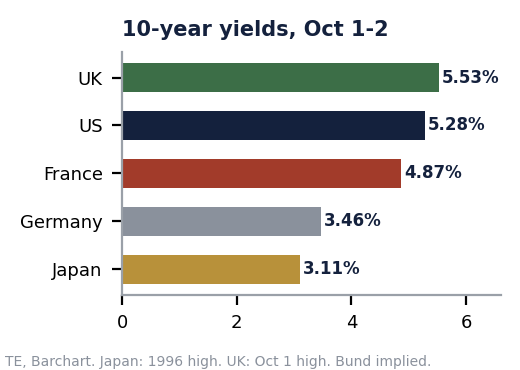
Long-end yields set the tone of the week. The UK, US and France all sit well above Germany, and Japan's 10-year is at a level last seen in 1996.
| US 10Y5.28%Fri close; hit 5.34%, highest since 2002 | OAT-Bund141bpFri close; ~148bp Mon a.m. | France 10Y4.87%Oct 1-2; ~4.89% Mon a.m. | UK 30Y~6.0%Touched Thursday |
| Japan 10Y3.11%Highest since 1996 | TTF gas~€73Mon a.m.; storage 71.5% | Brent~$103Mon a.m.; WTI ~$91.6 | USD/CAD~1.424Mon a.m.; CAD weakest since Apr 2025 |
Levels are as at the Friday, October 2, 2026 close unless stated. Figures marked Mon a.m. are early-session readings on Monday, October 5, as carried in the source document. The German 10-year yield in the chart above is implied rather than a quoted print. Levels have not been independently re-verified.
How our view changed this issue
| Theme | Change this issue | Why |
|---|---|---|
| Rotation framework (Axis 1) | Credit-unwind weighting raised | Last issue we judged credit by the indexes and missed the stress building under them in AI lending. With Europe breaking this week, that is two cracks at once. |
| French budget | New this issue, monitoring | A government without a majority is hunting for about €54B of savings, and the unrest makes a budget harder to pass. |
| French spread | New this issue, monitoring | The spread is at its widest since 2012 with a presidential vote ahead in April and May 2027. |
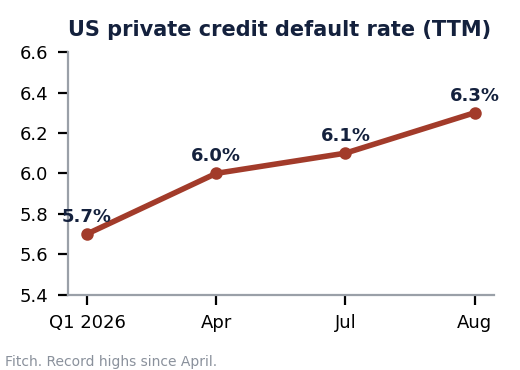
| US private credit defaults | New this issue, monitoring | Fitch's default rate is at a record 6.3%, and most big private credit funds have limited withdrawals this year. |
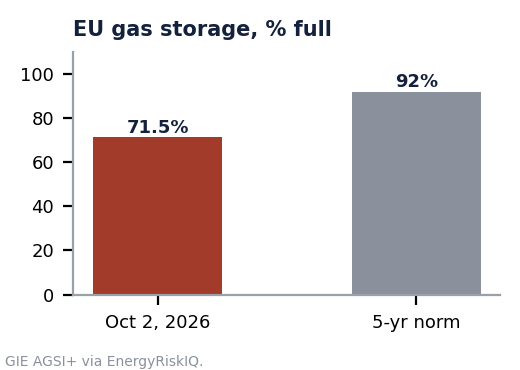
| European gas | Unchanged, held more firmly | Storage is about 20 points short of normal going into winter. |
| Oil into the midterms | Closed, condition met | The scenario of oil easing before the November 3 midterms was met when WTI traded at $88.06 on Friday. |
| Debasement | Unchanged | Gold fell with a stronger dollar, which says nothing about the long-term thesis. |
| Canadian dollar | Unchanged, under review | USD/CAD is near 1.424, with the Canadian dollar at its weakest since April 2025. |
| CUSMA and 2027 oil | Unchanged | Argued below in On our radar. |
The entries above describe how ArcStone Financial Pulse's own house view changed between issues. They are not ratings, recommendations, or price targets in respect of any security, and none should be inferred from them.
On the calendar
| Date | Event |
|---|---|
| Mon Oct 5 | US ISM services |
| Tue Oct 6 | France: teachers' unions join the student strike; RN budget counter-proposal due |
| Wed Oct 7 | FOMC minutes |
| This week | 22 scheduled ECB speeches, including Lane and Schnabel; US preliminary Michigan sentiment on Friday |
| Mon Oct 12 (est.) | Fitch US private credit default rate for September (release date estimated) |
| Wed Oct 14 | US CPI and Beige Book |
| Thu Oct 15 | BoJ: Koeda speech |
| Mon Oct 19 | BoC Business Outlook Survey |
| Oct 26 to 29 | China Fifth Plenum |
| Wed Oct 28 | BoC decision with Monetary Policy Report; FOMC decision |
| Thu Oct 29 | ECB decision |
| Nov 1 | EU gas storage checkpoint ahead of winter |
| Tue Nov 3 | US midterms |
| November | BDC Q3 tender results; possible Spanish snap election (November 29 reported, not announced); OPEC+ meeting November 29 |
| Jan 10, 2027 | US-China tariff truce expires |
| Apr 18 and May 2, 2027 | French presidential election, first and second rounds |
On our radar
1. Europe cracks first
Europe is carrying more pressure than any other region right now, and we think its credit cracks first. Everyone else follows in time, Japan most likely next. "First" is about the order things break, not the timing. We think this year's cracks get contained, which is why the credit-unwind weighting in our rotation framework stays at 20% and not higher.
The street isn't only French
France has the headlines, but the same argument is running across the continent. Spain's tenant protests spread to some 50 cities on Saturday, a day after parliament killed the government's housing relief decrees. Police in Valencia used rubber bullets and tear gas, the unions are talking about a general strike, and Sánchez may call a snap election in November. In Germany, organisers say more than 45,000 students walked out of school on September 25 against the return of conscription, and Friday's Berlin march carried signs reading "Strike in Germany, strike in France." Britain's streets are quieter this month, but its bond market isn't: 30-year gilts touched 6% on Thursday, the first G7 long bond at that level since the euro crisis.
Governments are being asked to pay for defence, energy and higher debt service at the same time, and voters are pushing back on every line of it. Each of these fights is over money the state doesn't have.
France is where it shows in credit
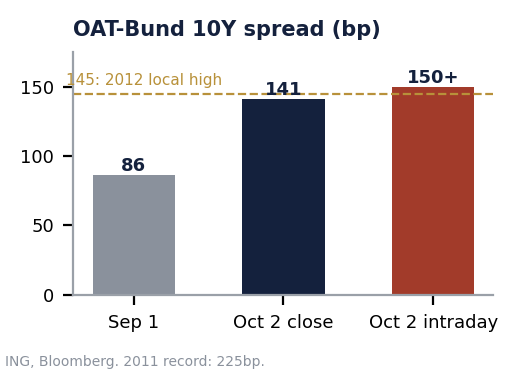
The riots make the pictures, but they aren't what moved the spread. OAT-Bund closed Friday at 141bp, the widest since 2012, and pushed toward 148bp on Monday morning as the euro hit a 17-month low. France now trades wider than Italy, and the spread is still climbing.
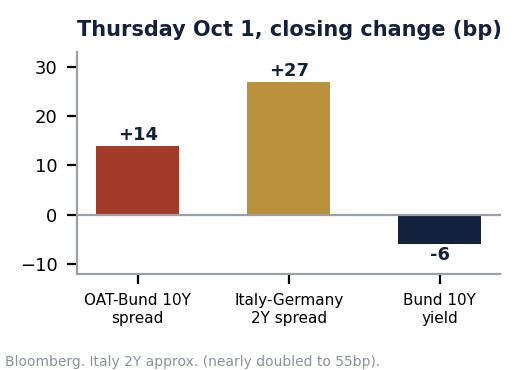
Commerzbank's read is that the selloff "seems to increasingly feed on itself." The spread moved on things the market already knew: a government without a majority hunting for about €54B of savings, a record borrowing program next year, and hedge funds crowded into the same trade. Thursday shows the pattern in a single session. The French spread and Italy's short-end spread both widened while the Bund yield fell, as money left the periphery for Germany.
What the riots do is make that budget harder to pass, and our house view puts even odds on France reaching year-end without one. The vote after that matters more. Le Pen leads the polls for April, which makes Tuesday's RN budget proposal an early look at her economics, and Mélenchon, running second, wants to cancel French debt held at the central bank. The ECB has a tool for this kind of split, but we don't see it rescuing a country that hasn't passed its own budget. That leaves the spread room to widen, and our house view puts a 40% weighting on a substantial further widening before the April 18, 2027 first round.
Then comes winter
Europe goes into the heating season with its gas storage around 71.5% full, about 20 points below the five-year norm. TTF is near €73, and Morgan Stanley sees a cold winter combined with another supply problem out of Qatar pushing prices sharply higher.
Two wars make that more likely. Russia opened its winter campaign on Wednesday with close to 190 drones and missiles aimed at Ukraine's power grid, and over the weekend the Houthis claimed strikes on Aramco sites while Iran said Hormuz stays shut. Brent started the week near $103. Every euro of energy support lands on budgets that are already the problem, and the ECB is still tightening into it. That is why we think Europe goes first: it has the energy exposure, the war on its border, the most fragile politics and a central bank with the least room to help any one country.
2. The American crack is in AI lending
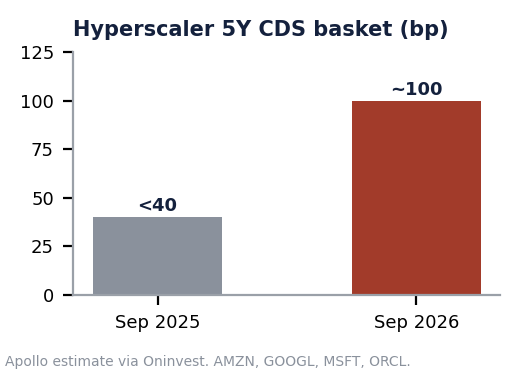
The US version is further along than it looks, because the index is hiding it. Banks quoted the $18B of loans behind Oracle's Project Jupiter at 89 to 91 cents in mid-September and could not find takers. Days later, Oracle invoked force majeure on the site. Borrowers at the centre of the buildout are funding at or near junk levels, and CDS on a basket of the biggest cloud names has more than doubled in a year.
An issuer-by-issuer breakdown belongs in a company-level piece, not a macro issue, so this stays at the mechanism level on purpose. The mechanism is that the lenders have their own problems. US private credit defaults are at a record 6.3% on Fitch's measure, and most big private credit funds have limited withdrawals this year. When the funding source is gated and its own losses are rising, stress in the borrowers it finances does not show up in the public indexes until late. Our house view puts a 30% weighting on the Fitch default rate reaching 7% by year-end.
3. Japan next, and Canada waiting on a deal
Japan is next in line
If Europe breaks first, we think Japan is the next domino. Its 10-year yield hit 3.11% on Friday, the highest since 1996 (see the yields chart in Market snapshot), and the 30-year has broken 4% for the first time. The prime minister asked the BoJ in May to step up its bond purchases, even as the bank tries to raise rates. Japanese investors hold about $1 trillion of Treasuries, have long been purchasers of European government debt, French included, and are still net purchasers of foreign assets. If European stress keeps pushing global yields up, Japanese insurers and pensions start bringing money home, and that is how a European problem ends up in the US bond market.
Canada's opportunity needs a deal
For Canada, most of this is good news, provided Washington comes back to the table. Europe needs energy and somewhere stable to put money, and Canada has both: oil and gas to sell, a central bank at 2.25% with room to move, politics that aren't playing out in the street, and a fresh set of investment commitments from last month's summit. The trade war is what blocks it. The 50% Section 338 tariffs that took effect on August 22 are still in place, Ottawa matched them, and Washington said at the time it had no new talks planned.
With a deal, Canada is one of the few places that gains from a European crack. Without one, most of that gain stays on paper, and the roughly C$500B of mostly American private credit held by Canadian pensions, insurers and banks is a reminder that our exposure runs south. Our CUSMA weighting still gives a deal only about a one-in-four chance, so the house view does not yet treat that gain as the base case. If talks restart, Canada is where we would expect the market to look first.
The house framework, reassessed
The near-term rotation framework (Axis 1) is reweighted this issue. The only change is a higher weighting on the credit-unwind tail.
| Axis 1 scenario (near-term) | House-view weighting |
|---|---|
| Continued rotation | 55% |
| Valuation top | 25% |
| Credit unwind (raised this issue) | 20% |
Alongside the framework, this issue adds three scenario weightings and closes one.
| Scenario | Weighting | Status |
|---|---|---|
| No French 2027 budget adopted by December 31 | 50% | New this issue |
| OAT-Bund spread widens substantially further before the April 18, 2027 first round | 40% | New this issue |
| Fitch US private credit default rate reaches 7% by year-end | 30% | New this issue |
| Oil eases before the November 3 midterms | 60% | Condition met October 2; closed |
The second axis is not reweighted this issue. The two axes are independent, and their weightings are not additive.
The weightings above are ArcStone Financial Pulse's own house view as at the publication date. They are not market-implied probabilities, forecasts of any particular outcome, or targets.
Why this year holds, and 2027 probably doesn't
This round holds because the people who would need to act still can. An October Fed hike now looks unlikely, with hike odds down to about 25% after payrolls, underlying US inflation is near 2.3%, the ECB has its backstop ready even if it is waiting on Paris, and companies are still raising money, just at higher rates. Most of the exposure sits with pensions, insurers and gated funds who can sit through a bad quarter.
2027 is a different setup. France votes in April and May, possibly without a budget. AI spending heads toward $1.3 trillion, most of it borrowed, and private credit starts working through its 2028 maturity wall. If our 2027 oil scenario plays out and Brent moves materially higher, central banks will be fighting inflation at the moment credit needs them to ease. That is the scenario where a credit problem turns into our debasement thesis, and we will weight it in the month-end recap.
What is still open
- France this week. Tuesday's strike, as teachers' unions join the students, and the RN's budget counter-proposal as an early read on Le Pen's economics.
- Spain. Whether the unions set a general strike date, and whether the reported November 29 snap election is called.
- The French spread. Whether OAT-Bund closes above its 2012 local high of 145bp, shown in the first chart under On our radar.
- Gas. The first cold snap of the season, and the November 1 storage checkpoint.
- Japan. The 30-year yield, now above 4%, as the clearest gauge of whether repatriation pressure is building.
- Private credit. Fitch's September default rate, with release estimated for October 12, and BDC Q3 tender results in November.
- Canada. Any sign that Washington is ready to restart talks, which is what would move our CUSMA weighting.
Disclosures
ArcStone Financial Pulse Inc. is owned by the same parent entity (ArcStone Securities and Investments Corp.) that owns ArcStone Securities, LLC. This common ownership, together with the joint operating relationship between ArcStone Securities, LLC and Kingswood Capital Partners, LLC under the ArcStone Kingswood DBA OSJ banner, represents a structural conflict of interest. Issuers referred to in ArcStone Financial Pulse content may be current or former clients of ArcStone or any of its subsidiaries and affiliates. Where ArcStone or its subsidiaries and affiliates have received or have been promised consideration for services provided to such an issuer, such consideration may include cash, stock, stock options, warrants, and/or Restricted Stock Units (RSUs) for the provision of corporate advisory, investor relations, digital media, or capital markets consulting services. This relationship represents a potential conflict of interest. The principals, directors, officers, employees, and related entities of ArcStone and its affiliates may, from time to time, own, buy, or sell securities or derivatives of such issuers or their affiliates.
The information contained herein is provided by ArcStone Financial Pulse Inc. ("ArcStone Financial Pulse"), a subsidiary of ArcStone Securities and Investments Corp. ("ArcStone"), for informational purposes only. It is not, and under no circumstances should it be construed as, an offer to sell or a solicitation of an offer to buy any securities or other financial instruments in any jurisdiction. This content is not a research report within the meaning of FINRA Rules 2241 or 2242 and does not constitute a research report under any applicable securities laws.
Certain statements contained herein may constitute "forward-looking statements" within the meaning of applicable Canadian and U.S. securities laws. Forward-looking statements are based on current expectations, estimates, and assumptions that involve known and unknown risks and uncertainties which may cause actual results or developments to differ materially from those expressed or implied. These statements often include words such as "anticipate," "believe," "expect," "intend," "may," "plan," "project," "should," "target," or similar expressions. Readers are cautioned not to place undue reliance on such statements, which speak only as of the date made. Except as required by law, ArcStone undertakes no obligation to update or revise any forward-looking information.
This content is not intended as investment advice or a recommendation to buy or sell any security and does not take into account the investment objectives, financial situation, or needs of any individual. Investors should consult their own professional advisors before making any investment decisions.
ArcStone Securities and Investments Corp. is not a registered broker-dealer and does not provide investment advice or recommendations. All registrable activities in the United States are conducted through ArcStone Securities, LLC (CRD# 306029) and/or Kingswood Capital Partners, LLC (CRD# 288898), both FINRA-registered broker-dealers, members SIPC. ArcStone Canada Inc. is not registered as a dealer in any Canadian jurisdiction; registrable dealing activities in Canada are conducted through appropriately registered affiliates.
ArcStone Kingswood is a DBA Office of Supervisory Jurisdiction (OSJ) of Kingswood Capital Partners, LLC (Member FINRA/SIPC) under which registered representatives of ArcStone Securities, LLC (Member FINRA/SIPC) and registered representatives of Kingswood Capital Partners, LLC conduct joint capital markets and investment banking activities. ArcStone Securities, LLC and Kingswood Capital Partners, LLC are parties to a written agreement governing the sharing of fees on transactions in which registered representatives of both firms participate. All securities transactions and investment banking services conducted by ArcStone are conducted exclusively through ArcStone Securities, LLC and/or Kingswood Capital Partners, LLC; "ArcStone Kingswood" itself is not a registered broker-dealer or separate legal entity.
Subject matter. This issue discusses French fiscal and political stress and the spread between French and German 10-year government bond yields (OAT-Bund) ahead of the April and May 2027 French presidential election; social unrest in France, Spain and Germany; UK long-dated gilt yields; EU gas storage and TTF gas prices going into winter, in the context of Russia's campaign against Ukraine's power grid, claimed Houthi strikes on Saudi energy sites and Iran's statement on the Strait of Hormuz; US Treasury yields, payrolls and Federal Reserve expectations; credit conditions in AI-related lending, including a hyperscaler credit default swap basket and the US private credit default rate; Japanese government bond yields and the potential repatriation of Japanese capital; and the Canada-US trade dispute, including the 50% Section 338 tariffs in effect since August 22, 2026 and the outlook for CUSMA.
Independence. The views in this commentary are ArcStone Financial Pulse Inc.'s own house view. They have not been influenced by any investment banking, advisory or other business relationship of ArcStone Financial Pulse Inc. or its affiliates, and no part of the compensation of any person who prepared this commentary is tied to the views expressed in it.
No ratings. ArcStone Financial Pulse Inc. does not operate a rating system, maintain a coverage universe, or publish a distribution of ratings. The entries in 'How our view changed this issue' describe changes in the house view between issues. The scenario weightings in 'The house framework, reassessed' (the near-term rotation framework and the issue scenarios), and the weightings referred to in 'On our radar' (the French budget, the French spread, US private credit defaults and the roughly one-in-four weighting on a CUSMA deal), are house-view weightings about macro outcomes. They are not ratings, recommendations, market-implied probabilities or targets in respect of any security.
Affiliate sector exposure. Affiliates of ArcStone Financial Pulse Inc. may have, or may seek, business relationships with issuers in the sectors discussed in this commentary, including energy, financial services, technology and enterprise AI services. Readers should take this potential conflict into account.
Third-party views cited. This commentary cites Commerzbank's characterisation of the French government bond selloff, a Morgan Stanley scenario for European gas prices in a cold winter combined with a further supply problem out of Qatar (reported here directionally), an Apollo estimate of hyperscaler five-year CDS levels as reported by Oninvest, and ING and Bloomberg data on the OAT-Bund spread. These views and estimates belong to their authors and are reported as carried in the source document. ArcStone Financial Pulse Inc. has not independently verified them.
Price basis and as-of date. Unless stated, market levels are as at the Friday, October 2, 2026 close. Levels marked as Monday morning (the OAT-Bund spread near 148bp, the French 10-year yield near 4.89%, the euro at $1.1161, Brent near $103, WTI near $91.6, TTF near EUR 73 and USD/CAD near 1.424) are early-session readings on Monday, October 5, 2026, as carried in the source document. All levels were carried from the source document and have not been independently re-verified by ArcStone Financial Pulse Inc.
Charts. Figure 1 plots the OAT-Bund 10-year spread at three points (September 1, the October 2 close and the October 2 intraday reading) against the 2012 local high, sourced from ING and Bloomberg; its intraday reading above 150bp has not been reconciled with the Monday-morning level of roughly 148bp cited in the text. Figure 2 plots closing changes on Thursday, October 1 in the OAT-Bund 10-year spread, the Italy-Germany 2-year spread and the 10-year Bund yield, sourced from Bloomberg; the Italy 2-year figure is approximate. Figure 3 plots a five-year CDS basket of Amazon, Alphabet, Microsoft and Oracle at September 2025 and September 2026; both points are Apollo estimates as reported by Oninvest, not ArcStone calculations. Figure 4 plots Fitch's trailing-twelve-month US private credit default rate from Q1 2026 through August 2026, as reported by Fitch. Figure 5 compares EU gas storage on October 2, 2026 with a five-year norm, sourced from GIE AGSI+ via EnergyRiskIQ. Figure 6 compares 10-year government bond yields for the UK, US, France, Germany and Japan on October 1-2, 2026, sourced from Trading Economics and Barchart; the German yield is implied rather than a quoted print. No chart in this issue contains an ArcStone estimate.
As-reported figures. The following are reported figures carried from the source document, not ArcStone calculations: the Fitch default rates; EU gas storage levels; US payrolls of 29,000; close to 5,000 arrests in France; protests in some 50 Spanish cities; close to 190 drones and missiles in Russia's opening strikes on Ukraine's grid; $18B of loans quoted at 89 to 91 cents; the roughly EUR 54B of French savings sought; Japanese holdings of about $1 trillion of US Treasuries; roughly C$500B of private credit held by Canadian pensions, insurers and banks; AI spending heading toward $1.3 trillion; the Bank of Canada policy rate of 2.25%; and underlying US inflation near 2.3%.
Unverified and estimated items. The figure of more than 45,000 students walking out in Germany on September 25 is an organisers' claim. The strikes on Aramco sites are claims by the Houthis and have not been independently confirmed. A possible Spanish snap election on November 29 is reported, not announced. The October 12 release date for Fitch's September default rate is an estimate. The Italy-Germany 2-year spread change in Figure 2 is approximate, and the German 10-year yield in Figure 6 is implied.
No company named in this commentary is a current or former client of ArcStone or any of its subsidiaries and affiliates, and no consideration has been paid or promised to ArcStone or any of its subsidiaries or affiliates in connection with this commentary. Companies are named only to report their own scheduled reporting dates or publicly observable market data, and no view is expressed on their securities.
Sources: Bloomberg: OAT-Bund 10-year spread, Italy-Germany 2-year spread and 10-year Bund yield, as at the October 2, 2026 close and Monday morning, October 5, 2026; ING: OAT-Bund 10-year spread history including the 2012 local high and 2011 record, as at October 2, 2026; Reuters: news reporting, as at October 5, 2026; Financial Times: news reporting, as at October 5, 2026; Fitch: US private credit default rate, trailing twelve months, Q1 2026 through August 2026; GIE AGSI+ via EnergyRiskIQ: EU gas storage, as at October 2, 2026; Trading Economics and Barchart: 10-year government bond yields, as at October 1-2, 2026; Apollo via Oninvest: hyperscaler five-year CDS basket estimate, September 2025 and September 2026; Bank of Canada: policy rate, as at October 2, 2026; Commerzbank and Morgan Stanley: views as cited in the source document dated October 5, 2026.
© 2026 ArcStone Financial Pulse Inc. All rights reserved. May be redistributed in full and unaltered with attribution.