No Room for 50 in a Freefall
Week of November 23, 2026. Issue No. 16.
ArcStone View
Last issue we argued that the 2027 hike path was the policy error. This week the market made that case for us and brought the error forward. Fed hawks spent the week talking about a 50bp hike in December. By Friday, the S&P 500 was in correction and Reuters had reported that the SEC is examining Nvidia's accounting. High-yield spreads were back at their November wides, Taiwan had its worst week on record, and the Canadian dollar broke below 70 US cents. Gold, silver and bitcoin were sold alongside the chip stocks. That is what raising cash looks like, not rotation, and the clearest precedent for that tape is autumn 2008. Meanwhile, the energy shock behind this year's inflation is leaving the system: the delivered cost of a barrel fell about $37 in two weeks. The market did the Fed's tightening for it in five sessions, and on Monday morning the odds of 50bp went to zero. Our view is that the roughly 93% still priced for a quarter point is too high.
Since last issue: what actually moved
- Rates: The 10-year yield fell 22bp on the week to 4.92%. Market-implied odds of a December hike slipped to about 89% by Friday. On Monday morning the odds of a 50bp move went to zero.
- Stocks: S&P 500 -8.6%, Nasdaq -10.0%, S&P/TSX -8.1%. It was the worst S&P 500 week since April 2025.
- Oil: Brent fell 3.4% to $92.57 and WTI fell 5.2% to $83.98. This was the third straight weekly decline.
- Havens: Since September 1, gold is down 22%, bitcoin 25% and silver 39%.
- Canada: The loonie fell below 70 US cents. Markets still price about a 65% chance that the Bank of Canada hikes.
- Overnight into Monday: S&P 500 futures were up nearly 3% and Nasdaq futures 3.5%, led by chips. Korea fell 3.3% and Taiwan rose 2.2% on the first day of its short-selling ban. Brent was below $91 despite more attacks in the Gulf, and gold was up 2.5%.
- Our view: Last issue we called a December quarter point defensible. We have moved, and On our radar explains why.
Market snapshot
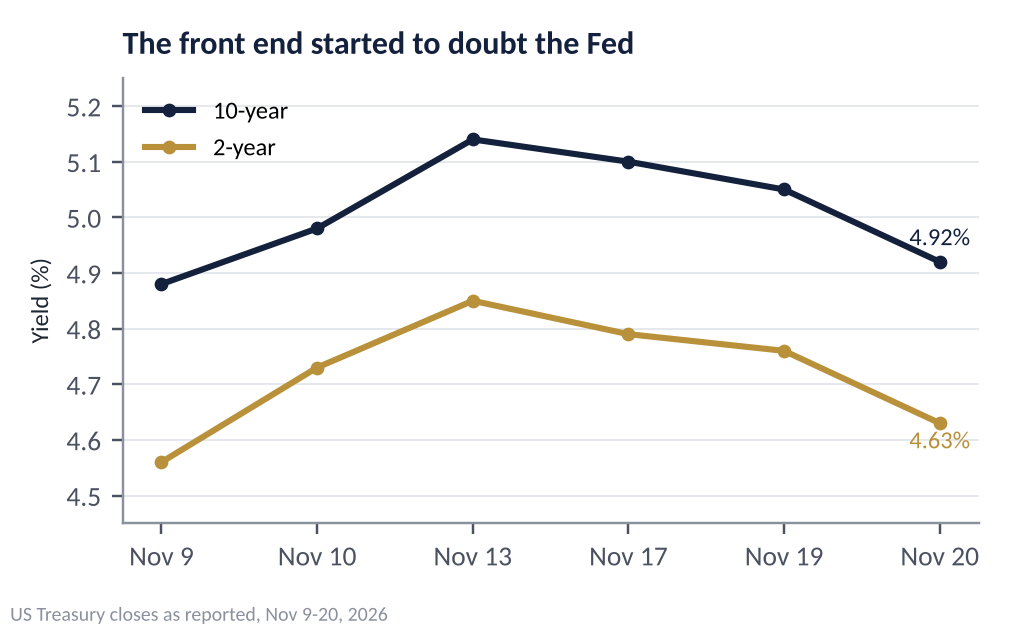
Yields climbed into November 13 on the hawkish talk, then fell as equities broke. The 2-year led the move on Friday.
| S&P 5006,910-8.6% wk | Nasdaq22,618-10.0% wk | S&P/TSX33,190-8.1% wk | VIX35.9+16.6 pts wk |
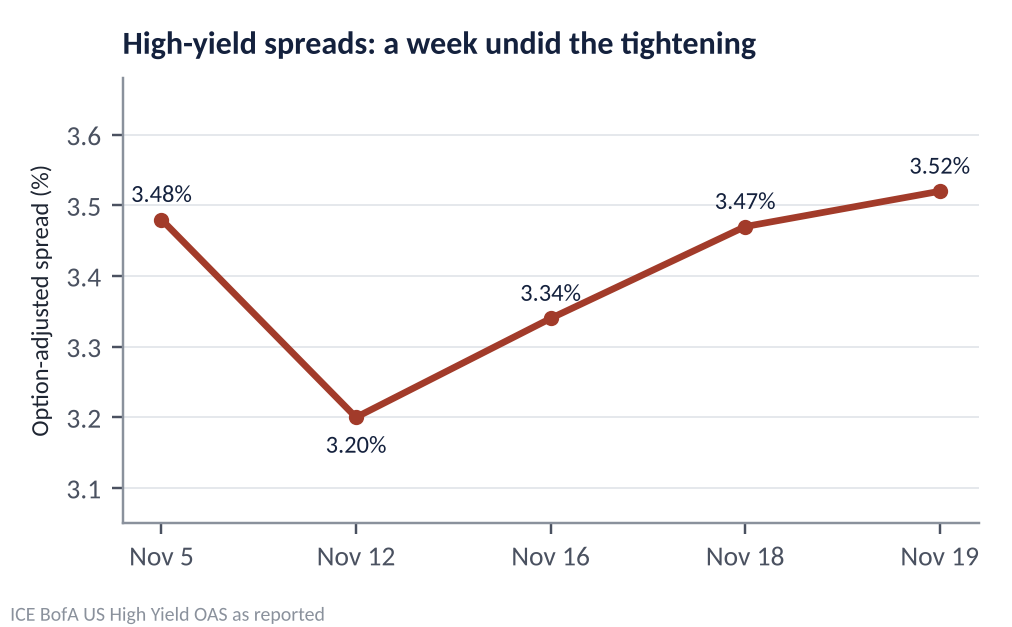
| US 2-year4.63%-13bp Fri | US 10-year4.92%-22bp wk | Dec Fed hike~89%from ~100% | HY spread3.52%+32bp vs Nov 12, at Nov 19 |
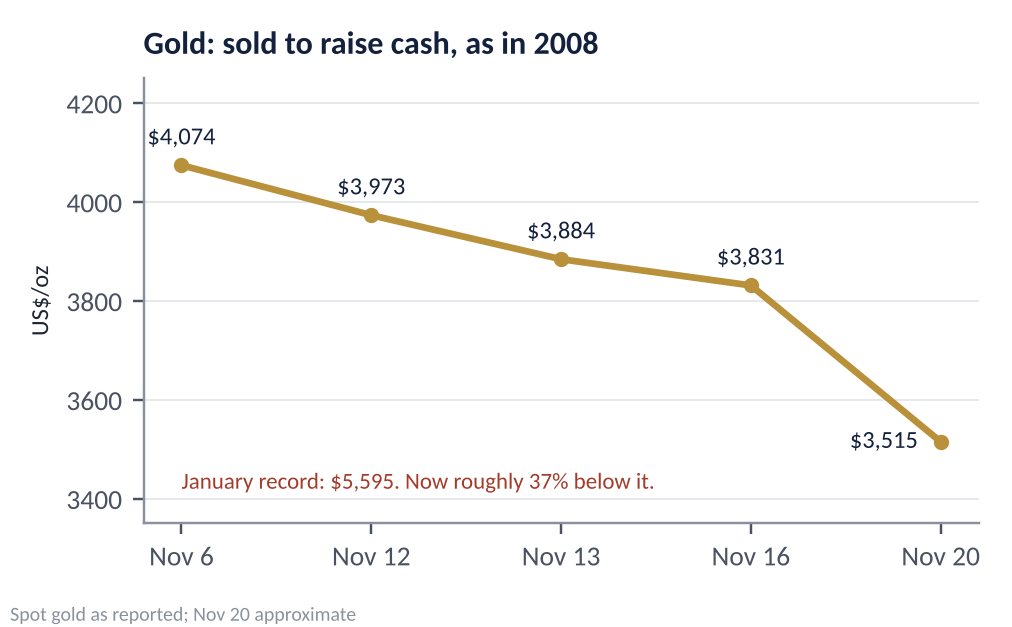
| Gold~$3,515-9.5% wk | WTI$83.98-5.2% wk | Bitcoin~$59.0kbelow $60k | USD/CAD~1.43469.7 US cents, Thu |
Levels are as at the close on Friday, November 20, 2026 unless stated. The high-yield spread is as at Thursday, November 19, and USD/CAD is as at Thursday. Figures marked ~ are approximate as reported. The December hike probability is a CME Group FedWatch reading as reported, not an ArcStone estimate. Moves described as overnight or Monday morning are as at about 7 a.m. ET on Monday, November 23.
How our view changed this issue
| Theme | Change this issue | Why |
|---|---|---|
| December Fed decision | Revised this issue | Last issue we called a December quarter point defensible and put the error in the 2027 path. A week of falling markets brought that error forward. We now expect no 50bp move, and we think the roughly 93% priced for a quarter point is too high. |
| Oil war premium | Unchanged, tracking | Brent settled at $92.57 on Friday, its third straight weekly decline. It slipped below $91 on Monday despite more attacks in the Gulf. |
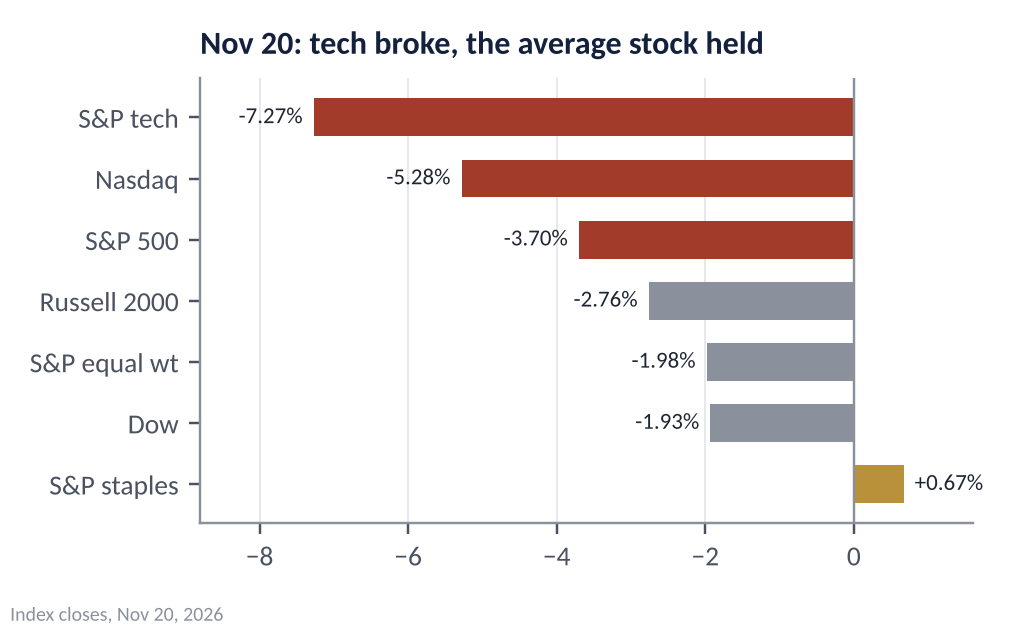
| Semiconductors versus the broad market | Unchanged, tracking | Several large chip stocks fell 12 to 14% on Friday alone, while the equal-weight S&P 500 fell about 2%. |
| Supplier financing in the AI build-out | Unchanged, first evidence this issue | The first public sign of a supplier pulling back on customer financing arrived this week (see On our radar). We treat it as evidence, not as a disclosed change. |
| Bank of Canada, December 9 | Unchanged, stronger if the Fed stops | We expect the overnight rate to stay at 2.50%. Markets still price about 65% for a hike. |
| Canadian dollar as a funding currency | Unchanged | We have held this view since November 2025. The loonie broke below 70 US cents this week. |
| Scenario weightings | Unchanged, review next issue | The rotation base case and the debasement tail are unchanged. We will revisit both, and the credit-unwind tail, in next week's month-end recap. |
The entries above describe how ArcStone Financial Pulse's own house view changed between issues. They are not ratings, recommendations, or price targets in respect of any security, and none should be inferred from them.
On the calendar
| Date | Event | Why it matters |
|---|---|---|
| Mon Nov 23 | Flash PMIs; 2-year auction; NY Fed's Williams speaks | The PMIs give the first read on demand after the sell-off. Williams wants more tightening, but not a big move. |
| Wed Nov 25 | October PCE and Q3 GDP (second estimate) | PCE is the Fed's preferred gauge, and a hot core print revives the 50bp talk. |
| Thu Nov 26 | US Thanksgiving, markets closed | On Friday, stocks close at 1 p.m. and bonds at 2 p.m. ET. |
| Sun Nov 29 | OPEC+ ministerial | Ministers set 2027 quotas from the capacity audit. A push for market share adds to the glut. |
| Fri Dec 4 | US November payrolls | This is the last jobs report before the decision. |
| Wed Dec 9 | Bank of Canada (9:45 a.m.) and FOMC (2:00 p.m. ET) | The Bank decides about four hours before it knows what the Fed does. |
| Thu Dec 10 | US November CPI | The print lands the day after the Fed decides. |
| Dec 14-15 | G20 summit, Miami | Putin's attendance is still unconfirmed. |
| Tue Dec 15 | Macklem speaks, Greater Vancouver Board of Trade | This is the first read on the Bank's thinking after December 9. |
| Dec 17-18 | ECB and Bank of Japan decisions | Both are priced for hikes. A Fed pause would leave them tightening alone. |
On our radar
1. The Fed cannot hike 50 into a freefall
Our view is simple. The Fed does not hike 50bp in December, the roughly 93% priced for a quarter point is too high, and September's hike may prove to be the last of this cycle. Last issue we said a December quarter point was defensible and that the mistake was the 2027 path. This week brought the mistake forward, and the market has already conceded the first point: on Monday morning the odds of 50 went to zero.
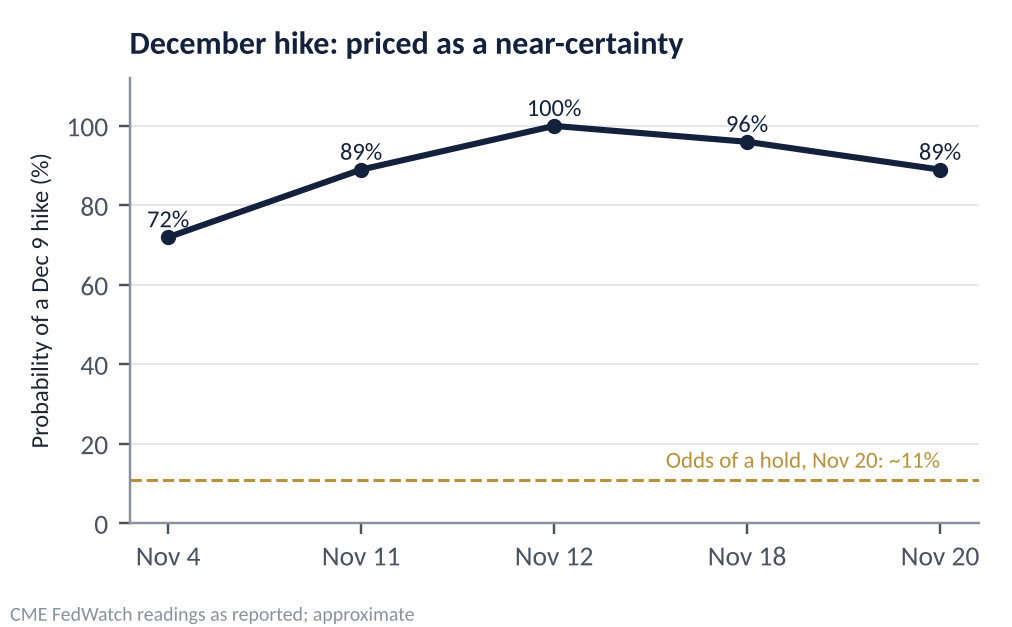
The consensus says December is done: core inflation is sticky, payrolls are strong and the minutes were hawkish. That reading is convenient but backward-looking. It describes the economy the Fed saw in October and misses the one that showed up on Friday. Hike pricing peaked at 100% on November 12 and has been leaking since.
The world is in freefall, and the hawks want 50
Taiwan had its worst week on record, down 17.5%, and Korea and Japan each lost more than 5% on Friday. China's October numbers were poor across the board: retail sales barely grew, and investment fell at the fastest pace since 2020. Into that backdrop, Waller floated 50bp, the minutes showed a couple of officials open to it, and Cook warned that waiting means bigger hikes later.
Asia's authorities have already started stepping in. Korea readied its market stabilization fund over the weekend. Taiwan banned short selling below the prior close, its third round of curbs this month, while its own stabilization fund buys. China moved to cut margin requirements. On Monday, Taiwan rose 2.2% under the new rules while Korea fell 3.3%. This is the intervention playbook we expect to see globally when the bigger credit test arrives, and Asia is running it early. The ECB and the Bank of Japan are both priced to hike in the same week as the Fed. Three central banks tightening into a global sell-off is how a correction turns into a credit event, and we would rather the Fed did not find that out the hard way.
The inflation they are fighting is already leaving
Core CPI at 0.3% a month is the hawks' best argument, and we take it seriously. But this year's inflation was an energy shock, and the energy shock is reversing. The delivered cost of a barrel, meaning crude plus freight and war-risk insurance, fell about $37 in two weeks. Consumers' one-year inflation expectations dropped to 3.7%, the lowest since March.
Hormuz stayed noisy over the weekend. Tankers were hit off Oman, Iran claimed mine strikes, and there was a claimed attack on a Saudi refinery. Brent still slipped below $91 on Monday, which tells you how much supply is out there. Our view has not changed: the Gulf is Asia's and Europe's problem. North American supply is secure, the barrels are finding buyers, and the war premium keeps leaking out of the price.
Warsh does not want to hike
Warsh took the chair arguing that AI would bring inflation down and give the Fed room to ease. His most recent speech focused on what happens if AI disappoints, and his prepared remarks never mentioned inflation. He scrapped forward guidance in June, so he has no December promise to keep, and November CPI lands the day after the meeting. A chair who wants to wait has everything he needs. We think he waits.
Rates are where this shows up first. As the yield chart under Market snapshot shows, the 2-year fell 13bp on Friday, and it gave back about half of that in Monday morning's bounce. Our house view is that the front end has the most room, and that front-end yields have further to fall once the data turns.
2. Tech like 2001, credit like early 2008
We said this last issue, and the tape agreed. Nvidia helped finance its own customers through equity stakes and data-centre guarantees. It fell 14% on Friday after Reuters reported that the SEC is examining its accounting, and the neoclouds that rent its chips fell with it. The company has been here before: in 2002 it disclosed an SEC accounting inquiry and later restated three years of results. An inquiry is not a finding, and neither side has confirmed this one, but the market did not wait. Earlier in the week, management told investors it would be far more selective about financing deals from here. That is how the 2000 telecom story turned: the supplier that lent the money started lending less. A customer-by-customer breakdown belongs in a company-level piece, not a macro issue, so this stays at the mechanism level on purpose.
Credit is moving the way it did in late 2007 and early 2008. Headline spreads still look calm, yet high-yield spreads widened about 30bp in a week and the weakest borrowers sit near their widest levels of the year. Private credit funds sold to wealth clients have also been limiting withdrawals. A single week undid the tightening that ran into November 12.
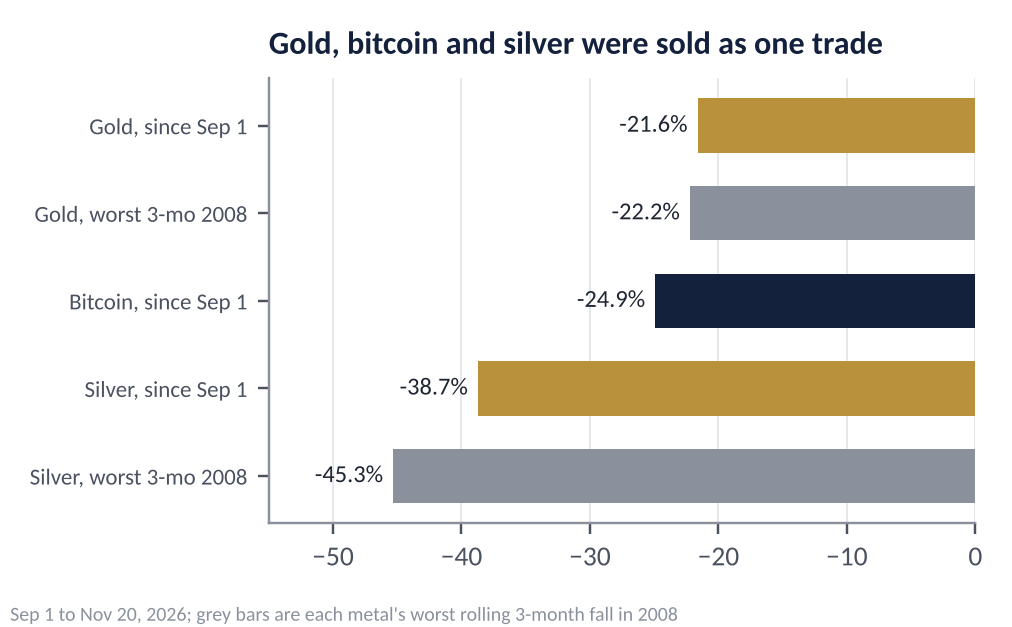
Then the havens went. Since September 1, gold is down 22%, bitcoin 25% and silver 39%. Gold alone fell 9.5% last week. Selling gold, silver and bitcoin alongside chip stocks is what investors do when they need cash, and it is exactly how autumn 2008 traded.
The 2008 comparison is closer than it looks. Gold's fall since September 1 nearly matches its worst three months of 2008, and silver is not far behind its own worst three months from that year. These are the signatures of forced selling, not of a change in the case for holding real assets.
This is liquidation, and liquidation ends. In 2008, gold's liquidation-driven fall ended in October. A Fed that stops is the trigger for the debasement scenario, and our house view on the gold and oil cycles is unchanged.
3. Bounce first, then the test
The bounce is here. On Monday morning, S&P 500 futures were up nearly 3% and Nasdaq futures 3.5%, led by the same chip stocks that broke last week. The bounce has history behind it. The S&P 500 is the furthest below its 50-day average since August 2015, the VIX had one of its five biggest weekly jumps on record, and leveraged funds were forced sellers all week. After spikes like this, the index has usually recovered over the following months. Take the bounce for what it is, though. In 2001 and 2008 the market rallied hard several times on the way down, and the AI complex has a financing problem that a relief rally does not fix.
The bounce is also the main risk to our Fed view, and it is already showing up in pricing: December hike odds went back above 90% overnight. A recovery that holds into December 9, or a hot core PCE print on Wednesday, gives the hawks their room back. Even then we would expect 25bp and a pause, the way the Fed hiked into a falling market in December 2018 and reversed within weeks. Nobody hikes 50 into this.
Underneath the index, Friday also showed the rotation at work. The equal-weight S&P 500 fell about half as much as the cap-weighted index, and consumer staples rose. That is consistent with the rotation base case in the framework below.
The house framework, reassessed
Our scenario weightings are unchanged this issue. We will revisit all three in next week's month-end recap.
| Scenario | House weighting | What this week did |
|---|---|---|
| Rotation | Base case, unchanged | In this scenario, leadership moves away from the AI leaders toward hard assets and value. On Friday, the equal-weight index fell about half as much as the cap-weighted index. |
| Debasement | Tail, unchanged | The havens sell-off reads as liquidation, not a break in the thesis. A Fed that stops is the trigger. |
| Credit unwind | Tail, review next issue | Today's stress looks controllable. The test we worry about is 2027, and we expect Europe to crack first. |
The policy path is where the view moved this issue. We expect no 50bp hike in December. We think a hold is more likely than the roughly 93% priced for a quarter point implies, and that September's hike may prove the last of this cycle. If the bounce holds or core PCE runs hot, we would expect 25bp and a pause rather than 50. Three central banks tightening into the same week of a global sell-off is the configuration that would push the credit-unwind tail up the list.
In Canada, we have described the loonie as a funding currency since November 2025, and it broke 70 US cents this week. The Bank of Canada decides on December 9, about four hours before the Fed, and our house view is that it holds at 2.50%. A softer Fed narrows the rate gap. The rest needs a trade deal.
The weightings above are ArcStone Financial Pulse's own house view as at the publication date. They are not market-implied probabilities, forecasts of any particular outcome, or targets.
What is still open
- Core PCE on Wednesday, November 25. A hot core print is the quickest way to revive the 50bp talk.
- Whether the bounce holds into December 9. Hike odds were already back above 90% overnight.
- The reported SEC examination of Nvidia's accounting. It was reported by Reuters and is unconfirmed by either side, and an inquiry is not a finding. Separately, it remains to be seen whether the pullback in supplier financing shows up as a disclosed reduction, restructuring or write-down by mid-2027.
- The Gulf. The mine strikes and the refinery attack remain claims. OPEC+ meets on November 29, and a push for market share would add to the glut.
- Credit. We want to see whether withdrawal limits at private credit funds spread, and whether the 2027 test we worry about starts in Europe.
- The ECB and the Bank of Japan on December 17-18. Both are priced to hike, and a Fed pause would leave them tightening alone.
- Scenario weightings. We will revisit the rotation, debasement and credit-unwind scenarios in next week's month-end recap.
Disclosures
ArcStone Financial Pulse Inc. is owned by the same parent entity (ArcStone Securities and Investments Corp.) that owns ArcStone Securities, LLC. This common ownership, together with the joint operating relationship between ArcStone Securities, LLC and Kingswood Capital Partners, LLC under the ArcStone Kingswood DBA OSJ banner, represents a structural conflict of interest. Issuers referred to in ArcStone Financial Pulse content may be current or former clients of ArcStone or any of its subsidiaries and affiliates. Where ArcStone or its subsidiaries and affiliates have received or have been promised consideration for services provided to such an issuer, such consideration may include cash, stock, stock options, warrants, and/or Restricted Stock Units (RSUs) for the provision of corporate advisory, investor relations, digital media, or capital markets consulting services. This relationship represents a potential conflict of interest. The principals, directors, officers, employees, and related entities of ArcStone and its affiliates may, from time to time, own, buy, or sell securities or derivatives of such issuers or their affiliates.
The information contained herein is provided by ArcStone Financial Pulse Inc. ("ArcStone Financial Pulse"), a subsidiary of ArcStone Securities and Investments Corp. ("ArcStone"), for informational purposes only. It is not, and under no circumstances should it be construed as, an offer to sell or a solicitation of an offer to buy any securities or other financial instruments in any jurisdiction. This content is not a research report within the meaning of FINRA Rules 2241 or 2242 and does not constitute a research report under any applicable securities laws.
Certain statements contained herein may constitute "forward-looking statements" within the meaning of applicable Canadian and U.S. securities laws. Forward-looking statements are based on current expectations, estimates, and assumptions that involve known and unknown risks and uncertainties which may cause actual results or developments to differ materially from those expressed or implied. These statements often include words such as "anticipate," "believe," "expect," "intend," "may," "plan," "project," "should," "target," or similar expressions. Readers are cautioned not to place undue reliance on such statements, which speak only as of the date made. Except as required by law, ArcStone undertakes no obligation to update or revise any forward-looking information.
This content is not intended as investment advice or a recommendation to buy or sell any security and does not take into account the investment objectives, financial situation, or needs of any individual. Investors should consult their own professional advisors before making any investment decisions.
ArcStone Securities and Investments Corp. is not a registered broker-dealer and does not provide investment advice or recommendations. All registrable activities in the United States are conducted through ArcStone Securities, LLC (CRD# 306029) and/or Kingswood Capital Partners, LLC (CRD# 288898), both FINRA-registered broker-dealers, members SIPC. ArcStone Canada Inc. is not registered as a dealer in any Canadian jurisdiction; registrable dealing activities in Canada are conducted through appropriately registered affiliates.
ArcStone Kingswood is a DBA Office of Supervisory Jurisdiction (OSJ) of Kingswood Capital Partners, LLC (Member FINRA/SIPC) under which registered representatives of ArcStone Securities, LLC (Member FINRA/SIPC) and registered representatives of Kingswood Capital Partners, LLC conduct joint capital markets and investment banking activities. ArcStone Securities, LLC and Kingswood Capital Partners, LLC are parties to a written agreement governing the sharing of fees on transactions in which registered representatives of both firms participate. All securities transactions and investment banking services conducted by ArcStone are conducted exclusively through ArcStone Securities, LLC and/or Kingswood Capital Partners, LLC; "ArcStone Kingswood" itself is not a registered broker-dealer or separate legal entity.
Subject matter. This issue discusses five things: market pricing for the US Federal Reserve's December 9, 2026 decision and the public remarks of Federal Reserve officials; the November 2026 sell-off in US, Canadian and Asian equities and the stabilization measures taken by Asian authorities; US high-yield credit spreads; the concurrent declines in gold, silver and bitcoin; and the oil price and Gulf supply disruption. It also covers the Bank of Canada's December 9, 2026 decision and the Canadian dollar, and press reports that the US Securities and Exchange Commission is examining Nvidia's accounting.
Independence. The views in this commentary are ArcStone Financial Pulse Inc.'s own. They have not been influenced by any investment banking, advisory or other business relationship of ArcStone Financial Pulse Inc. or its affiliates. No part of the compensation of anyone who prepared this commentary is tied to the views expressed in it.
No ratings. ArcStone Financial Pulse Inc. operates no rating system, maintains no coverage universe and publishes no distribution of ratings. The entries in 'How our view changed this issue' and the scenario weightings in 'The house framework, reassessed' are ArcStone Financial Pulse's own house view about macro themes and regimes. They are qualitative, and no numeric scenario weightings are published in this issue. They are not ratings, recommendations or price targets in respect of any security. Market-implied probabilities quoted in the text, such as Fed and Bank of Canada hike odds, are third-party market pricing and not ArcStone views.
Affiliate sector exposure. This commentary discusses semiconductors and AI infrastructure, energy and crude oil, precious metals, credit and capital markets, and Canadian markets. ArcStone affiliates, including ArcStone Canada Inc., may have or may seek advisory relationships with issuers in these sectors.
Third-party sources cited. No third-party economic forecaster is cited by name. Fed hike probabilities are CME Group FedWatch readings as reported. The reported SEC examination of Nvidia's accounting is attributed to Reuters. The Bank of Canada hike pricing of about 65% and the consumer one-year inflation expectations figure of 3.7% were carried from the source document, which does not name their provider.
Price basis and as-of date. Market levels are as at the close on Friday, November 20, 2026 unless stated. The high-yield spread is as at November 19, 2026. USD/CAD is as at Thursday, November 19, 2026. Overnight futures, Asian closes, Brent and gold moves, and Fed pricing described as Monday morning or overnight are as at about 7 a.m. ET on Monday, November 23, 2026. All levels were carried from the source document and have not been independently re-verified by ArcStone Financial Pulse Inc. Figures marked with a tilde are approximate as reported.
Charts. Figure 1 plots CME Group FedWatch probabilities of a hike at the December 9 FOMC meeting on November 4, 11, 12, 18 and 20, 2026, approximate as reported. Figure 2 plots US 2-year and 10-year Treasury closes as reported on selected dates from November 9 to November 20, 2026. Figure 3 plots one-day index moves on November 20, 2026 from closes as reported. Figure 4 plots the ICE BofA US High Yield Index option-adjusted spread as reported on selected dates from November 5 to November 19, 2026. Figure 5 plots spot gold as reported on selected dates from November 6 to November 20, 2026, with the November 20 level approximate, and gives the January record and the roughly 37% decline from it as a calculation. Figure 6 plots percentage changes in gold, bitcoin and silver from September 1 to November 20, 2026, against gold's and silver's worst rolling three-month falls in 2008. The 2008 comparisons and the percentage changes are calculations carried from the source document, which does not specify the underlying price series. They have not been independently re-verified. No chart shows a settled third-party assessment of any future level.
As-reported figures and estimates. The following are as reported by third parties and not ArcStone calculations: index levels and moves, Treasury yields, the VIX, oil settlements, gold, silver and bitcoin prices, FedWatch probabilities, the high-yield spread, Asian market moves and stabilization measures, Chinese October activity data, and consumer inflation expectations. The fall of about $37 in the delivered cost of a barrel, defined as crude plus freight and war-risk insurance, is an approximate figure carried from the source document. Its components are not separately sourced, so it should be read as an estimate.
Unverified claims. The reported SEC examination of Nvidia's accounting has not been confirmed by either the SEC or the company, and an inquiry is not a finding of wrongdoing. Reports of Iranian mine strikes and of an attack on a Saudi refinery are claims that had not been independently verified at the as-of date.
No company named in this commentary is a current or former client of ArcStone or any of its subsidiaries and affiliates, and no consideration has been paid or promised to ArcStone or any of its subsidiaries or affiliates in connection with this commentary. Companies are named only to report their own scheduled reporting dates or publicly observable market data, and no view is expressed on their securities.
Sources: CME Group FedWatch tool, probability of a hike at the December 9, 2026 FOMC meeting, readings as reported November 4, 11, 12, 18 and 20, 2026, and about 7 a.m. ET November 23, 2026; US Treasury 2-year and 10-year yield closes as reported, November 9 to November 20, 2026; US, Canadian and volatility index closes (S&P 500, S&P 500 sector and equal-weight indexes, Nasdaq, Russell 2000, Dow, S&P/TSX, VIX) as reported, November 20, 2026; US equity index futures as at about 7 a.m. ET November 23, 2026; ICE BofA US High Yield Index option-adjusted spread as reported, November 5 to November 19, 2026; Spot gold, silver and bitcoin prices as reported, September 1 to November 20, 2026 (gold and bitcoin November 20 levels approximate); gold overnight move as at about 7 a.m. ET November 23, 2026; Brent and WTI settlements as reported, November 20, 2026; Brent as at about 7 a.m. ET November 23, 2026; USD/CAD as reported, November 19, 2026; Bank of Canada market pricing as reported, as at November 23, 2026; Reuters report on an SEC examination of Nvidia's accounting, as reported in the week ended November 20, 2026; Taiwan, Korea and Japan market closes and Asian stabilization measures as reported, November 20 to November 23, 2026; China October 2026 activity data as reported, November 2026; FOMC minutes and public remarks of Federal Reserve officials as reported, week ended November 20, 2026, and Chair Warsh's most recent speech; Consumer one-year inflation expectations as reported, November 2026; Event calendar dates as published by the respective organizations, as at November 23, 2026.
© 2026 ArcStone Financial Pulse Inc. All rights reserved. May be redistributed in full and unaltered with attribution.