Polls, pipelines and the December Fed
Week of October 26, 2026. Issue No. 12.
ArcStone View
Markets go into the last week of October priced for a Democratic sweep on November 3 and for a war in Ukraine that grinds on into winter. Our house view differs on both. We think a Ukraine settlement is closer than the market assumes, and we give a Republican Senate more weight than prediction-market pricing does. Positioning suggests the market is not set up for either outcome. Both run through oil, European gas, the loonie and the December Fed, which is why they lead this issue. Until the vote, Brent near $117 keeps a December hike in play.
Since last issue: what actually moved
- Oil and stocks. Brent settled at $116.72 on Friday, from $109.86, its highest close since March. The Nasdaq fell 0.7% while the Russell 2000 rose 2.0%.
- Rates and the Fed. The 10-year Treasury yield ended at 5.00%, from 5.10% last issue, after touching 4.96% on Thursday. Odds of an October hike are under 10%; December was near 80% at Friday's close.
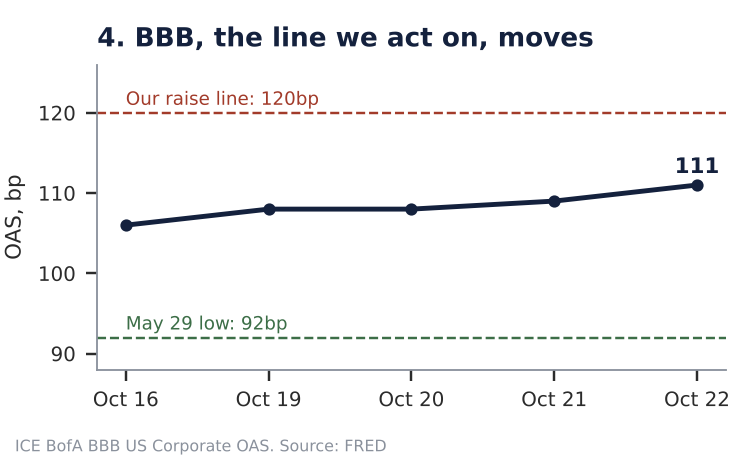
- Credit. High yield widened 9bp to 340bp, CCC 43bp to 1,340bp (from about 1,300bp a week earlier), and BBB 5bp to 111bp, on ICE BofA option-adjusted spreads.
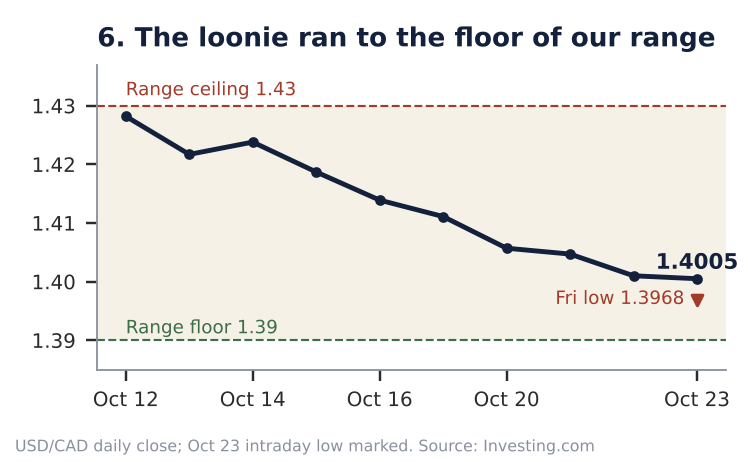
- Metals and FX. Gold fell 3.8% to about $4,012, from $4,166. Silver ended near $54.60. USD/CAD closed at 1.4005, from 1.4139.
- Diplomacy. US envoys met Zelensky in Oslo on Tuesday and Putin in St. Petersburg on Wednesday. Both sides backed US-proposed three-way talks, and Kyiv offered to stop hitting Russian refineries.
- Elections. British Columbia's Conservatives won Saturday's preliminary count by about 11 points, against a lead of about 5 in final-week polls. The miss ran right.
- Monday morning, after our as-of date. Brent was about 2% lower after President Trump ruled out an Iran strike for now, and Ukraine talks were set for November.
- Reassessed. Standing weightings unchanged; credit tail held at 20% with numbered review triggers. New this issue: a view on a Ukraine settlement and a view on the Senate.
Market snapshot
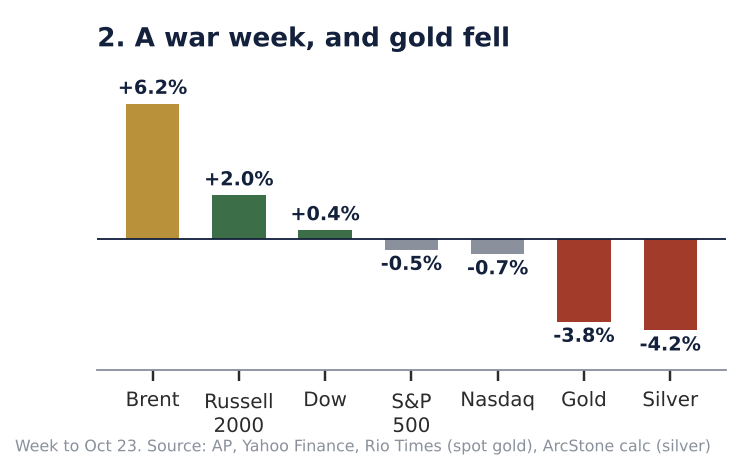
The week in one line: oil and small caps up, the large indices slightly lower, and precious metals sold in a week of war headlines.
| Brent$116.72From $109.86. About $114.30 Mon a.m. | Dec hike oddsNear 80%About 76% Mon a.m. Wed hold about 90% priced | US 10Y5.00%5.10% last issue. 4.99% Mon a.m. | Gold~$4,012-3.8% from $4,166. About $4,010 Mon a.m. |
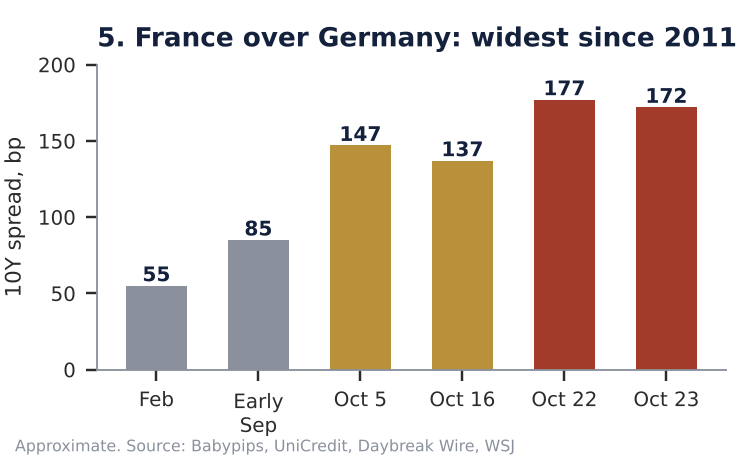
| HY spread340bp+9bp. CCC 1,340bp | BBB spread111bp+5bp on the week | OAT-Bund~172bp177bp Thu, widest since 2011 | USD/CAD1.4005From 1.4139. 1.4022 Mon a.m. |
Levels are as at the close on Friday, October 23, 2026 unless stated. Figures marked "Mon a.m." are indicative readings from the morning of Monday, October 26, before publication. Credit spreads are ICE BofA option-adjusted spreads. The OAT-Bund spread is approximate, and the weekly change in silver shown in the chart is an ArcStone calculation.
How our view changed this issue
| Theme | Change this issue | Why |
|---|---|---|
| Equity rotation (Axis 1, near term) | Unchanged, supported | Small caps rose 2% and equal weight beat the index in a week the Nasdaq fell. Outside AI, the S&P 500 is up about 6.6% in October. |
| Credit stress tail (Axis 1) | Weighting held at 20%, review triggers named | BBB moved 5bp to 111bp. We would raise the weighting if BBB clears 120bp or high yield clears 350bp. |
| Debasement scenario (Axis 2, 18-month horizon) | Unchanged | A liquidation week says nothing about the structural case. |
| Precious metals (tactical view, to year-end) | Unchanged | Metals were sold for cash this week, which we read as liquidation. The cost of holding non-yielding metal is tied to December hike odds. |
| Ukraine settlement | New this issue, monitoring | We think a deal is closer than priced. Talks are now set for November. Next test: whether refinery strikes stop. |
| US Senate outcome | New this issue, monitoring | We give a Republican Senate more weight than prediction markets, which price Democrats at 66%. The BC polling miss and a pollster's admission of fabricated surveys argue for caution on polls. |
| USD/CAD 1.39 to 1.43 range | Unchanged, near the floor | Leveraged funds are about 91,000 contracts net short CAD. If the range breaks, we think it breaks in the loonie's favour. |
The entries above describe how ArcStone Financial Pulse's own house view changed between issues. They are not ratings, recommendations, or price targets in respect of any security, and none should be inferred from them.
On the calendar
| Day | Event |
|---|---|
| Mon Oct 26 | $69B 2-year note auction. Qatar mediating in Tehran after President Trump ruled out a strike "today". |
| Tue Oct 27 | FOMC meeting begins. Israel election. |
| Wed Oct 28 | Fed decision and Warsh's press conference (hold about 90% priced). Bank of Canada decision and Monetary Policy Report. Microsoft and Alphabet report earnings. |
| Thu Oct 29 | US Q3 GDP (3.0% expected) and September PCE (core 3.1% expected). ECB decision. Amazon reports earnings. Alberta official results. |
| Fri Oct 30 | Bank of Japan decision (hold expected). Texas early voting ends. Revised US tariff list on Canadian goods takes effect. CFTC positioning data, including the CAD short. |
| Tue Nov 3 | US midterm elections. Next French budget vote (reported; date not confirmed by us). Reported US and Israeli strike plans on Iran are for after the vote. |
| Thu Nov 5 | French national strike day. |
On our radar
1. Ukraine: the incentives finally line up
The diplomacy moved further this week than it has in months. On Tuesday Witkoff, with Kushner joining by video, met Zelensky and European and NATO officials in Oslo, and on Wednesday he carried the results to Putin in St. Petersburg. By the end of the week both sides had backed a US proposal for three-way technical talks on security guarantees, and Zelensky had offered to stop striking Russian refineries if Moscow does the same.
What makes us take it more seriously this time is that the incentives line up. Moscow needs sanctions relief, Kyiv needs to get through a winter with the lights on, and the White House wants a win it can show voters. We are mindful that the energy truce announced on October 11 fell apart within days, so the test we apply is simple: do the refinery strikes stop, and do the talks get a date. Half of it was met over the weekend, when Zelensky confirmed three-way talks for November.
The mechanism is what matters for markets. If the strikes stop too, diesel and European gas give back part of their premium, and December hike odds, which had already eased to about 76% on Monday morning from near 80% at Friday's close, would come off further. Europe would get its first relief in months. For Canada the effect cuts both ways: cheaper global energy weighs on the loonie, and a Russia back in fuel markets competes directly with Canadian barrels.
2. Midterms: what the polls may be missing
Kalshi prices Democrats at 91% to take the House and 66% for the Senate, up from 63% a week ago, and gives a Republican sweep only 9%. Those are market-implied odds, not ours. Our view is that the polls behind them overstate the Democratic lead, and on Saturday we got a live test of that idea at home.
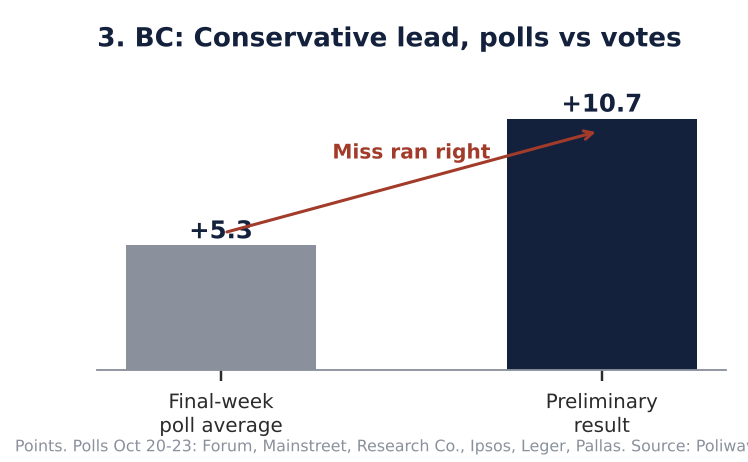
Every poll in the final week of British Columbia's election had the Conservatives ahead by about 5 points. On the preliminary count they won by about 11, 48.1% to 37.4%, taking 64 of 93 seats. In the same week Wedgewood, a pollster whose numbers had been cited by the New York Times and folded into several averages, admitted that almost all of its surveys were fabricated.
That is why we are reading the raw data ahead of the headlines. Texas early voting has been described as leaning Democratic, but that read comes from a model that assigns party by primary history, and such models can undercount Republican-leaning voters who skip primaries. The county counts tell a thinner story: Harris, Bexar and Hidalgo, three Democratic base counties, are all turning out below the 19.6% state average while the suburbs run above it. A Republican Senate would keep tariffs and the fiscal agenda intact, and because markets are positioned for gridlock, long yields would likely rise first.
The soft spot in that Texas read is AI. Rural anger over noise, water and power bills has put data centres on the ballot, and Abbott has paused new projects pending tough water and power guardrails. Local permitting is becoming a binding constraint on AI capital spending.
British Columbia's result also matters well beyond polling. The incoming Conservative government has promised to double natural gas production by 2032, pass a 120-day permitting law for projects over $250 million, repeal CleanBC and drop PST on business machinery. At the sector level, that is supportive of north coast LNG and of mining finance in the province. The one risk to the LNG side is our own Ukraine view, since a settlement would take some of the premium out of European gas, now at €86.
3. Oil, the Fed and a liquidation week
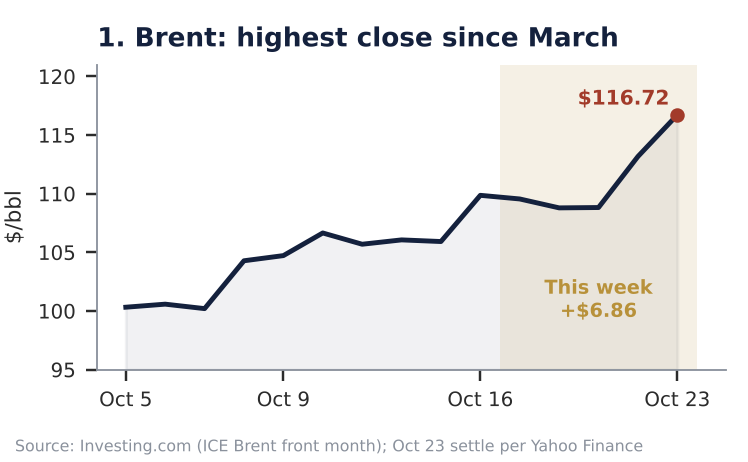
A Ukraine deal would do nothing for the Gulf, and the Gulf is where this week's oil move came from. Brent settled at $116.72, up $6.86 on the week and at its highest close since March, and US gasoline averaged $4.29 against $3.07 a year ago.
Iran and the Houthis look intent on keeping prices there through the vote. Kpler counted at least 18 vessels attacked in two weeks, Houthi strikes have reached Aramco's Dhahran headquarters, and on Thursday the State Department pulled staff out of Saudi Arabia. The same day the New York Times reported US and Israeli strike plans on Iran for after November 3; we have not verified that report. On Monday morning Brent was about 2% lower after President Trump ruled out a strike for now.
That premium is what keeps the Fed boxed in. We expect Warsh to hold on Wednesday and stay hawkish on December, with GDPNow at 3.5% and September core PCE, due the morning after he speaks, expected at 3.1%.
Gold was sold for cash. Against that backdrop gold fell 3.8% to about $4,012, a three-month low (see the cross-asset chart under Market snapshot), in a week when the 10-year real yield dropped 8 basis points. Rates cannot explain that move, and we read it as liquidation selling. The 10-year slid from 5.33% to under 5% in little more than a week, and trend-following funds that had built extremely short Treasury futures positions were forced to cover. When leveraged books take losses on that scale they sell what they can, and gold is the easiest thing in any portfolio to sell.
We have seen this sequence before. In 2008 gold fell 32% between March and October while the system raised cash, then was back near its high four months after the low. In March 2020 it was sold for liquidity again and set a record that summer. The tell is who is selling. Global gold ETF holdings reached a record 4,256 tonnes in the World Gold Council's October 7 data, with the price already about 26% below its January peak, so long-term holders are absorbing the leveraged selling, a pattern that has preceded recoveries in past liquidation episodes.
Our tactical precious metals view is unchanged. What it costs to carry that position depends on the December hike: with odds near 80% at Friday's close, holding a non-yielding metal still means giving up a rising cash yield, and that cost falls as those odds come down. None of this touches the debasement thesis, and with gold at about C$5,600 an ounce the financing window for junior miners stays open into Christmas.
Everyone is short the same things. Goldman's prime book shows hedge fund equity shorts near five-year highs, with short leverage at the 99th percentile and the heaviest two-week net selling of tech on record. Leveraged funds are short the loonie as well, and trend funds were short Treasuries until last week's rally forced them out. That bond squeeze showed what crowded positioning does when the news turns, and a calmer-than-expected Fed on Wednesday could do the same to stocks and the loonie at once.
The rates market disagrees with itself. Fed funds priced about a 76% chance of a December hike on Monday morning, while options traders paid record premiums on Thursday for protection against a further Treasury rally, so one of the two is wrong. A Republican Senate would lift long yields at first on fiscal expectations, but credit stress and a Ukraine deal both pull the other way, and over the months after the vote we think they win out. On balance we lean toward the options market.
4. Credit, Europe and the loonie
AI funding shifts to shareholders. Meta reported revenue growth of 26% and its shares still fell 7% on Thursday, as capital spending of $34.9 billion outran operating cash flow and left free cash flow at minus $2.1 billion. With $83 billion of cash on hand, it chose to raise equity through new non-voting shares rather than another bond deal, which says something about where the largest AI spenders expect debt to cost. Expected listings from the large private AI developers would add to the same supply. With $775 billion of cash and a pullback from bonds, the hyperscalers are shifting the funding burden onto shareholders, and more equity supply concentrated in the largest AI names is consistent with our rotation view. A company-by-company breakdown of AI funding belongs in a company-level piece, not a macro issue, so this stays at the mechanism level on purpose.
Credit takes its first step. Underneath, high yield widened 9 basis points to 340 and BBB, the line we said we would act on, rose 5 to 111 in its first move of note. We are holding the credit tail weighting at 20% and will raise it if BBB clears 120 or high yield clears 350. Those are review triggers for our own weighting, not forecasts of where spreads go. Meanwhile the S&P 500 outside AI is up about 6.6% in October, which is the rotation view doing what we expected.
France. Europe's credit, which we have argued since Issue No. 9 would crack first, moved another step this week. France's 10-year yield hit a 24-year high of 5.14% on Thursday and its spread over Germany reached 177 basis points, the widest since 2011, after the worst rioting in years: about 550,000 protesters and 2,400 arrests on October 17, and 410,000 more marching under curfews on Saturday. The spread was about 172 on Friday. The ECB meets Thursday with the spread on its desk, and a national strike day follows on November 5.
Canada. USD/CAD closed Friday at 1.4005 from 1.4139 after touching 1.3968, helped by $117 oil, a narrower yield gap and Alberta's 75% vote to stay, with official results due Thursday. With core inflation softening, we expect the Bank of Canada to hold at 2.25% on Wednesday. On trade, the White House swapped 50% tariffs on goods that matter to Senator Collins for tariffs on others, with the revised list taking effect Friday. Trump says a deal is close; Carney says he can wait. We read all of it as election politics, and expect the CUSMA standoff to run through the vote.
Positioning leans against the loonie into its rally. Leveraged funds held 91,113 net short CAD futures contracts on October 20, up from 39,022 in mid-September, and kept adding as USD/CAD fell through the week. Our 1.39 to 1.43 range is a house-view framing range, not a forecast or a target, and if it breaks we think it breaks in the loonie's favour.
The house framework, reassessed
Standing weightings are unchanged this issue. Axis 1, the near-term regime, is summarised below.
| Axis 1 scenario | Weighting | Read this issue |
|---|---|---|
| Equity rotation beyond AI leadership (near term) | Unchanged | Small caps +2.0% and equal weight ahead of the index in a week the Nasdaq fell 0.7%. S&P 500 outside AI up about 6.6% in October. Rising AI equity supply points the same way. |
| Credit stress tail | 20%, held | BBB at 111bp, up from a May 29 low of 92bp; high yield at 340bp. Review triggers: BBB above 120bp or high yield above 350bp. |
Axis 2, debasement, runs on an 18-month clock and is unchanged. A liquidation week says nothing about the structural case, and record gold ETF holdings during the sell-off suggest long-term holders read it the same way.
Two event views are new this issue and carry no numeric weighting: that a Ukraine settlement is closer than markets assume, with the refinery strikes as the next test, and that a Republican Senate is more likely than prediction markets price. The Kalshi odds quoted in this issue are market-implied figures, not ArcStone weightings.
The weightings above are ArcStone Financial Pulse's own house view as at the publication date. They are not market-implied probabilities, forecasts of any particular outcome, or targets.
What is still open
- Ukraine. Whether the refinery strikes stop and the November talks get a firm date. The October 11 energy truce is the reminder of how quickly this can unwind.
- The Fed on Wednesday. Warsh's tone on December, with the Bank of Canada that morning and Microsoft and Alphabet reporting that evening, then GDP and core PCE on Thursday.
- Iran. The reported US and Israeli strike plans for after November 3 remain unverified, and Monday's step back from a strike is "for now".
- Polling. Whether the British Columbia miss carries over. Texas early voting ends Friday, and the partisan read of it rests on a primary-history model.
- The loonie. Friday's CFTC data on the CAD short, Alberta's official results on Thursday, and the revised tariff list taking effect the same week.
- Credit. BBB against our 120bp review line and high yield against 350bp, checked every morning.
- France. The next budget vote, reported for November 3 but not confirmed by us, and the November 5 national strike day.
Disclosures
ArcStone Financial Pulse Inc. is owned by the same parent entity (ArcStone Securities and Investments Corp.) that owns ArcStone Securities, LLC. This common ownership, together with the joint operating relationship between ArcStone Securities, LLC and Kingswood Capital Partners, LLC under the ArcStone Kingswood DBA OSJ banner, represents a structural conflict of interest. Issuers referred to in ArcStone Financial Pulse content may be current or former clients of ArcStone or any of its subsidiaries and affiliates. Where ArcStone or its subsidiaries and affiliates have received or have been promised consideration for services provided to such an issuer, such consideration may include cash, stock, stock options, warrants, and/or Restricted Stock Units (RSUs) for the provision of corporate advisory, investor relations, digital media, or capital markets consulting services. This relationship represents a potential conflict of interest. The principals, directors, officers, employees, and related entities of ArcStone and its affiliates may, from time to time, own, buy, or sell securities or derivatives of such issuers or their affiliates.
The information contained herein is provided by ArcStone Financial Pulse Inc. ("ArcStone Financial Pulse"), a subsidiary of ArcStone Securities and Investments Corp. ("ArcStone"), for informational purposes only. It is not, and under no circumstances should it be construed as, an offer to sell or a solicitation of an offer to buy any securities or other financial instruments in any jurisdiction. This content is not a research report within the meaning of FINRA Rules 2241 or 2242 and does not constitute a research report under any applicable securities laws.
Certain statements contained herein may constitute "forward-looking statements" within the meaning of applicable Canadian and U.S. securities laws. Forward-looking statements are based on current expectations, estimates, and assumptions that involve known and unknown risks and uncertainties which may cause actual results or developments to differ materially from those expressed or implied. These statements often include words such as "anticipate," "believe," "expect," "intend," "may," "plan," "project," "should," "target," or similar expressions. Readers are cautioned not to place undue reliance on such statements, which speak only as of the date made. Except as required by law, ArcStone undertakes no obligation to update or revise any forward-looking information.
This content is not intended as investment advice or a recommendation to buy or sell any security and does not take into account the investment objectives, financial situation, or needs of any individual. Investors should consult their own professional advisors before making any investment decisions.
ArcStone Securities and Investments Corp. is not a registered broker-dealer and does not provide investment advice or recommendations. All registrable activities in the United States are conducted through ArcStone Securities, LLC (CRD# 306029) and/or Kingswood Capital Partners, LLC (CRD# 288898), both FINRA-registered broker-dealers, members SIPC. ArcStone Canada Inc. is not registered as a dealer in any Canadian jurisdiction; registrable dealing activities in Canada are conducted through appropriately registered affiliates.
ArcStone Kingswood is a DBA Office of Supervisory Jurisdiction (OSJ) of Kingswood Capital Partners, LLC (Member FINRA/SIPC) under which registered representatives of ArcStone Securities, LLC (Member FINRA/SIPC) and registered representatives of Kingswood Capital Partners, LLC conduct joint capital markets and investment banking activities. ArcStone Securities, LLC and Kingswood Capital Partners, LLC are parties to a written agreement governing the sharing of fees on transactions in which registered representatives of both firms participate. All securities transactions and investment banking services conducted by ArcStone are conducted exclusively through ArcStone Securities, LLC and/or Kingswood Capital Partners, LLC; "ArcStone Kingswood" itself is not a registered broker-dealer or separate legal entity.
Subject matter. This issue discusses the US-brokered diplomacy between Ukraine and Russia, including the proposed three-way technical talks on security guarantees and the offer to halt refinery strikes; the November 3, 2026 US midterm elections and prediction-market pricing of their outcome; the preliminary result of the October 24, 2026 British Columbia provincial election and the accuracy of its final-week polling; Brent crude oil and shipping and strike risk in the Gulf involving Iran and the Houthis; the October 27 and 28, 2026 FOMC meeting and market pricing of a December rate hike; gold and silver price moves; US corporate credit spreads (high yield, CCC and BBB) and equity funding of AI capital spending; the spread of French over German 10-year government bond yields; and USD/CAD, the October 28, 2026 Bank of Canada decision and US tariffs on Canadian goods.
Independence. The views in this issue are ArcStone Financial Pulse Inc.'s own market commentary. They were not influenced by any investment banking, advisory or other business relationship of ArcStone Financial Pulse Inc. or any of its affiliates, and no part of the compensation of anyone who prepared this issue is tied to the views expressed in it.
No ratings. ArcStone Financial Pulse Inc. does not maintain a rating system, a coverage universe or a distribution of ratings. The entries in 'How our view changed this issue', the scenario weightings and new event views in 'The house framework, reassessed', the 120bp BBB and 350bp high yield review triggers, and the 1.39 to 1.43 USD/CAD range are ArcStone Financial Pulse's own house view about macro regimes. They are not ratings, recommendations or price targets in respect of any security, issuer or commodity, and the prediction-market odds quoted in this issue are market-implied figures, not ArcStone weightings.
Affiliate sector exposure. Affiliates of ArcStone Financial Pulse Inc., including ArcStone Canada Inc., have or may seek advisory mandates with issuers in sectors discussed in this issue, including precious metals and junior mining, energy, natural gas and LNG, British Columbia mining, credit, and Canadian issuers generally. The sector-level discussion of British Columbia's announced resource policies, north coast LNG, mining finance in the province and the junior gold financing window should be read in that light.
Third parties cited. This issue cites Kalshi prediction-market pricing for the US midterms; the GDPNow nowcast; consensus expectations for US Q3 GDP, September core PCE and the Bank of Japan decision, as carried in the source compilation without a named provider; fed funds futures pricing of FOMC outcomes; Goldman prime brokerage positioning data; Kpler counts of vessels attacked; World Gold Council global gold ETF holdings data of October 7, 2026; CFTC data on leveraged fund positioning in CAD futures as of October 20, 2026; final-week British Columbia polls from Forum, Mainstreet, Research Co., Ipsos, Leger and Pallas; and reporting by the New York Times. ArcStone's own expectations for the Fed and the Bank of Canada are house views, not forecasts of any particular outcome.
Price basis and as-of date. Market levels are as at the close on Friday, October 23, 2026 unless stated. Figures labelled 'Mon a.m.' or attributed to Monday morning are indicative readings from the morning of Monday, October 26, 2026, before publication. All levels and figures were carried from the source compilation prepared for this issue and were not independently re-verified by ArcStone Financial Pulse Inc. The OAT-Bund spread is approximate. The weekly change in silver is an ArcStone calculation. The prior-week CCC spread is given as about 1,300bp.
Charts. Figure 1 plots ICE Brent front-month daily closes from October 5 to October 23, 2026 from Investing.com, with the October 23 settlement of $116.72 taken from Yahoo Finance; the shaded week shows a gain of $6.86. Figure 2 plots percentage changes for the week to October 23, 2026 in Brent, the Russell 2000, the Dow, the S&P 500, the Nasdaq, gold and silver, from AP, Yahoo Finance and Rio Times (spot gold); the silver change of -4.2% is an ArcStone calculation. Figure 3 compares the Conservative lead in British Columbia's final-week polls, shown as an average of +5.3 points across polls dated October 20 to 23 from Forum, Mainstreet, Research Co., Ipsos, Leger and Pallas, with the +10.7 point margin on the October 24 preliminary count; the averaging was carried from the source compilation and the preliminary result is subject to the official count. Figure 4 plots the ICE BofA BBB US Corporate option-adjusted spread from FRED for October 16 to October 22, 2026, with the May 29 low of 92bp and ArcStone's 120bp review line, which is a house-view trigger and not a forecast. Figure 5 shows the 10-year France-Germany yield spread at six points from February to October 23, 2026, compiled from Babypips, UniCredit, Daybreak Wire and WSJ; all values are approximate. Figure 6 plots USD/CAD daily closes from October 12 to October 23, 2026 from Investing.com, marking the October 23 intraday low of 1.3968 and ArcStone's 1.39 to 1.43 house-view range, which is not a forecast or a target.
As-reported figures. The following are reported by third parties and are not ArcStone calculations: Meta's revenue growth of 26%, capital expenditure of $34.9 billion, free cash flow of minus $2.1 billion, cash of $83 billion and its share move of 7% on October 22, 2026; the $775 billion cash figure for the largest AI spenders; the British Columbia preliminary result of 48.1% to 37.4% and 64 of 93 seats; Alberta's 75% vote, with official results due October 29, 2026; French protest and arrest numbers; US gasoline averages; Texas early voting turnout, including the 19.6% state average; global gold ETF holdings of 4,256 tonnes; leveraged fund CAD futures positions of 91,113 and 39,022 contracts; and the Goldman positioning measures.
Unverified and reported items. The following were reported and have not been verified by ArcStone Financial Pulse Inc.: US and Israeli strike plans on Iran for after November 3, 2026, as reported by the New York Times; the date of the next French budget vote; Wedgewood's reported admission that almost all of its surveys were fabricated; and the characterisation of Texas early voting as leaning Democratic, which rests on a model that assigns party by primary history.
No company named in this commentary is a current or former client of ArcStone or any of its subsidiaries and affiliates, and no consideration has been paid or promised to ArcStone or any of its subsidiaries or affiliates in connection with this commentary. Companies are named only to report their own scheduled reporting dates or publicly observable market data, and no view is expressed on their securities.
Sources: Investing.com: ICE Brent front-month daily closes, October 5 to October 23, 2026; USD/CAD daily closes, October 12 to October 23, 2026, and October 23 intraday low; Yahoo Finance: Brent settlement, October 23, 2026; weekly index changes to October 23, 2026; AP: weekly US market changes to October 23, 2026; Rio Times: spot gold, week to October 23, 2026; FRED: ICE BofA BBB US Corporate option-adjusted spread, October 16 to October 22, 2026; ICE BofA: US high yield and CCC option-adjusted spreads, as at October 23, 2026; Kalshi: US midterm House, Senate and sweep contract pricing, week ended October 23, 2026; Forum, Mainstreet, Research Co., Ipsos, Leger and Pallas: British Columbia final-week polls, October 20 to October 23, 2026; Polling aggregator named in the Figure 3 source line (name cut off in the chart image as 'Poliwa'; full name to be confirmed): British Columbia poll average and preliminary count, October 24, 2026; Babypips, UniCredit, Daybreak Wire and WSJ: France-Germany 10-year spread, February to October 23, 2026 (approximate); World Gold Council: global gold ETF holdings, October 7, 2026 data; CFTC: leveraged fund positioning in CAD futures, October 20, 2026; Goldman: prime brokerage hedge fund positioning data, as cited for the week to October 23, 2026; Kpler: vessels attacked in the two weeks to October 23, 2026; New York Times: reporting on US and Israeli strike plans on Iran, October 22, 2026; GDPNow: US Q3 GDP nowcast, as at October 23, 2026; Fed funds futures: FOMC October and December pricing, October 23, 2026 close and October 26, 2026 morning.
© 2026 ArcStone Financial Pulse Inc. All rights reserved. May be redistributed in full and unaltered with attribution.