The Long End Found Buyers. December Didn't Go Away.
Week of October 12, 2026. Issue No. 10.
ArcStone View
The long end found buyers this week, and for gold that mattered more than anything the Fed said. Thursday's $22 billion 30-year sale cleared at 5.618%, with indirect bidders taking 72.3% and dealers left with 6.8%, and gold recovered toward $4,200 within a day. Our near-term view on gold improved this issue, but it carries one risk the market has not let go of: the hike it moved out of October, now about 16% priced, is still about 74% priced for December. Canada lost 110,000 jobs across August and September, erasing all of 2026's hiring and pushing the loonie to an 18-month low. We think Canada is heading for the bad end of our range, but the trigger is the January 1 tariff step, not last Friday's report. And Kyiv has chosen its oil war over Washington's fuel prices: five days after Zelensky said Ukraine would hit harder, its drones struck Omsk, Russia's largest refinery, roughly 2,500 km from the border.
Since last issue: what actually moved
- Treasuries. The 10-year hit its highest level since 2002 on Wednesday, then a strong 30-year auction pulled it back to 5.23% on Thursday, from 5.28% in our last issue. The 30-year closed at 5.60%.
- Fed. October hike odds slid to about 16% from roughly 25%. December holds near 74%.
- Canada. Employment fell 68,300 against a forecast gain. USD/CAD touched just under 1.43, from 1.427 in our last issue.
- Energy. Brent jumped 4% to about $104 on Thursday on a report of new Iran strike options; Trump then ruled out strikes before the midterms. Hurricane Isaias shut in 63% of Gulf of Mexico output. Ukraine hit Omsk.
- Gold. A two-month low on Wednesday, then back near $4,200 on Friday, from $4,143 in our last issue. China's central bank bought 21 tonnes in September.
- Europe and Japan. France's spread over Germany eased to about 132bp from a peak near 150bp on October 2, the widest since 2011. Japan's 30-year auction cleared cleanly near 4.11%.
- Our framework. Standing weightings unchanged, with the credit tail held at 20%. One new near-term view on gold. USD/CAD sits at the top of our range.
Market snapshot
| US 10Y5.23%30Y 5.60%, after the auction | PBOC gold+21tSeptember, largest in 3 years | Oct hike odds16%December 74% | Gold~$4,200-21% vs record |
| Brent~$104Gulf output 63% shut in | USD/CAD~1.43Top of 1.39-1.43 range | Canada unemp.6.5%Ontario 7.0% | Gold in C$~C$6,000Weak loonie; ArcStone calculation |
Levels are as at the Friday, October 9, 2026 close unless stated. Treasury yields and Brent are Thursday, October 8 levels. Fed meeting odds are prediction-market readings as at October 11, 2026, compiled by DeFi Rate. Gold and Brent levels are approximate. Gold in Canadian dollars is an ArcStone calculation from approximate gold and USD/CAD levels.
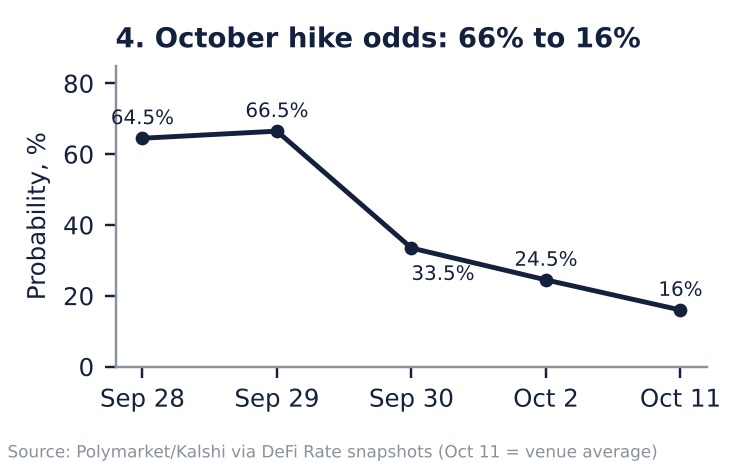
The week's sharpest repricing was in Fed meeting odds. The chance of an October hike, as priced on prediction markets, fell from about two-in-three at the end of September to about 16%. That shift is the backdrop for most of what follows, and the gold section below explains why we think the market moved the hike rather than dropped it.
How our view changed this issue
| Theme | Change this issue | Why |
|---|---|---|
| Axis 1 rotation scenario, near term | Unchanged; credit tail weighting held at 20% | The S&P 500 set records on Tuesday with the 10-year at a 24-year high, and consensus expects about 31% Q3 earnings growth. A clean long-bond auction argues against raising the credit tail; Europe's spreads argue against cutting it. |
| Axis 2 debasement scenario, 18-month clock | Unchanged | Gold's drawdown since January is a rates story. The structural case and its clock have not moved. |
| Gold, near term, through year-end | New this issue, monitoring | Our view improved, with December rate risk as its main exposure. It would firm on a sustained retreat in the 10-year yield or December hike odds falling below 50%. We would revisit it if September CPI puts October back in play. Kept separate from the debasement scenario on purpose. |
| CUSMA scenario tree | Unchanged; termination weighting under watch | September's losses were public sector. Private payrolls have not broken yet. The 50% auto tariff on January 1 is where we would expect them to. |
| USD/CAD range | Unchanged; spot at the top of the range | Spot touched just under 1.43, the top of the 1.39-1.43 range we set at month-end. A clean break above it would tell us Canada's own data, not just the rate gap with the Fed, is driving the loonie, and we would reset the range higher. |
The entries above describe how ArcStone Financial Pulse's own house view changed between issues. They are not ratings, recommendations, or price targets in respect of any security, and none should be inferred from them.
On the calendar
| Date | Event |
|---|---|
| Mon, Oct 12 | Gulf of Mexico restart after Isaias; US Q3 bank earnings begin this week |
| Tue, Oct 13 | France: fresh nationwide youth protest call |
| Wed, Oct 14 | US September CPI, the first test for our near-term gold view |
| Thu, Oct 15 | EIA weekly inventories |
| Mon, Oct 19 | Canada September CPI |
| Tue-Wed, Oct 27-28 | FOMC, with a hold about 84% priced |
| Wed, Oct 28 | Bank of Canada decision; policy rate 2.25% |
| Tue, Nov 3 | US midterm elections |
| Fri, Nov 6 | Canada October Labour Force Survey |
| Wed, Dec 9 | FOMC, with a hike about 74% priced |
| Fri, Jan 1, 2027 | US 50% tariff on Canadian autos, parts and steel takes effect |
On our radar
1. Gold: the bond market did the Fed's job for it
Our near-term read on gold improved this issue. We hold that view knowing it depends on one thing the market has not conceded yet.
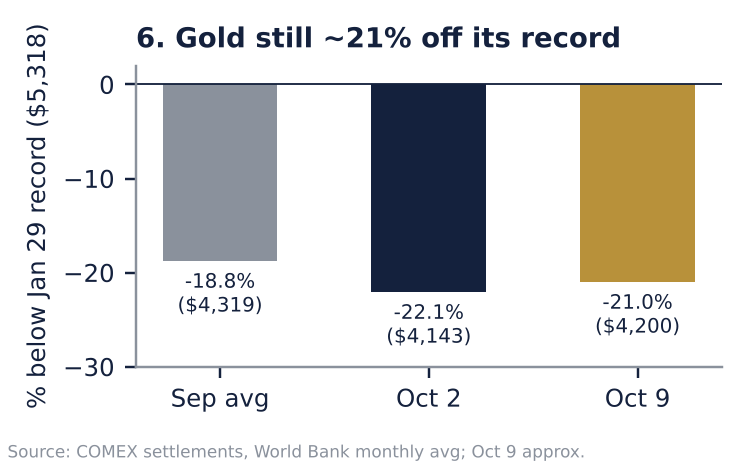
Since the January 29 record of $5,318, gold has traded like a rates asset. It hit a two-month low on Wednesday as the 10-year Treasury touched its highest level since 2002, then recovered toward $4,200 once the long end turned.
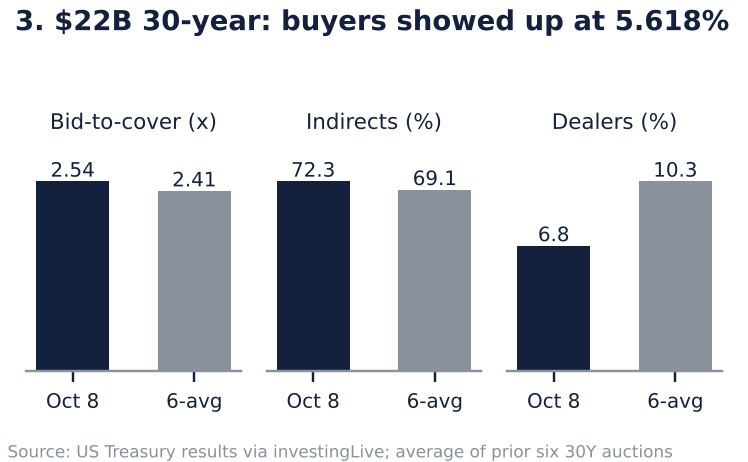
That turn came from Thursday's auction. Treasury sold $22 billion of 30-year bonds at 5.618%. The bid-to-cover was 2.54 against a 2.41 average, indirect bidders took 72.3%, and dealers were left with 6.8%, well under their usual 10%. Buyers stepped in at these yields without demanding a concession. That is the first evidence in weeks that the long end has a ceiling, and gold responded to it within a day.
Where we would push back is on the idea that hikes are off the table. October is: prediction markets price about a 16% chance of a move on the 28th, down from roughly two-in-three at the end of September. December is not. A hike at the December 9 meeting is still around 74% priced, and the odds of at least one more hike this year sit near 78%. The Fed itself is saying so: the September minutes show most participants expected another hike by year-end, with core PCE at 3.4%. Friday's Michigan survey added to it, with one-year inflation expectations at 4.7% and five-year at 3.5%.
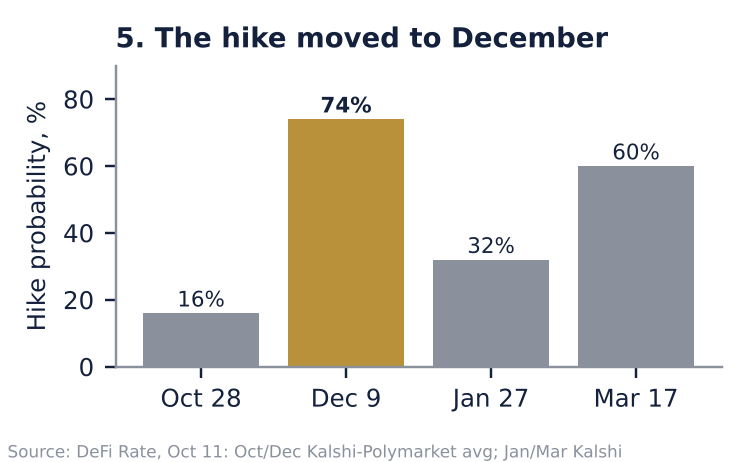
That is why December is the risk any gold view carries into year-end. Holding gold exposure through the fourth quarter means carrying December rate risk with it, and the cost of that carry depends on whether the 74% comes down. The first test is Wednesday's September CPI. Oil works against gold here: Brent back above $100 keeps headline inflation hot, which keeps December alive, even as the same geopolitics support gold as a haven. A soft CPI with oil above $100 would be the most supportive combination for gold. A hot one puts October back on the table, and we would expect gold to retest Wednesday's low.
The other support for our view is who else is buying. China's central bank bought 21 tonnes in September, its largest monthly purchase in three years and its 23rd straight month of buying, and its pace has picked up as the price has fallen. That is a price-insensitive buyer under the market, and it is the floor we would lean on if CPI goes the wrong way.
In Canadian dollar terms the picture is firmer than the US dollar price suggests. With USD/CAD near 1.43, gold is worth about C$6,000 an ounce to a domestic producer, and a weak loonie pads Canadian producers' margins on top of whatever bullion does. An issuer-by-issuer breakdown of what that means for individual miners belongs in a company-level piece, not a macro issue, so this stays at the mechanism level on purpose.
We are keeping this view separate from the debasement scenario, as we have since September. A bounce driven by Treasury auctions is a rates trade. The structural case does not need it, and it does not get stronger because of it.
2. Canada: heading for the bad end of the range, but the trigger is January
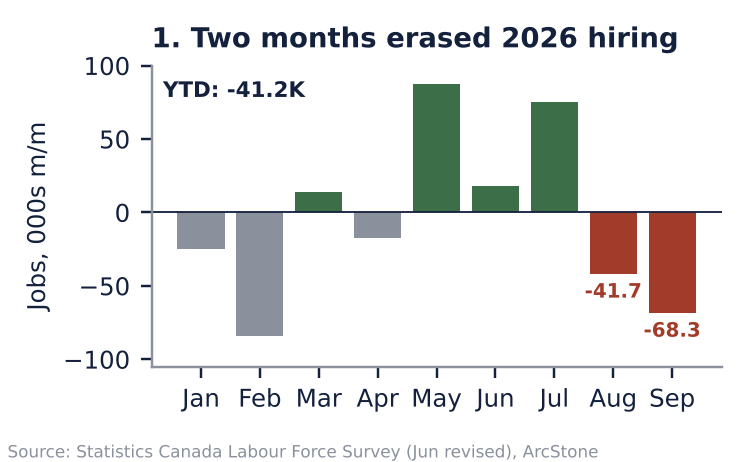
The headline is as bad as it looks. Canada lost 68,300 jobs in September against a forecast gain, on top of 41,700 in August. Those two months wiped out every job created this year: employment is down 41,200 since January. Unemployment rose to 6.5%, Ontario's sits at 7.0%, and the participation rate fell to 64.8%, its lowest outside 2020 since 1997. USD/CAD jumped to just under 1.43 within minutes, an 18-month high.
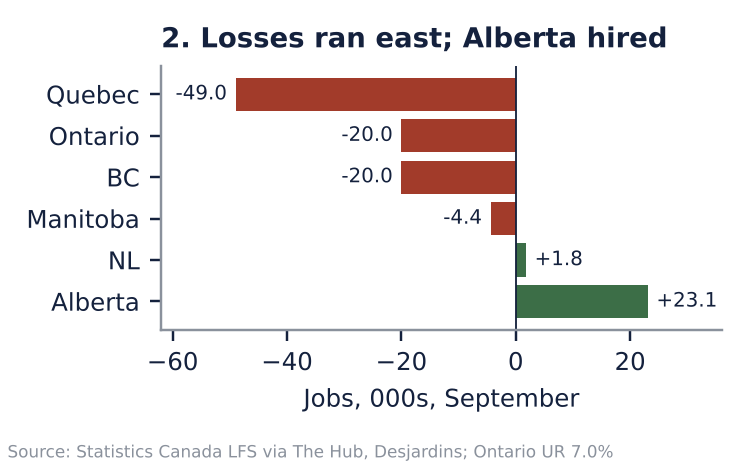
We would stop short of calling it the worst case yet, because the composition does not fit a tariff collapse. Public sector employment fell 70,000, about half of it in education, which Desjardins ties to fewer international students. Private sector employment was roughly flat for a second month. Alberta added 23,100 jobs. Desjardins still tracks third-quarter GDP near 2%, and employment remains 95,000 higher than a year ago.
Our worry is what has not shown up yet. The Section 338 tariffs went live in September, and the 50% duty on Canadian cars, parts and steel lands on January 1. Private payrolls in the auto corridor are where we would expect the damage to appear, and that is a first-quarter story. So our read is that Canada is moving into the bad half of our range now, with the worst case arriving on a schedule the market can already see. The Bank of Canada meets on October 28, after CPI on the 19th. Traders have pushed hike expectations out to December, and the weak dollar is doing some of the Bank's easing for it.
3. Kyiv chooses its oil war over Washington's fuel prices
On October 3, Zelensky said Ukraine would intensify strikes on Russian refineries, despite Trump's repeated requests since mid-September to stop hitting diesel supply. He tied it to a Russian winter campaign against Ukrainian cities and power. Two days later, Trump posted that Ukraine's refinery strikes, not Hormuz, were now driving gasoline prices. On Thursday, Ukrainian drones hit Omsk, Russia's largest refinery, roughly 2,500 km from the border, after Bloomberg reported Russian refining at its lowest in more than two decades.
The two governments now want opposite things from the same barrels. Washington's priority into the November 3 midterms is pump prices, with US diesel above $6 and a 100-million-barrel G7 stock release already announced. Thursday made that plain: hours after a report that the Pentagon was drawing up Iran strike options, Trump posted that there would be no strikes before the midterms, citing productive talks through Qatar. He can switch off the Iran risk. He cannot switch off Ukraine's, and Hurricane Isaias, which shut in 63% of Gulf of Mexico oil output ahead of landfall, shows how little spare room the product market has.
Kyiv's priority is cutting Russian war revenue before winter. We do not think Ukraine is trying to engineer a global energy crisis; its stated aims are Russian revenue and military fuel. But the effect lands in refined products either way, and Russia's diesel export ban compounds it. What we would watch is whether Washington starts using its leverage on Kyiv, through aid, intelligence or the Patriot licensing it offered in July. Any sign of that would ease product markets quickly. Absent it, diesel stays tight through winter regardless of what happens to crude.
4. Europe: France's streets heat up while its spread eases
The street story we flagged last issue is spreading, but unevenly. In France, the Interior Ministry counted about 256,000 marchers on October 6, classes were disrupted at 891 of the country's 3,700 lycées, and the Prime Minister put police and gendarme injuries above 715. Organisers have called fresh protests for Tuesday. London saw clashes and 11 arrests around Wednesday's October 7 anniversary marches. Germany's September 25 school strike against conscription drew more than 45,000 students in about 100 cities, by organisers' count, and passed off peacefully.
The bond market moved the other way. France's spread over Germany eased to about 132bp by Friday from a peak near 150bp on October 2, the widest since 2011. The streets got hotter while credit cooled. We still think Europe's credit cracks first, because the spread remains more than double where it sat in June and Paris has yet to put a credible consolidation plan on the table. But this week was a reprieve, and we would say so. The UK and Germany are building political risk that has not reached prices yet. For gold, this is a haven bid that sits outside the US rates channel, and it does not depend on the Fed.
The house framework, reassessed
| Scenario | House weighting | This issue |
|---|---|---|
| Axis 1, credit tail | 20% | Held |
| Axis 1, other standing weightings | Unchanged from last issue | No change |
| CUSMA scenario tree, termination branch | Unchanged | Under watch into January 1 |
Axis 2, the debasement scenario, stays on its 18-month clock with no change this issue. In our reading, gold's drawdown from its January record is a rates story rather than a verdict on the structural case, which is why the new near-term gold view sits apart from it and is tracked separately.
The case for leaving Axis 1 alone cuts both ways. Equities are not pricing stress: the S&P 500 set records on Tuesday with the 10-year at a 24-year high, and consensus expects about 31% Q3 earnings growth. A clean 30-year auction argues against raising the credit tail. France's spread, still more than double its June level with no credible consolidation plan from Paris, argues against cutting it. On the Canadian side, USD/CAD sits at the ceiling of the 1.39-1.43 range we set at month-end; a clean break above it would tell us Canada's own data is driving the loonie, and we would reset the range higher.
The weightings above are ArcStone Financial Pulse's own house view as at the publication date. They are not market-implied probabilities, forecasts of any particular outcome, or targets.
What is still open
- Wednesday's September CPI. It is the whole week for gold and the 10-year: whether December's roughly 74% starts to come down, or October comes back into play.
- France on Tuesday. Whether the fresh protest day shows the unrest broadening or burning out, and whether UK and German political risk starts to reach prices.
- Canada's private payrolls. Whether they hold until the January 1 tariff step, and what Canada's CPI on the 19th sets up for the Bank of Canada on October 28.
- USD/CAD at the ceiling. Whether spot breaks cleanly above 1.43, which would lead us to reset the range higher.
- Washington and Kyiv. Whether the US starts using its leverage over Ukraine's refinery campaign. Absent that, and with the Gulf of Mexico still restarting after Isaias, diesel stays tight through winter.
Disclosures
ArcStone Financial Pulse Inc. is owned by the same parent entity (ArcStone Securities and Investments Corp.) that owns ArcStone Securities, LLC. This common ownership, together with the joint operating relationship between ArcStone Securities, LLC and Kingswood Capital Partners, LLC under the ArcStone Kingswood DBA OSJ banner, represents a structural conflict of interest. Issuers referred to in ArcStone Financial Pulse content may be current or former clients of ArcStone or any of its subsidiaries and affiliates. Where ArcStone or its subsidiaries and affiliates have received or have been promised consideration for services provided to such an issuer, such consideration may include cash, stock, stock options, warrants, and/or Restricted Stock Units (RSUs) for the provision of corporate advisory, investor relations, digital media, or capital markets consulting services. This relationship represents a potential conflict of interest. The principals, directors, officers, employees, and related entities of ArcStone and its affiliates may, from time to time, own, buy, or sell securities or derivatives of such issuers or their affiliates.
The information contained herein is provided by ArcStone Financial Pulse Inc. ("ArcStone Financial Pulse"), a subsidiary of ArcStone Securities and Investments Corp. ("ArcStone"), for informational purposes only. It is not, and under no circumstances should it be construed as, an offer to sell or a solicitation of an offer to buy any securities or other financial instruments in any jurisdiction. This content is not a research report within the meaning of FINRA Rules 2241 or 2242 and does not constitute a research report under any applicable securities laws.
Certain statements contained herein may constitute "forward-looking statements" within the meaning of applicable Canadian and U.S. securities laws. Forward-looking statements are based on current expectations, estimates, and assumptions that involve known and unknown risks and uncertainties which may cause actual results or developments to differ materially from those expressed or implied. These statements often include words such as "anticipate," "believe," "expect," "intend," "may," "plan," "project," "should," "target," or similar expressions. Readers are cautioned not to place undue reliance on such statements, which speak only as of the date made. Except as required by law, ArcStone undertakes no obligation to update or revise any forward-looking information.
This content is not intended as investment advice or a recommendation to buy or sell any security and does not take into account the investment objectives, financial situation, or needs of any individual. Investors should consult their own professional advisors before making any investment decisions.
ArcStone Securities and Investments Corp. is not a registered broker-dealer and does not provide investment advice or recommendations. All registrable activities in the United States are conducted through ArcStone Securities, LLC (CRD# 306029) and/or Kingswood Capital Partners, LLC (CRD# 288898), both FINRA-registered broker-dealers, members SIPC. ArcStone Canada Inc. is not registered as a dealer in any Canadian jurisdiction; registrable dealing activities in Canada are conducted through appropriately registered affiliates.
ArcStone Kingswood is a DBA Office of Supervisory Jurisdiction (OSJ) of Kingswood Capital Partners, LLC (Member FINRA/SIPC) under which registered representatives of ArcStone Securities, LLC (Member FINRA/SIPC) and registered representatives of Kingswood Capital Partners, LLC conduct joint capital markets and investment banking activities. ArcStone Securities, LLC and Kingswood Capital Partners, LLC are parties to a written agreement governing the sharing of fees on transactions in which registered representatives of both firms participate. All securities transactions and investment banking services conducted by ArcStone are conducted exclusively through ArcStone Securities, LLC and/or Kingswood Capital Partners, LLC; "ArcStone Kingswood" itself is not a registered broker-dealer or separate legal entity.
Subject matter. This issue discusses the US Treasury long end, including the October 8, 2026 30-year Treasury auction; prediction-market pricing of US Federal Reserve decisions at the October 28 and December 9, 2026 meetings; the gold price and central-bank gold buying; Canada's September 2026 Labour Force Survey, the Canadian dollar and the scheduled January 1, 2027 US 50% tariff on Canadian autos, parts and steel; Ukraine's strikes on Russian refineries and their effect on refined-product markets; and political unrest and sovereign spreads in France, the United Kingdom and Germany.
Independence. The views in this issue are ArcStone Financial Pulse Inc.'s own house view. They were not influenced by any investment banking, advisory or other business relationship of ArcStone or any of its subsidiaries or affiliates, and no compensation of any person who prepared this commentary is tied to the views expressed in it or to any transaction.
No ratings. ArcStone Financial Pulse Inc. maintains no rating system, no coverage universe and no distribution of ratings. The weightings and view changes in the sections headed How our view changed this issue and The house framework, reassessed are ArcStone Financial Pulse's own house view about macro regimes and themes. The near-term view on gold described in this issue is a view on the commodity as a macro asset; it is not a rating, recommendation or price target in respect of any security, fund or other product, and none should be inferred from it.
Affiliate sector exposure. ArcStone affiliates, including ArcStone Canada Inc., may have, or may seek, advisory or capital markets relationships with issuers in sectors discussed in this issue, including precious metals and gold mining, oil, refining and energy, and Canadian issuers more broadly, including issuers exposed to US tariffs on autos, parts and steel. Readers should take that potential conflict into account.
Third-party forecasters and data providers cited. This issue cites Desjardins for its tracking of Canadian third-quarter GDP near 2% and its attribution of public sector education job losses to fewer international students; Polymarket and Kalshi, as compiled by DeFi Rate, for market-implied Fed meeting probabilities; the minutes of the Federal Reserve's September 2026 meeting; the Michigan consumer survey for inflation expectations; and a consensus expectation of about 31% S&P 500 third-quarter earnings growth, whose compiler the source material does not identify. These are third-party figures, not ArcStone forecasts.
Price basis and as-of date. Market levels are as at the Friday, October 9, 2026 close unless stated. US Treasury yields and the Brent price are Thursday, October 8, 2026 levels; Fed meeting probabilities are prediction-market snapshots as at October 11, 2026. The gold and Brent levels are approximate. All levels were carried from the source document prepared for this issue and have not been independently re-verified by ArcStone Financial Pulse Inc.
Charts. Figure 1 plots Statistics Canada Labour Force Survey monthly employment changes, January to September 2026, in thousands, with June revised; the year-to-date total is the sum of the monthly changes. Figure 2 plots September 2026 provincial employment changes from the Statistics Canada Labour Force Survey via The Hub and Desjardins, with Ontario's unemployment rate. Figure 3 compares the October 8, 2026 30-year Treasury auction results, as reported via investingLive, with the average of the prior six 30-year auctions. Figure 4 plots prediction-market probabilities of an October 28 Fed hike from September 28 to October 11, 2026, from Polymarket and Kalshi snapshots compiled by DeFi Rate, with the October 11 point a venue average. Figure 5 plots per-meeting Fed hike probabilities as at October 11, 2026, with October and December as Kalshi-Polymarket averages and January and March from Kalshi only. Figure 6 plots gold's percentage distance below its January 29, 2026 record of $5,318, using a World Bank monthly average for September, a COMEX settlement for October 2 and an approximate level for October 9; the drawdown percentages are ArcStone calculations and the October 9 level is an approximation, not a settled price. No chart presents an ArcStone forecast.
As-reported figures and ArcStone calculations. Employment, unemployment and participation figures, auction results, central-bank gold purchases, Fed minutes, survey readings, the Gulf of Mexico shut-in share, the France-Germany spread and the Japanese 30-year auction level are as reported by their sources. The two-month Canadian job loss of 110,000, the gold drawdown percentages and the gold price of about C$6,000 an ounce (derived from approximate gold and USD/CAD levels) are ArcStone calculations. Protest attendance and injury figures are as reported by the French Interior Ministry, the French Prime Minister and, for the German school strike, organisers, and have not been verified by ArcStone. The report of Pentagon Iran strike options and the reported level of Russian refining are restated as reported and have not been verified by ArcStone.
No company named in this commentary is a current or former client of ArcStone or any of its subsidiaries and affiliates, and no consideration has been paid or promised to ArcStone or any of its subsidiaries or affiliates in connection with this commentary. Companies are named only to report their own scheduled reporting dates or publicly observable market data, and no view is expressed on their securities.
Sources: Statistics Canada, Labour Force Survey, September 2026, released October 9, 2026 (June revised); provincial figures via The Hub and Desjardins; US Treasury, 30-year bond auction results, October 8, 2026, via investingLive; average of the prior six 30-year auctions as presented in the source chart; Polymarket and Kalshi Fed meeting probabilities, snapshots compiled by DeFi Rate, September 28 to October 11, 2026; COMEX gold settlements, October 2, 2026, and approximate level, October 9, 2026; World Bank monthly average gold price, September 2026; People's Bank of China gold purchases, September 2026; Desjardins commentary on the September 2026 Labour Force Survey, October 2026; Federal Reserve, minutes of the September 2026 FOMC meeting; Michigan consumer survey, inflation expectations, October 9, 2026; Bloomberg report on Russian refining levels, as cited, early October 2026; French Interior Ministry protest count, October 6, 2026; German school strike attendance by organisers' count, September 25, 2026; Market levels for Treasury yields, Brent, gold, USD/CAD, the France-Germany spread and the Japanese 30-year auction, October 8 to October 9, 2026, carried from the source document and not independently re-verified.
© 2026 ArcStone Financial Pulse Inc. All rights reserved. May be redistributed in full and unaltered with attribution.