The Vote and the Rollover
Week of November 2, 2026. Issue No. 13.
ArcStone View
Tuesday decides the Senate and how long Ottawa keeps waiting. Our house view is that Republicans hold the Senate, weighted well above market pricing: the early-vote lead looks like 2022, and more Republicans vote on the day. No result strips Trump's tariff powers, so Ottawa's wait-it-out option loses value after the vote, and we now weight an autos and steel deal by the end of the first quarter. Meanwhile the market's AI leaders are rolling over. The Nasdaq had its worst month since March 2025, two of the Magnificent Seven are in bear markets, and Meta's $95 billion stock sale moved the AI bill from bondholders to shareholders. The equal-weight S&P 500 rose a fourth week, so we read this as rotation underneath, not a top. Gold took the hit, down 3.3% last week to a one-year low on the month's heaviest volume, sold to cover losses elsewhere, and barely bouncing on Monday as oil fell. Our view is that the forced selling is not done.
Since last issue: what actually moved
- Stocks. S&P 500 -0.6%, Nasdaq -2.0%, Dow -0.9%, Russell 2000 +1.3% on the week. Friday's 1.8% S&P 500 drop was the worst since June. For October, the Nasdaq lost 5.3% and the Dow gained 1.7%.
- Big Tech. Alphabet -12.6% on the week after its first earnings miss in nearly four years; Tesla +7.4%.
- Rates. The Fed held at 3.75-4.00%, with two officials voting to hike. Market pricing puts December hike odds near 80%. The US 10-year yield is 4.93%, from 5.00% at last issue.
- Canada. The Bank of Canada hiked to 2.50%, its first increase since 2023. USD/CAD is 1.3974, from 1.4005.
- Oil and metals. Brent closed Friday at $113.43 after a 13.6% October gain, then traded about 4% lower near $108.50 on Monday morning on Qatari-mediated peace talks with Iran; WTI slipped below $100. Gold fell 3.3% on the week to a one-year low near $3,880 on Friday and was about $3,910 on Monday morning.
- Credit. Junk-bond spreads tightened to 326bp from 340bp. The France-Germany 10-year spread is about 155bp, off a 176bp peak on October 23.
Market snapshot
| Nasdaq25,437-2.0% wk, -5.3% Oct | US 10Y4.93%5.00% last issue | Dec hike odds~80%Market pricing; Fed held, 2 dissents | Gold~$3,880Fri one-year low; -3.3% wk; ~$3,910 Mon a.m. |
| Brent$113.43Fri close; ~$108.50 Mon a.m. | Junk spread326bp340bp last issue | France-Germany~155bp176bp peak Oct 23 | USD/CAD1.39741.4005 last issue; BoC at 2.50% |
Levels are as at the Friday, October 30, 2026 close unless stated. Brent and gold are also shown at indicative Monday morning, November 2 levels, labelled as such. The France-Germany spread is the October 29 reading. December hike odds are market pricing as reported, not an ArcStone view. No figure on this dashboard is an ArcStone estimate.
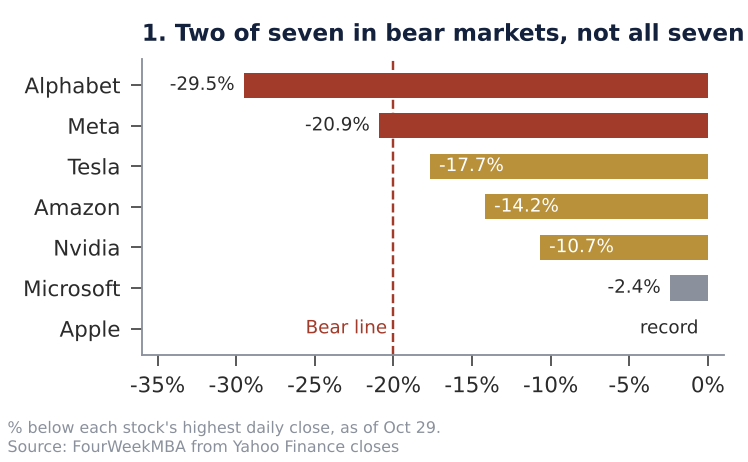
The index moves hide how uneven October was at the top. On closing prices, two of the seven largest technology stocks have fallen more than 20% from their highs, while another closed at a record. That split, not the index level, is what the rest of this issue reads as rotation.
How our view changed this issue
| Theme | Change this issue | Why |
|---|---|---|
| Rotation scenario (Axis 1) | Reassessed, weightings unchanged | The leaders are under distribution, the equal-weight S&P 500 rose four straight weeks and junk spreads tightened. |
| Debasement scenario (Axis 2) | Unchanged | A liquidation week in gold says nothing about it either way. |
| Canada-US sectoral deal | New this issue, weighted | Autos, steel and aluminum. Talks have intensified since the October 21 Trump-Carney call. |
| CUSMA outcome to 2036 | Weightings revised | A sectoral deal lifts the odds of extension but does not end the annual reviews. |
| US Senate control | Weighting added | Last issue said the Senate was closer than priced; this is our first number. Market pricing moved the other way. |
| Ukraine settlement path | Unchanged | The Kherson humanitarian truce held more than 80 hours, and President Zelensky says trilateral talks are agreed for November. |
| Gold, near-term view | Under review | The test we set, gold steadying while oil stayed high, failed. The forced selling has not visibly ended. |
| USD/CAD range through year-end | Unchanged, near the lower bound | 1.3974 after the Bank of Canada hike. A signed Canada-US deal is the catalyst that would break the floor. |
| European gas elevated through Q1 2027 | Unchanged | Not retested this week. Unrest over fuel costs argues it stays a political problem. |
| Crude easing before the midterms | Did not play out, closed | WTI settled at $104.12 on Friday and was just under $100 on Monday morning. The Hormuz premium outweighed returning supply. |
| Crude elevated through 2027 | Unchanged | Separate from the debasement scenario. About 1 billion barrels have been drawn from inventories since the war began, which is the 2027 case. |
The entries above describe how ArcStone Financial Pulse's own house view changed between issues. They are not ratings, recommendations, or price targets in respect of any security, and none should be inferred from them.
On the calendar
| Date | Event |
|---|---|
| Tue Nov 3 | US midterms; JOLTS |
| Wed Nov 4 | First read on Senate control |
| Thu Nov 5 | Canada Budget 2026 |
| Fri Nov 6 | US October payrolls |
| After Nov 3 | Iran: talks or resumed US strikes; Canada-US talks |
| November, TBD | US-Ukraine-Russia trilateral talks |
| Tue Nov 17 | France 2027 budget vote |
| Fri Nov 27 | S&P review of France |
On our radar
1. The vote: a Republican Senate, then a Canada deal
Our house view is that Republicans hold the Senate, weighted at 55% against market pricing, as reported, of 28%. The early vote looks a lot like 2022. In the states that register by party, Democrats cast 43.1% of the record 52.8 million early ballots to Republicans' 31.7%, close to a mid-campaign 2022 snapshot of 43% to 34%, and Republicans took the House that year. Republicans also lean toward voting on the day: only 6% of them say they will vote by mail, so more of their vote is still to come on Tuesday. And the polls have earned some doubt. Last month one pollster admitted fabricating surveys, and British Columbia's final polls missed the winning margin by about six points.
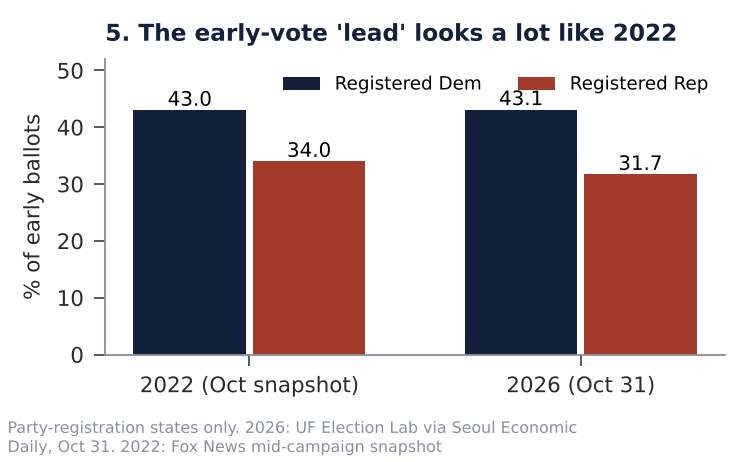
The one data point against us is Florida, where the early vote is running bluer than in 2022. Market pricing has also moved the other way this week, with Democrats' Senate odds rising from 66% to 72%. We would read a Republican Senate as tariffs and the fiscal agenda intact, with rates moving first.
For Canada, we now weight a sectoral deal on autos, steel and aluminum after the vote at 55% by the end of the first quarter. Ottawa's stated position is that it will wait for another administration if it has to, but no midterm result strips Trump's delegated tariff powers, so waiting stops paying on Wednesday. We think Ottawa is reading the early vote the same way we are. It re-engaged in the campaign's final two weeks, and its public line that it is not ready to sign is what you would say before a vote you cannot call. The talks have moved since the October 21 Trump-Carney call, and Reuters reports that a deal to ease tariffs on Canadian steel and autos is being worked.
A sectoral deal would not end CUSMA's annual reviews, so we only nudge our CUSMA weightings: extension or deal to 30% from 25%, standoff to 50% from 55%, termination unchanged at 20%. The first beneficiaries are the Windsor-to-Oshawa auto corridor and the loonie. USD/CAD sits at 1.3974 after the Bank of Canada's hike, near the floor of the range we have described, and a signed deal is the catalyst that would break it. Thursday's federal budget is Ottawa's chance to show which way it is leaning.
2. The rollover: the AI bill moves to shareholders
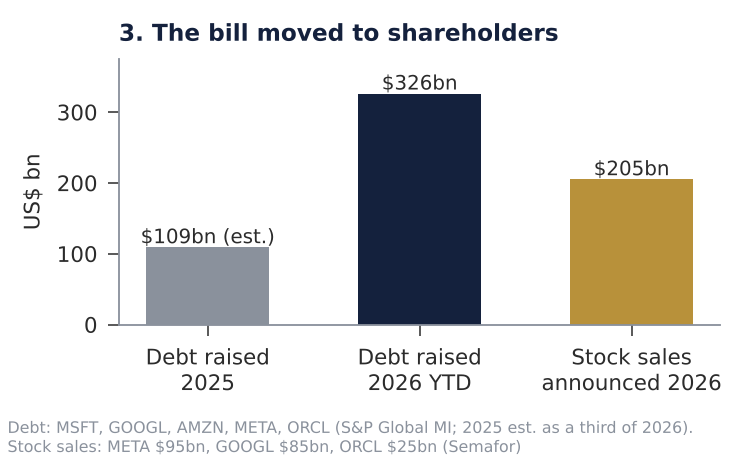
The AI debt problem we have tracked since August has spilled from the bond market into the stock market, and the companies themselves are the sellers. Meta launched a $95 billion stock sale last week, its first new shares since 2013, with chip makers lining up to take up to $5 billion of it. Alphabet and Oracle sold stock earlier in the year. All of that sits on top of $326 billion of debt the five biggest AI spenders have raised in 2026, about triple last year.
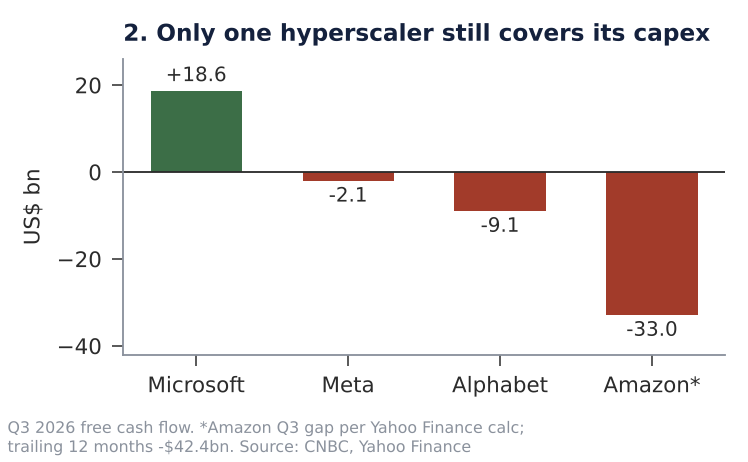
The reason is cash. Microsoft is now the only hyperscaler whose operating cash still covers its capex, and it says it will start borrowing too. Alphabet burned $9.1 billion in the quarter, more than three times what analysts expected, and its long-term debt has gone from $21.6 billion to $125 billion in a year.
When bond investors started charging more to insure Meta's debt, Meta turned to shareholders, and its credit spreads came back in. Junk-bond spreads also tightened on the week. Shareholders now carry the bill through dilution and years of new supply. That is distribution in the plainest sense: issuers selling new paper to the public. With chip makers buying their customer's stock, it is also a bigger version of the vendor-financing problem we raised in Issue No. 4. The second tier is paying too: cash-burn warnings are now arriving from outside the Magnificent Seven, which says the AI spend is squeezing more than the leaders. A company-by-company breakdown of who is funding whom belongs in a company-level piece, not a macro issue, so this stays at the mechanism level on purpose.
The leaders are rolling over, but the breadth points to our rotation scenario, with no sign yet of a 2000-style top. On closing prices, two of the Magnificent Seven are in bear markets, as the drawdown chart in the snapshot above shows, while Apple closed at a record on Thursday. Underneath them, the equal-weight S&P 500 rose for a fourth straight week. The Nasdaq lost 5.3% in October, its worst month since March 2025, while the Dow gained 1.7%, nine of eleven sectors rose and small caps were the only major index up this week. Money is leaving the leaders and moving down the cap scale into cyclicals. What would change our minds is credit. If junk-bond spreads widen alongside the equity selling, the credit-unwind scenario gets more weight. They tightened on the week but edged wider on Thursday, so that is the line we are watching.
3. The Hormuz bill: Europe, crude and gold
Europe's streets. The unrest reached Germany on Saturday. Organisers claimed 120,000 protesters across more than 30 cities; police in Berlin, Frankfurt and Munich counted up to 18,000. In Frankfurt, rioters threw Molotov cocktails and looted shops on the Zeil. France held a third weekend of protests on lower turnout, with 1,193 police officers injured since the protests began, and Italy, Spain and Portugal all saw demonstrations. The grievances rhyme: fuel, rent, schools, and in Germany compulsory military service.
Europe's spreads. Our read is that this is the Hormuz bill landing in Europe. Brent rose 13.6% in October, and Europe imports the energy North America produces. Governments facing the street will choose spending over consolidation, which is why the bond market matters more than the pictures. The extra yield France pays over Germany on 10-year debt reached 176bp on October 23, its widest since 2011, then eased to about 155bp after Moody's held France's rating.
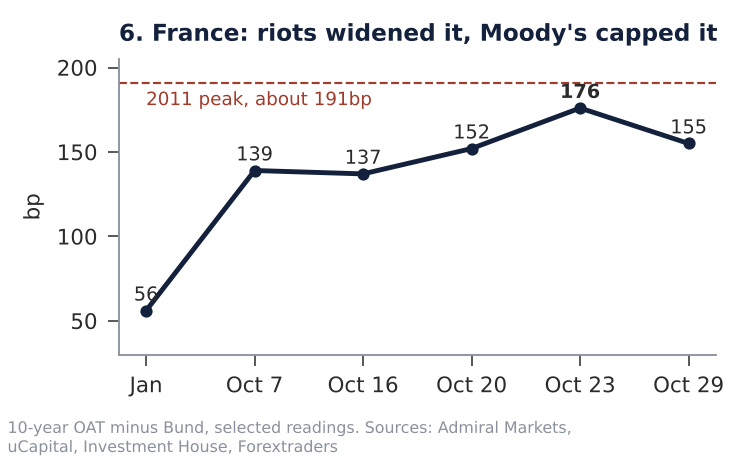
Moody's tied that rating to a 2027 budget, so the reprieve is conditional. The next tests are the November 17 budget vote and S&P's review on November 27. Our view stays that Europe cracks first.
Crude. Crude made the big move on Monday morning. Brent fell about 4% to roughly $108.50 and WTI slipped under $100 after Qatari mediators spent a third straight day in Tehran on a proposal to end the war. Nothing is agreed, Tehran wants the US blockade lifted first, and tankers were hit near the strait over the weekend. We read the drop as the market pricing a chance of peace while the shortage remains: about a billion barrels have come out of global inventories since the war began, which is why our view that crude stays elevated into 2027 is unchanged. Trump has said he will not strike before the vote, and the Wall Street Journal reported that he expects to resume afterwards, so Wednesday tells us which way this breaks. This is still an Asian and European supply problem first. The drop also came too late for our view that crude would ease materially before the midterms: WTI settled at $104.12 on Friday, and we have marked that view as closed in the change log.
Gold. We will own this one. Last issue we described gold's slide as forced selling, as in 2008, and expected that pressure to clear after the vote. It has not yet. Gold fell 3.3% on the week to about $3,880, a one-year low, and Friday's fall came on the month's heaviest volume, in lockstep with the Nasdaq. The test we set, gold steadying while oil stayed high, failed.
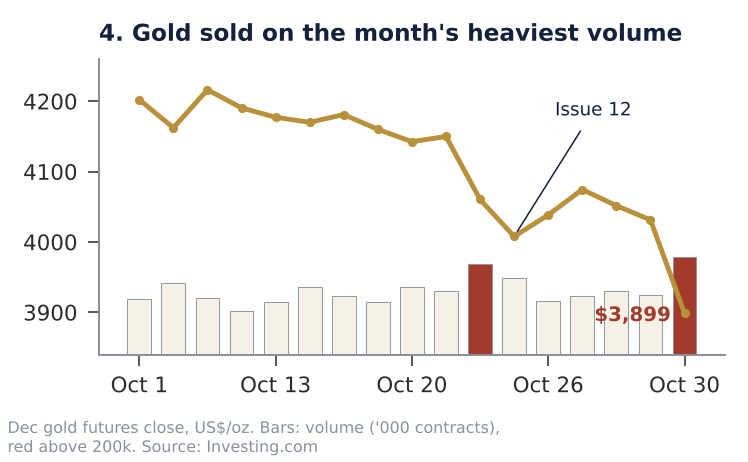
The flows split by geography. North American gold funds are selling, while European funds, Indian buyers and the Shanghai exchange are buying physical metal. Russia's central bank has also sold about 62 tonnes this year, a seller the bullish case rarely mentions. Our view remains that this is liquidation, and the signs that it has run its course would be calmer equities, US fund outflows stopping and December hike odds easing. We have seen none of those yet. In a forced-selling phase gold has traded with the Nasdaq rather than against it, so gold exposure currently carries equity drawdown risk alongside it. The debasement scenario is a separate view on its own clock, and this week does not change it.
The house framework, reassessed
Axis 1 asks what drives US equities from here. We reassessed it at month-end and held the weightings.
| Axis 1 scenario | House weighting | What we see now |
|---|---|---|
| Rotation | 60% | Leaders distributing, equal weight up four straight weeks, nine of eleven sectors up in October. |
| Valuation top | 25% | No sign yet of a 2000-style top; selling is concentrated in the leaders. |
| Credit unwind | 15% | Junk spreads tightened on the week but edged wider on Thursday. Widening alongside equity selling would add weight here. |
Axis 2 is the debasement scenario, weighted at 25-30% on an 18-month clock: a regime in which gold and oil reprice sharply higher. The two axes are independent and do not sum together. A liquidation week in gold says nothing about Axis 2 either way, and our separate view that crude stays elevated through 2027 rests on depleted inventories, not on debasement.
The political and trade weightings sit alongside the two axes:
| Event | House weighting | Context |
|---|---|---|
| Republicans hold the Senate | 55% | Market pricing as reported: 28%. First number this issue. |
| Canada-US sectoral deal on autos, steel and aluminum by end Q1 2027 | 55% | New this issue. |
| CUSMA to 2036: deal or extension / standoff / termination | 30 / 50 / 20 | From 25 / 55 / 20. |
The weightings above are ArcStone Financial Pulse's own house view as at the publication date. They are not market-implied probabilities, forecasts of any particular outcome, or targets.
What is still open
- Bonds and the Fed disagree. The 10-year yield fell 36bp in October while December hike odds stayed near 80%. One of them is wrong by year-end, and Friday's payrolls are the first test.
- Credit. Junk-bond spreads tightened on the week but edged wider on Thursday. Widening alongside the equity selling is the signal that would move weight toward the credit-unwind scenario.
- The Senate count. Florida's early vote is running bluer than in 2022, the one data point against our view. Wednesday gives the first read.
- Iran after the vote. Talks or resumed US strikes. Nothing is agreed, and the Wall Street Journal's report on post-vote strikes is unconfirmed.
- Ottawa's lean. Thursday's budget, and whether the reported steel and autos talks produce a signed text.
- France. The November 17 budget vote and S&P's November 27 review decide whether the reprieve on spreads holds.
- Ukraine. Whether the trilateral talks President Zelensky says are agreed for November actually convene.
- Gold. Whether US fund outflows stop and equities calm, the conditions that would mark the end of forced selling.
Disclosures
ArcStone Financial Pulse Inc. is owned by the same parent entity (ArcStone Securities and Investments Corp.) that owns ArcStone Securities, LLC. This common ownership, together with the joint operating relationship between ArcStone Securities, LLC and Kingswood Capital Partners, LLC under the ArcStone Kingswood DBA OSJ banner, represents a structural conflict of interest. Issuers referred to in ArcStone Financial Pulse content may be current or former clients of ArcStone or any of its subsidiaries and affiliates. Where ArcStone or its subsidiaries and affiliates have received or have been promised consideration for services provided to such an issuer, such consideration may include cash, stock, stock options, warrants, and/or Restricted Stock Units (RSUs) for the provision of corporate advisory, investor relations, digital media, or capital markets consulting services. This relationship represents a potential conflict of interest. The principals, directors, officers, employees, and related entities of ArcStone and its affiliates may, from time to time, own, buy, or sell securities or derivatives of such issuers or their affiliates.
The information contained herein is provided by ArcStone Financial Pulse Inc. ("ArcStone Financial Pulse"), a subsidiary of ArcStone Securities and Investments Corp. ("ArcStone"), for informational purposes only. It is not, and under no circumstances should it be construed as, an offer to sell or a solicitation of an offer to buy any securities or other financial instruments in any jurisdiction. This content is not a research report within the meaning of FINRA Rules 2241 or 2242 and does not constitute a research report under any applicable securities laws.
Certain statements contained herein may constitute "forward-looking statements" within the meaning of applicable Canadian and U.S. securities laws. Forward-looking statements are based on current expectations, estimates, and assumptions that involve known and unknown risks and uncertainties which may cause actual results or developments to differ materially from those expressed or implied. These statements often include words such as "anticipate," "believe," "expect," "intend," "may," "plan," "project," "should," "target," or similar expressions. Readers are cautioned not to place undue reliance on such statements, which speak only as of the date made. Except as required by law, ArcStone undertakes no obligation to update or revise any forward-looking information.
This content is not intended as investment advice or a recommendation to buy or sell any security and does not take into account the investment objectives, financial situation, or needs of any individual. Investors should consult their own professional advisors before making any investment decisions.
ArcStone Securities and Investments Corp. is not a registered broker-dealer and does not provide investment advice or recommendations. All registrable activities in the United States are conducted through ArcStone Securities, LLC (CRD# 306029) and/or Kingswood Capital Partners, LLC (CRD# 288898), both FINRA-registered broker-dealers, members SIPC. ArcStone Canada Inc. is not registered as a dealer in any Canadian jurisdiction; registrable dealing activities in Canada are conducted through appropriately registered affiliates.
ArcStone Kingswood is a DBA Office of Supervisory Jurisdiction (OSJ) of Kingswood Capital Partners, LLC (Member FINRA/SIPC) under which registered representatives of ArcStone Securities, LLC (Member FINRA/SIPC) and registered representatives of Kingswood Capital Partners, LLC conduct joint capital markets and investment banking activities. ArcStone Securities, LLC and Kingswood Capital Partners, LLC are parties to a written agreement governing the sharing of fees on transactions in which registered representatives of both firms participate. All securities transactions and investment banking services conducted by ArcStone are conducted exclusively through ArcStone Securities, LLC and/or Kingswood Capital Partners, LLC; "ArcStone Kingswood" itself is not a registered broker-dealer or separate legal entity.
Subject matter. This issue is general market commentary on: the November 3, 2026 US midterm elections and control of the US Senate; Canada-US negotiations toward a sectoral tariff arrangement covering autos, steel and aluminum, and the CUSMA review process; the financing of AI-related capital spending by large US technology companies through debt and new share issuance, and the related rotation within US equities; Federal Reserve and Bank of Canada policy; crude oil and gold price moves connected with the war involving Iran, the Strait of Hormuz and Qatari-mediated peace talks; and protests over fuel and living costs in Europe together with the France-Germany 10-year government bond spread.
Independence. The views in this commentary are ArcStone Financial Pulse Inc.'s own. They were not influenced by any investment banking, advisory or other business relationship of ArcStone or its affiliates, and no part of the compensation of anyone who prepared this commentary is tied to the views expressed in it.
No ratings. ArcStone Financial Pulse Inc. operates no rating system, maintains no coverage universe and publishes no distribution of ratings. The entries in 'How our view changed this issue' and the weightings in 'The house framework, reassessed' (the Axis 1 and Axis 2 scenario weightings and the weightings on US Senate control, a Canada-US sectoral deal and the CUSMA outcome) are ArcStone Financial Pulse's own house view about macro, political and trade outcomes. They are not ratings, recommendations or price targets in respect of any security. The Senate figure of 28% and the December hike odds of about 80% are market pricing as reported, not ArcStone views.
Affiliate sector exposure. ArcStone Canada Inc. and other affiliates of ArcStone Financial Pulse Inc. may have, or may seek, advisory or other business relationships with issuers in sectors discussed in this commentary, including energy (crude oil and natural gas), mining (including gold), technology and semiconductors, and the autos, steel and aluminum sectors referred to in the Canada-US trade discussion.
Third parties cited. This commentary cites no named third-party economic forecaster. It refers to market pricing of US Senate control and of a December Federal Reserve rate increase, and to analysts' expectations for Alphabet's quarterly cash flow, none of which is attributed to a named provider. It reports news coverage by Reuters (Canada-US steel and autos talks) and the Wall Street Journal (expected timing of US strikes on Iran), a rating decision on France by Moody's, a scheduled review of France by S&P, and statements by President Zelensky of Ukraine.
Price basis and as-of date. Market levels are as at the Friday, October 30, 2026 close unless stated. Brent, WTI and gold are also given at indicative Monday morning, November 2, 2026 levels where labelled. Seven-stock drawdowns are as of October 29, 2026; early-vote data are as of October 31, 2026; the France-Germany spread of about 155bp is the October 29, 2026 reading. All levels were carried from the source document prepared for this issue and have not been independently re-verified by ArcStone Financial Pulse Inc.
Charts. Figure 1 plots each of seven large US technology stocks' percentage decline from its highest daily close, as of October 29, 2026 (FourWeekMBA from Yahoo Finance closes). Figure 2 plots Q3 2026 free cash flow for Microsoft, Meta, Alphabet and Amazon; Amazon's Q3 figure is a Yahoo Finance calculation (CNBC, Yahoo Finance). Figure 3 plots debt raised by Microsoft, Alphabet, Amazon, Meta and Oracle in 2026 year to date (S&P Global MI) and stock sales announced in 2026 (Semafor); its 2025 debt bar of about $109bn is an estimate set at one third of the 2026 figure, not a reported total, and is the only estimated point in the six charts. Figure 4 plots December gold futures daily closes and volume from October 1 to October 30, 2026 (Investing.com); its $3,899 close is a futures price and differs from the approximate gold levels quoted in the text. Figure 5 compares party-registration early-vote shares as of October 31, 2026 (UF Election Lab via Seoul Economic Daily) with an October 2022 mid-campaign snapshot (Fox News). Figure 6 plots selected readings, not a continuous series, of the French 10-year OAT spread over the German Bund from January to October 29, 2026; the 2011 peak line of about 191bp is approximate (Admiral Markets, uCapital, Investment House, Forextraders).
As-reported figures and unverified items. Company cash flow, debt raised, long-term debt and stock sale amounts, early-vote counts and shares, protest attendance, police injury counts, Russian central bank gold sales of about 62 tonnes and the drawdown of about 1 billion barrels from global oil inventories are as reported by third parties and are not ArcStone calculations. Protest attendance differs between organisers (120,000) and police (up to 18,000) and neither figure is verified. The Reuters report of a Canada-US steel and autos deal being worked and the Wall Street Journal report that US strikes on Iran are expected to resume after the vote are unconfirmed reports, and the agreement of trilateral US-Ukraine-Russia talks rests on President Zelensky's statement.
No company named in this commentary is a current or former client of ArcStone or any of its subsidiaries and affiliates, and no consideration has been paid or promised to ArcStone or any of its subsidiaries or affiliates in connection with this commentary. Companies are named only to report their own scheduled reporting dates or publicly observable market data, and no view is expressed on their securities.
Sources: Market levels for US equity indices, US 10-year yield, junk-bond spreads, USD/CAD, Brent and WTI: as of Friday, October 30, 2026 close, with Monday morning, November 2, 2026 indications for Brent, WTI and gold where stated; underlying data providers not named in the source document; FourWeekMBA from Yahoo Finance closes: drawdowns from highest daily close for seven large US technology stocks, as of October 29, 2026; CNBC and Yahoo Finance: Q3 2026 free cash flow for Microsoft, Meta, Alphabet and Amazon, including Yahoo Finance's calculation of Amazon's Q3 and trailing 12-month figures, Q3 2026 reporting; S&P Global MI: debt raised by Microsoft, Alphabet, Amazon, Meta and Oracle, 2026 year to date; Semafor: stock sales announced in 2026 by Meta, Alphabet and Oracle, 2026; Investing.com: December gold futures daily closes and volume, October 1 to October 30, 2026; UF Election Lab via Seoul Economic Daily: party-registration early-vote shares, October 31, 2026; Fox News: 2022 mid-campaign early-vote snapshot, October 2022; Admiral Markets, uCapital, Investment House, Forextraders: France-Germany 10-year spread readings, January to October 29, 2026; Reuters: report on Canada-US talks on steel and autos tariffs, before publication; date not stated in the source document; Wall Street Journal: report on expected timing of US strikes on Iran, before publication; date not stated in the source document; Moody's: decision to hold France's rating, October 2026.
© 2026 ArcStone Financial Pulse Inc. All rights reserved. May be redistributed in full and unaltered with attribution.