Two Fronts: A Tariff War Opens as Warsh Resets the Rate Path
Talks with Washington collapsed into live Section 338 tariffs, and one Jackson Hole speech moved September hike odds 20 points in a session. We reduce the debasement weighting, and separate oil from LNG.
Week of August 31, 2026. Issue No. 4.
ArcStone View
Two stories did all the work: the Canada and United States trade file went from suspended talks to a live tariff war, and the Federal Reserve's first Jackson Hole speech under Chair Warsh repriced the rate path in a single session. A production issue held last week's edition back, so this one covers both weeks.
Since last issue: what actually moved
- Canada and the United States: talks collapsed on August 21 and 22 with no resumption planned before the U.S. midterms. Section 338 tariffs took effect August 22. Canada's retaliatory package, up to 50% on roughly 700 U.S. goods worth about $20B, is set for September 8.
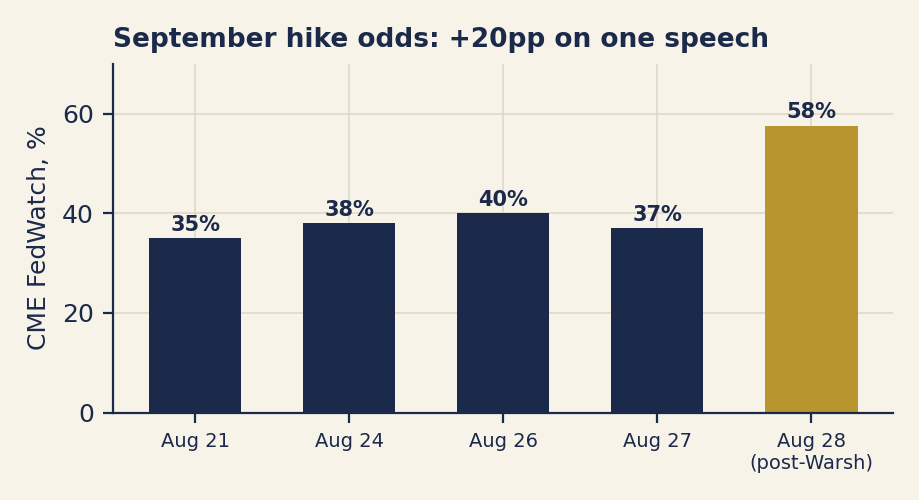
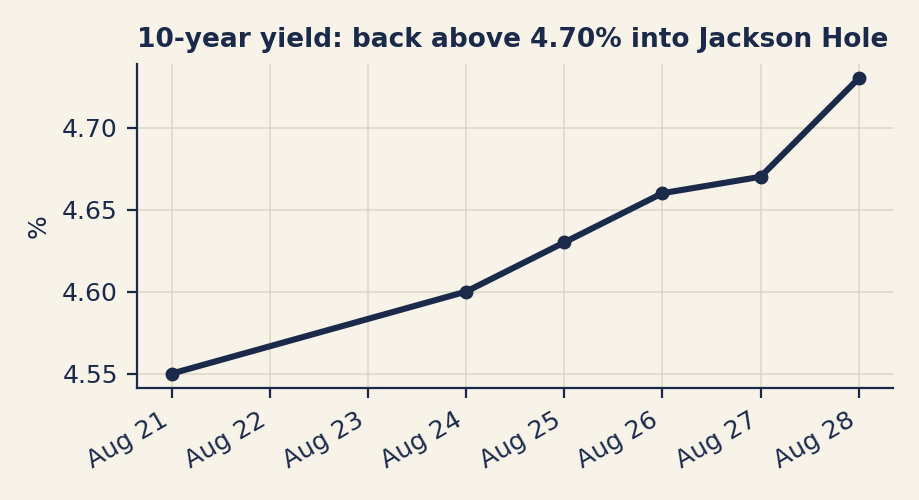
- The Fed: Warsh's August 28 Jackson Hole speech was read hawkish. September hike odds jumped from roughly 35% to 57.5% on the CME FedWatch tool. The 10-year yield rose from 4.55% to 4.73%, breaking a multi-year technical ceiling on the way. Gold fell 3.2% on Friday alone.
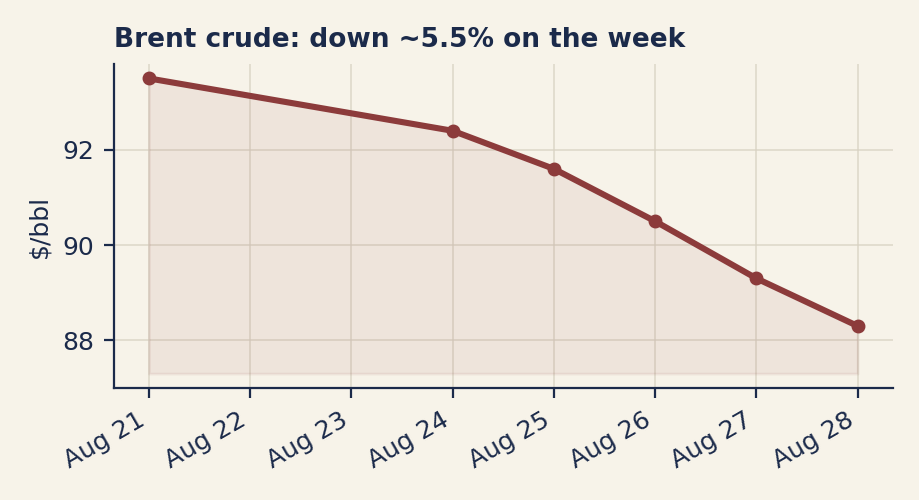
- Oil and gas: Brent fell over 5% on the week to roughly $88, helped by Hormuz bypass capacity coming online through Saudi and Iraqi pipeline expansions, even as QatarEnergy extended its LNG force majeure into October. Oil and LNG are decoupling: pipelines bypass Hormuz, LNG tankers cannot.
- Venezuela, the same trade: on August 28 Trump announced a deal granting the United States majority control of 65 billion barrels of Venezuelan oil across 17 fields on a 100-year lease. It is a direct, long-duration competitor for the Gulf Coast heavy-sour refining capacity Canadian WCS depends on. We fold it into the Canada and United States section this issue rather than treating it as a separate story.
- Japan: Treasury Secretary Bessent defended last month's yen intervention in a letter to Senator Warren, stating that Treasury swapped existing ESF euro holdings for yen with no credit extended to Japan. Separately, Japan itself spent a record $96.4B in the past month defending the currency.
- AI capex mechanism: Nvidia's second quarter, reported August 26, showed days sales outstanding jumping from 45 to 60 in one quarter as it extends financing to weaker AI buyers, the same mechanism Cisco ran in 2000. Not broken yet. Detail below.
Reassessment: a single speech does not reverse a structural debt trajectory, but it does raise the near-term cost of holding the debasement position. We reduce that weighting this issue. See the house framework below.
Market snapshot
| S&P 500~7,700Flat on the week | 10Y UST4.73%Up 18bp on the week | Gold$4,435Down 3.2% Friday | Brent$88.3Down 5.5% on the week |
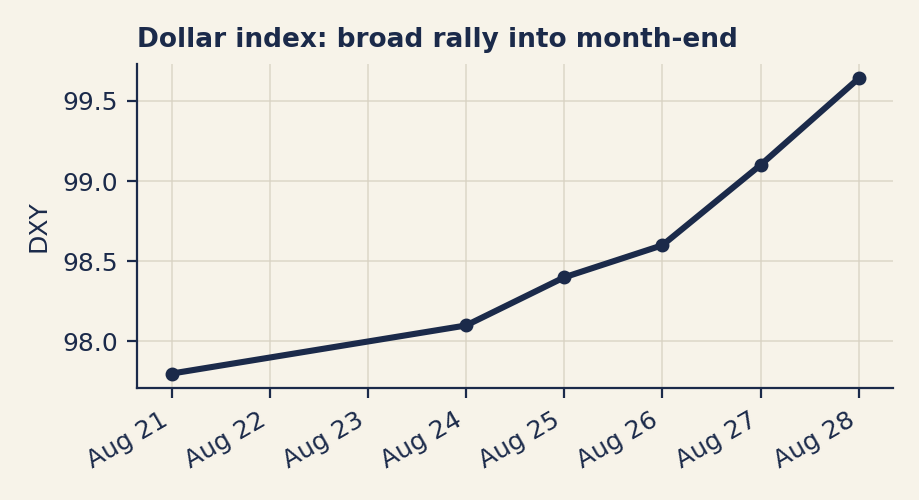
| DXY99.6Up 1.9 on the week | WCS discount>19%Widening | IG OAS74bpsUnmoved | HY OAS278bpsUnmoved |
Levels are as at Friday, August 28, 2026 unless stated. The WCS discount is an ArcStone estimate.
How our view changed this issue
| Theme | Change this issue | Why |
|---|---|---|
| Debasement scenario | Weighting reduced | A hawkish Fed repricing is a real headwind to gold and replacement-currency positioning over the next four to eight weeks. The 18-month structural clock is unchanged. |
| AECO and Western Canada gas | Unchanged, timeline under review | We would not lean the near-term case on a persistent Gulf LNG premium. WCSB oversupply remains the dominant driver of AECO pricing regardless of Hormuz headlines. |
| Canada and U.S. sector exposure | Unchanged | Wood products remain outside core Section 338 exposure. Auto parts sit under Section 232, not 338. |
| Section 338 legal risk | New this issue, monitoring | An untested statute now generating roughly $20B in cross-border retaliation. Litigation risk is real and, on our read, not obviously reflected anywhere. |
| WCS and oil sands leverage | New this issue, structural | Venezuela's 65 billion barrel, 100-year, majority U.S.-owned arrangement is a long-duration substitute for the same Gulf Coast coking slate WCS depends on. It weakens Canada's energy leverage independent of the tariff headlines. |
| Oil and LNG divergence | New this issue, treat separately | Genuine pipeline bypass capacity through Saudi Arabia, Iraq and the UAE supports oil staying lower even with Hormuz risk elevated. LNG has no pipeline bypass and stays exposed. Oil's decline should not be read as LNG de-risking. |
| AI capex financing | New this issue, monitoring | Days sales outstanding jumped from 45 to 60 in one quarter, concentrated in non-hyperscaler buyers. The Cisco-shaped risk sits in the marginal customers, not the blue-chip ones. We watch next quarter's print. |
The entries above describe how ArcStone Financial Pulse's own house view changed between issues. They are not ratings, recommendations, or price targets in respect of any security, and none should be inferred from them.
On the calendar
September 8: Canada's retaliatory tariffs take effect. September 15 and 16: FOMC meeting, with the decision and dot plot on September 16 at 2pm ET. October, date to be confirmed: QatarEnergy's extended force majeure window closes. November 3: U.S. midterms, the earliest plausible marker for renewed Canada and United States talks.
On our radar
Two stories moved everything this cycle. Here is the full read on both, plus the framework updates they drove.
1. Canada and the United States: the tariff war, and the leverage problem behind it
Talks are over, not paused. LeBlanc and Charette met Greer on August 21 to find a compromise before the extended deadline. It did not happen. Carney suspended negotiations, recalled Canada's team, and let the Section 338 tariffs take effect at midnight on August 22.
The rate is 50%, and the coverage is narrower than the headline suggests. The duties hit dairy, alcohol, and motor vehicles specifically, plus a wider annex covering hockey equipment, cement, furniture, wine, and clothing. Steel, aluminum, energy, potash, and critical minerals were carved out. The White House frames this as a response to what it calls discriminatory Canadian practices on autos, provincial liquor-board restrictions, and dairy supply management.
Canada's response is calibrated to match, not escalate. On August 25, Ottawa announced retaliatory tariffs of 15% to 50% on more than 700 U.S. goods worth roughly $20B, effective September 8. Steel and aluminum tariffs double to 50%. The stated logic is dollar-for-dollar parity, not asymmetric retaliation. Carney also announced a $7.5B domestic support package for affected businesses and workers.
No off-ramp is currently scheduled. USTR Greer told Fox News on August 22 that no further talks are planned. Carney's own language has hardened, describing the U.S. action as a conflict rather than a negotiation. Our base case is a multi-month standoff running at least into the U.S. midterms on November 3, not a near-term resolution.
There is a second shoe. Trump has separately said tariffs on Canadian cars, trucks, auto parts, and steel will rise to 50% from January 1, 2027, layering a further escalation onto an already-live dispute. That threat sits outside the current Section 338 framework and needs its own tracking line.
Sector exposure, reconfirmed
| Sector | Names | Status | Note |
|---|---|---|---|
| Wood and panel products | West Fraser, Canfor, Interfor | Excluded, core business | Core softwood lumber sits under the separate AD/CVD regime, not Section 338. Interfor states that neither Section 338 nor Section 301 applies to its lumber business. |
| Machinery and auto parts | Linamar, Magna | Excluded, Section 232 not 338 | Auto parts sit under Section 232. Linamar management states that over 90% of revenue is unaffected by the current tariff structure. |
| Packaging | Cascades | Confirmed, named target | Cascades has publicly assessed its Section 338 exposure. |
| Furniture, textiles, cement | Dorel, Gildan, Lafarge Canada | Category confirmed | Named annex categories. Company-level revenue exposure still requires disclosure-level verification. |
Companies are named above only to report the tariff category their own public disclosure places them in. No view is expressed on their securities.
The other pressure point: Venezuela
The tariff fight is not the only place Canada's energy leverage is being tested, and it belongs in this section rather than a separate one. On August 28, Trump announced a deal granting the United States majority control of 65 billion barrels of Venezuelan oil reserves across 17 fields, negotiated with acting president Delcy Rodriguez's government. The structure, as announced, is a new private company, 55% of effective U.S. output, a 100-year lease, and rights to buy oil at cost. Caracas puts the numbers at $100B in investment and $209B in tax revenue over the life of the deal. We have checked the figures against wire coverage and they are accurate as announced.
Section 338's carve-out for Canadian energy reflects today's dependency, not a permanent structural advantage. Venezuelan heavy sour crude, Merey and Boscan, and Canadian heavy sour, WCS, compete for the same slate of U.S. Gulf Coast coking refineries. A Venezuelan supply relationship anchored by U.S. ownership and running a century reduces that dependency over time. That is the exact leverage Canada is counting on holding in the broader trade dispute.
The growth numbers are not speculative. Chevron's Venezuelan joint ventures grew production 15% over six months to 280,000 barrels per day, per its own CFO, with a stated target of 420,000 barrels per day by the end of 2028. Rystad's independent and more conservative base case still projects national output up 194,000 barrels per day, about 17%, between the fourth quarter of 2025 and the fourth quarter of 2028, with international operators supplying roughly two thirds of that growth. Two different sources, same direction.
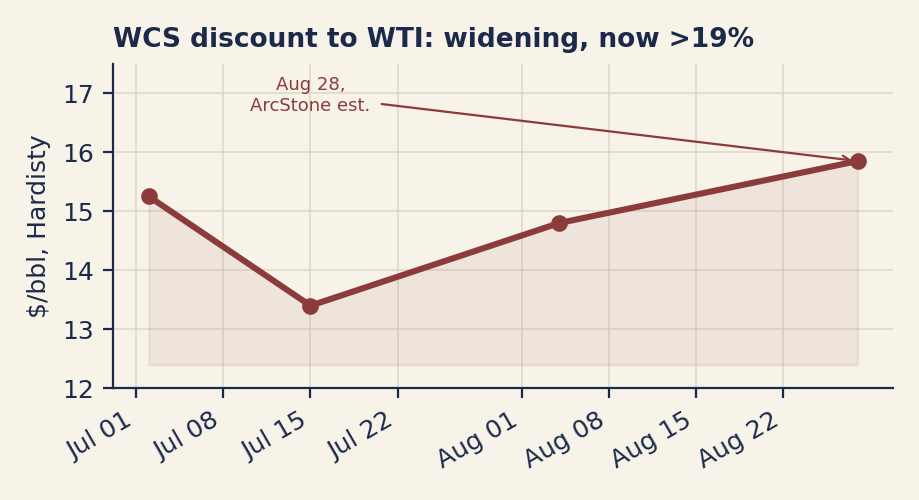
The WCS discount is already moving. WCS at Hardisty settled $14.80 per barrel below WTI on August 4, wider than a tighter print earlier in July, and the discount now sits above 19% on our estimate. More Venezuelan barrels reaching Gulf Coast cokers is a structural headwind to that differential, not a cyclical one. Canada has no offset, because the crude is landlocked and egress is capped.
Same trade, two fronts. Washington's negotiating position with Canada does not need to soften as long as an alternative heavy-oil relationship is being built in parallel. On our read that is a structural argument for accelerating Canadian egress capacity, including TMX expansion and further Enbridge Mainline capacity, rather than a cyclical one tied to this week's tariff headlines.
2. The repricing trade: Warsh, Japan, and the oil and LNG split
Warsh's first Jackson Hole speech as chair carried weight precisely because he has stopped telegraphing. The July FOMC vote was 9 to 3 to hold, with three dissents in favour of an immediate hike. Warsh withheld his own dot at the June SEP. Going into Friday, markets genuinely did not know where his baseline sat.
He did not deliver forward guidance, and the market treated the absence of dovish language as guidance anyway. Warsh said this summer's better inflation readings do not tell him that underlying trends have meaningfully improved, and explicitly pushed back on the idea that the Fed should validate whatever path markets are pricing. July headline PCE ran 3.7% year over year, above the 3.6% consensus and still well above target.
The reaction was fast and broad-based. September hike odds jumped from roughly 35% to 57.5% on the CME FedWatch tool. The 2-year yield rose nearly 8 to 12 basis points intraday depending on the print, the 10-year finished the week at 4.73%, and gold fell 3.2% on the day, its sharpest single-session drop since the rally began.
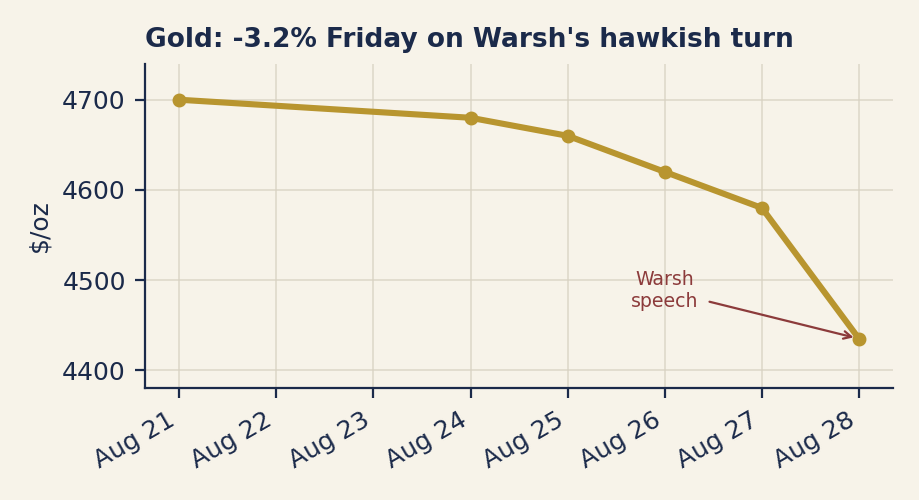
There is a second rates story this week, and it belongs to Japan rather than the Fed. Bessent defended last month's yen intervention in a letter to Senator Warren, stating that Treasury swapped its own euro holdings for yen with no new credit to Tokyo. The more decision-relevant number is that Japan itself spent a record $96.4B in the past month defending the currency. That is meaningful fiscal strain on the country holding more U.S. Treasuries than any other, and it is exactly the kind of data point that keeps the structural debasement case alive even while the near-term position takes a hit from Warsh.
Oil moved the other way this week, and for a different reason. Brent fell over 5% to the high $88s, driven less by Fed dynamics than by continued normalization of Gulf flows and bypass capacity coming online. Three pipelines are doing the work. Saudi Arabia's East-West line to Yanbu is adding 2 million barrels per day on top of its existing 7 million. Iraq has just reopened its line to Turkey at 250,000 barrels per day. The UAE's Habshan to Fujairah line never touches the strait at all. The IEA puts total bypass capacity at 3.5 to 5.5 million barrels per day, a meaningful offset to the roughly 15 million barrels per day of crude that normally transits Hormuz, though not a full substitute for it. Persian Gulf exports themselves have recovered to 15 to 16 million barrels a day, up from a March low of 5 to 6 million but still below the pre-conflict 22 to 24 million range.
One claim we are flagging rather than repeating: a single U.S. commentary outlet has reported satellite imagery of a newly dredged shipping corridor in Omani waters. There is no confirmation from the White House, the U.S. military, or Oman. Treat it as unverified until it is confirmed.
The gas side of that story has not caught up, and there is a physical reason it will not catch up the same way oil has. Pipelines can route around Hormuz. LNG cannot. It has no route but by tanker, and Qatar has no pipeline to anywhere. QatarEnergy extended its LNG force majeure into October, later than the August to September window the market had been expecting, and notified Pakistani and Bangladeshi buyers that cargo cancellations will continue. Oil and LNG are decoupling for a structural reason rather than a temporary one, and that split is now wide enough that treating them as a single Gulf risk is a mistake.
What this means. The Fed's hawkish turn is a genuine near-term headwind for the debasement scenario, and we reduce that weighting this issue rather than pretending one speech does not matter. It does not touch the structural argument, which runs on its own 18-month clock independent of any single data print, and Japan's record intervention spend this week is a fresh data point supporting that structural case even as the near-term weighting comes down. On oil and gas, we keep the two commodities separate: pipeline capacity supports oil staying lower, while LNG stays exposed with no equivalent bypass. For AECO-exposed producers, including Pine Cliff Energy, neither the oil decline nor the LNG delay should be treated as the dominant driver next to the Western Canada egress and oversupply dynamics that have set AECO pricing for most of the past two years. ArcStone Canada Inc. is engaged by Pine Cliff Energy on a paid basis; see Disclosures.
The house framework, reassessed
Two independent axes, as always: the near-term regime, which sums to 100%, and the debasement tail, which runs on its own 18-month clock and can unfold under any near-term outcome.
| Axis 1: near-term regime | Weighting | Notes |
|---|---|---|
| Rotation continues | 55% | Down 5 points. Credit has not budged, with IG at 74bp and HY at 278bp, and equities are still near records, but a hawkish Fed removes one tailwind the rotation case leaned on. |
| Valuation-led pullback | 28% | Up 3 points. A 20 point swing in hike odds off one speech is exactly the kind of repricing risk this scenario is built around, and the 10-year has just broken a multi-year technical ceiling on the way there. |
| Credit-driven unwind | 17% | Up 2 points. Still the low-probability tail. We watch September's heavy post-summer issuance calendar as the first real test. |
Axis 2, the debasement tail: 22% to 25%, reduced from 25% to 30%. The structural case, which rests on Treasury buyback expansion, the long-run debt trajectory, central-bank gold accumulation, and now Japan's record $96.4B monthly currency-defense spend, has not changed and does not run on a weekly clock. What changed is the near-term cost of carrying the position. A Fed that hikes into 2027 works directly against gold and any dollar-debasement exposure over the next two to three months, even if it does not touch the 18-month view. We separate the structural case being intact from the next eight weeks being an attractive point to add, which on our read they are not.
The weightings above are ArcStone Financial Pulse's own house view as at the publication date. They are not market-implied probabilities, forecasts of any particular outcome, or targets.
The technical case behind the pullback scenario
The valuation-pullback scenario now has a chart behind it, not just a rate-repricing story. The 10-year has been building a multi-year symmetric triangle since mid-2026, with resistance clustering around 4.56% to 4.6%. This week's move to 4.73% is the first close through that ceiling. On a confirmed breakout the pattern's measured move points materially higher, toward roughly 5%, with more aggressive counts pointing further still. These are chart-pattern measured moves on a government bond yield, not forecasts and not targets.
Layer on the debt-service math. Volcker needed fed funds near 20% to break 1970s inflation. Total federal debt is a different order of magnitude relative to GDP today, north of $40 trillion, so a far smaller and more sustained move in yields can produce comparable financial-system stress now. Core PCE at 3.3% is not the 1970s peak, and the drivers are different, being services and AI capex rather than oil shocks and wage spirals, so we treat the overlay as a pattern match worth tracking rather than a mechanical repeat. It is the technical confirmation sitting behind the 28% weighting, not the Fed's hawkish turn on its own.
The mechanism behind the multiple
If a valuation-led pullback does happen, Nvidia's second-quarter fiscal 2027 numbers, reported August 26, show where the pressure point would sit. Revenue hit $96.2B, up 106% year over year, while days sales outstanding jumped from 45 to 60 in a single quarter and receivables rose to $63.1B from $38.5B. Free cash flow fell by more than half on higher revenue. None of this is improper accounting, and revenue on shipment is standard and disclosed.
It is the same mechanism Cisco ran in 2000: the vendor extends terms so buyers can keep buying faster than their own cash flow supports, and the balance sheet quietly absorbs the credit risk the income statement does not show. The distinction that matters is that the extension is concentrated in non-hyperscaler buyers with weaker balance sheets rather than the largest cloud platforms, and that weaker tier is where the Cisco-shaped risk actually sits. It has not broken the way Cisco's channel did in 2001. We watch DSO next quarter. A customer-by-customer breakdown belongs in a company-level piece, not a macro issue, so this stays at the mechanism level on purpose.
What is still open
Five items need tracking rather than resolving this issue. None of them changes this issue's view, and any of them could change the next one.
- Section 338 legal challenge: expected, with no filed timeline yet.
- Canada's September 8 list: the $20B figure and the 15% to 50% range are Ottawa's own announcement, not yet a line-by-line schedule.
- The Venezuela deal's own gaps: the private operator taking the U.S. stake has not been named, and there is no disclosed ratification timeline through Venezuela's own institutions.
- The Oman dredging-corridor claim: sourced to a single U.S. commentary outlet, with no official confirmation.
- Nvidia's DSO print next quarter: it tells us whether this quarter's jump to 60 days was a one-time reset or the start of a trend.
Disclosures
ArcStone Financial Pulse Inc. is owned by the same parent entity (ArcStone Securities and Investments Corp.) that owns ArcStone Securities, LLC. This common ownership, together with the joint operating relationship between ArcStone Securities, LLC and Kingswood Capital Partners, LLC under the ArcStone Kingswood DBA OSJ banner, represents a structural conflict of interest. Issuers referred to in ArcStone Financial Pulse content may be current or former clients of ArcStone or any of its subsidiaries and affiliates. Where ArcStone or its subsidiaries and affiliates have received or have been promised consideration for services provided to such an issuer, such consideration may include cash, stock, stock options, warrants, and/or Restricted Stock Units (RSUs) for the provision of corporate advisory, investor relations, digital media, or capital markets consulting services. This relationship represents a potential conflict of interest. The principals, directors, officers, employees, and related entities of ArcStone and its affiliates may, from time to time, own, buy, or sell securities or derivatives of such issuers or their affiliates.
The information contained herein is provided by ArcStone Financial Pulse Inc. ("ArcStone Financial Pulse"), a subsidiary of ArcStone Securities and Investments Corp. ("ArcStone"), for informational purposes only. It is not, and under no circumstances should it be construed as, an offer to sell or a solicitation of an offer to buy any securities or other financial instruments in any jurisdiction. This content is not a research report within the meaning of FINRA Rules 2241 or 2242 and does not constitute a research report under any applicable securities laws.
Certain statements contained herein may constitute "forward-looking statements" within the meaning of applicable Canadian and U.S. securities laws. Forward-looking statements are based on current expectations, estimates, and assumptions that involve known and unknown risks and uncertainties which may cause actual results or developments to differ materially from those expressed or implied. These statements often include words such as "anticipate," "believe," "expect," "intend," "may," "plan," "project," "should," "target," or similar expressions. Readers are cautioned not to place undue reliance on such statements, which speak only as of the date made. Except as required by law, ArcStone undertakes no obligation to update or revise any forward-looking information.
This content is not intended as investment advice or a recommendation to buy or sell any security and does not take into account the investment objectives, financial situation, or needs of any individual. Investors should consult their own professional advisors before making any investment decisions.
ArcStone Securities and Investments Corp. is not a registered broker-dealer and does not provide investment advice or recommendations. All registrable activities in the United States are conducted through ArcStone Securities, LLC (CRD# 306029) and/or Kingswood Capital Partners, LLC (CRD# 288898), both FINRA-registered broker-dealers, members SIPC. ArcStone Canada Inc. is not registered as a dealer in any Canadian jurisdiction; registrable dealing activities in Canada are conducted through appropriately registered affiliates.
ArcStone Kingswood is a DBA Office of Supervisory Jurisdiction (OSJ) of Kingswood Capital Partners, LLC (Member FINRA/SIPC) under which registered representatives of ArcStone Securities, LLC (Member FINRA/SIPC) and registered representatives of Kingswood Capital Partners, LLC conduct joint capital markets and investment banking activities. ArcStone Securities, LLC and Kingswood Capital Partners, LLC are parties to a written agreement governing the sharing of fees on transactions in which registered representatives of both firms participate. All securities transactions and investment banking services conducted by ArcStone are conducted exclusively through ArcStone Securities, LLC and/or Kingswood Capital Partners, LLC; "ArcStone Kingswood" itself is not a registered broker-dealer or separate legal entity.
This commentary has been prepared and published by ArcStone Financial Pulse Inc. ("ArcStone Financial Pulse") for informational purposes only. It addresses economic, monetary, trade, currency, commodity and asset-allocation conditions generally, specifically the Section 338 tariff dispute between Canada and the United States, the repricing of September Federal Reserve rate expectations following the August 28, 2026 Jackson Hole speech, the announced United States and Venezuela oil arrangement, and the divergence between crude oil and LNG markets around the Strait of Hormuz. Nothing here constitutes an offer, solicitation, or recommendation to buy or sell any security, commodity, or instrument, nor investment, legal, tax, or accounting advice, and it is not tailored to the investment objectives, financial situation, or needs of any individual.
The views expressed have not been influenced by any pending or existing investment banking, advisory, or distribution relationship, and no part of any preparer's compensation is tied to the views expressed.
This commentary assigns no rating, recommendation, or price target in respect of any security, and none should be inferred from any statement, chart, table, or figure in it. ArcStone Financial Pulse maintains no rating system, no coverage universe, and no distribution of ratings. The scenario weightings described under "The house framework, reassessed", the entries under "How our view changed this issue", and the references to a rotation base case and to a longer-dated debasement scenario, reflect ArcStone Financial Pulse's house view as at the publication date and are not market-implied probabilities, forecasts of any particular outcome, or targets. The technical levels described for the 10-year U.S. Treasury yield are chart-pattern measured moves on a government bond yield, described to explain the house scenario weighting, and are not forecasts, targets, or recommendations in respect of any security.
Client relationships and consideration. Pine Cliff Energy Ltd. is named in this commentary and is a current client of ArcStone Canada Inc., an affiliate of ArcStone Financial Pulse Inc. Under an engagement letter for capital markets advisory services effective August 24, 2026 through November 24, 2026, Pine Cliff Energy Ltd. pays ArcStone Canada Inc. a fixed, non-contingent fee of CA$10,000 per month, with no success fee. That fee expressly includes the client's participation in an ArcStone Canada Inc. conference in Toronto in September 2026 and a separate ArcStone Financial Pulse report on the client. No additional or separate consideration has been paid or promised to ArcStone Financial Pulse Inc. or any of its affiliates in connection with this commentary or with the mention of Pine Cliff Energy Ltd. in it. This is a conflict of interest, and readers should assume ArcStone has an economic incentive in respect of that issuer. No other company named in this commentary is a current or former client of ArcStone or any of its subsidiaries and affiliates. West Fraser, Canfor, Interfor, Linamar, Magna, Cascades, Dorel, Gildan, Lafarge Canada, Chevron, QatarEnergy, Enbridge and Nvidia are named only to report their own public disclosure, their own reported results, or publicly observable market data, and no view is expressed on their securities.
ArcStone Financial Pulse Inc. is affiliated with entities that provide advisory and capital markets services to issuers, including issuers in the energy and oil and gas, natural gas, precious metals, copper and critical minerals, potash and fertilizer, and uranium and nuclear sectors discussed in this commentary, and those entities receive fees for those services. This commentary does not recommend, and is not intended to promote, any issuer to which ArcStone or its affiliates provide services.
This commentary contains forward-looking statements and forecasts, including the third-party views and projections of Chevron Corporation management, Rystad Energy, and the International Energy Agency as cited, and the scenario framing described above, which reflects ArcStone Financial Pulse's house view and not a market-implied distribution. These involve significant risk and uncertainty and actual results may differ materially. Unless otherwise stated, all index, yield, currency, metals and energy levels are as at Friday, August 28, 2026. The September rate-expectation chart plots CME FedWatch implied probabilities for the September 2026 FOMC meeting on August 21, 24, 26, 27 and 28, 2026. The gold, 10-year Treasury yield, Brent crude and dollar index charts each plot daily values from August 21 to August 28, 2026. The Western Canadian Select chart plots the WCS discount to WTI at Hardisty in U.S. dollars per barrel from July 1 to August 28, 2026; the final August 28, 2026 point is an ArcStone estimate and not a settled assessment, and the "above 19%" figure quoted in the text is likewise an ArcStone estimate. All other figures, including rate-expectation probabilities, credit spreads, PCE inflation, Nvidia's reported results, Venezuelan production and reserve figures, Japanese intervention spending, and Hormuz transit and bypass volumes, are as reported by the sources cited and are not ArcStone Financial Pulse calculations. The satellite-imagery claim regarding a dredged corridor in Omani waters is expressly identified in the text as unverified and is reported as an unconfirmed single-source claim, not as fact. Past performance is not indicative of future results. Commodity, currency and securities prices are volatile and subject to rapid change from factors outside ArcStone Financial Pulse's control.
Sources: Office of the United States Trade Representative and Fox News (statements on the suspension of talks, August 22, 2026); Government of Canada announcements on Section 338 retaliatory measures and domestic support (August 25, 2026); White House announcements on Section 338 tariffs (August 22, 2026) and on the United States and Venezuela oil arrangement (August 28, 2026); Federal Reserve Chair Kevin Warsh, Jackson Hole remarks (August 28, 2026); U.S. Bureau of Economic Analysis July PCE release; CME FedWatch (September 2026 meeting probabilities, August 21 to 28, 2026); U.S. Department of the Treasury correspondence to Senator Warren on yen intervention, and reported Japanese Ministry of Finance intervention totals; NVIDIA Corporation second-quarter fiscal 2027 results (reported August 26, 2026); Chevron Corporation management commentary on Venezuelan joint-venture production; Rystad Energy (Venezuelan output projections, fourth quarter 2025 to fourth quarter 2028); International Energy Agency (Strait of Hormuz bypass capacity); QatarEnergy force majeure notifications; company disclosure from Interfor, Linamar and Cascades on tariff exposure; and wire coverage of the Venezuela announcement. Data as at August 28, 2026 unless otherwise noted.
© 2026 ArcStone Financial Pulse Inc. All rights reserved. May be redistributed in full and unaltered with attribution.