Winter Is Coming, and Europe Just Lost Its Hormuz Workaround
Week of September 21, 2026. Issue No. 7.
ArcStone View
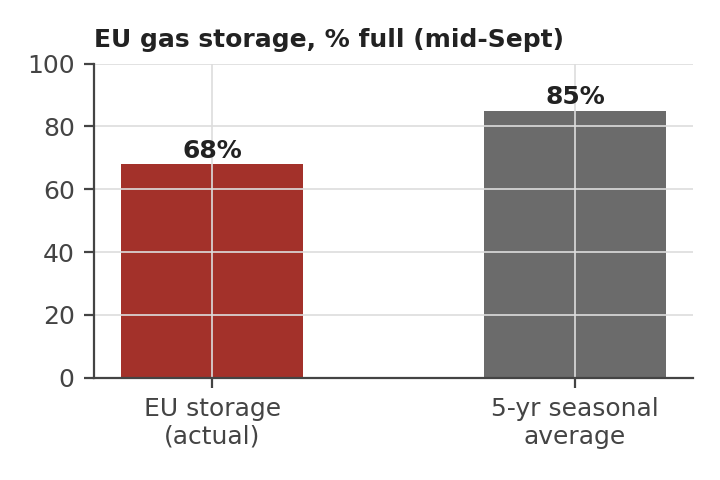
- 68%. That's Europe's gas storage heading into winter, against an 80% target and a seasonal average that's 16 to 20 points higher.
- Zero. That's the crude Aramco just told European refiners they'll get in October, after the East-West pipeline, the Hormuz bypass we covered building out in Issue No. 4, was struck and shut.
- $500B. That's what Carney's Investment Summit landed in committed capital this week, on the way to a stated $1 trillion, five-year target.
- 16 of 18. That's how many Fed officials still see another hike this year, even after delivering one Wednesday.
Since last issue: what actually moved
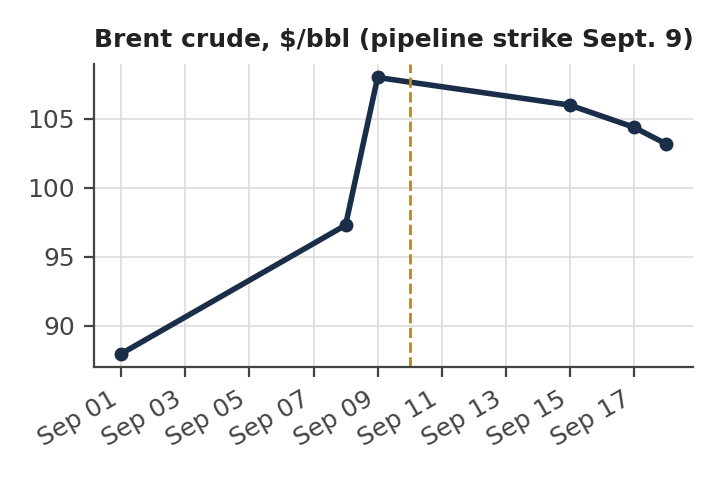
- Saudi Arabia's East-West pipeline, the Hormuz bypass built specifically to route crude around the strait, was struck and shut September 9. Aramco has told European refiners they'll get zero crude in October.
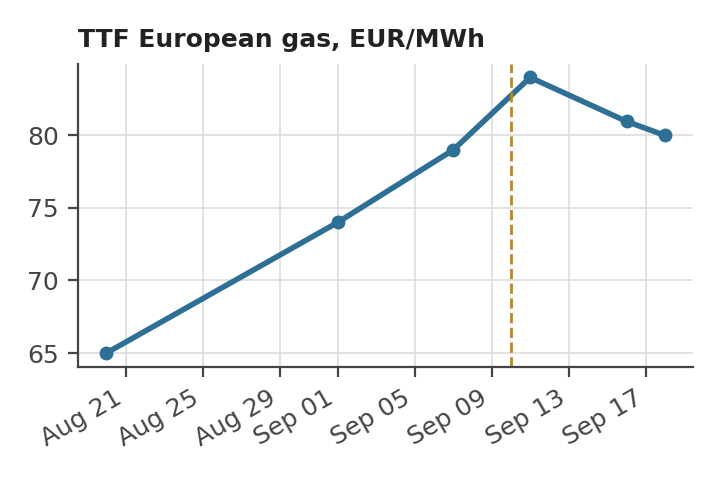
- Europe's gas storage sits around 68% full, 16 to 20 points below normal, with TTF near €80/MWh and Qatar's LNG force majeure now extended into November.
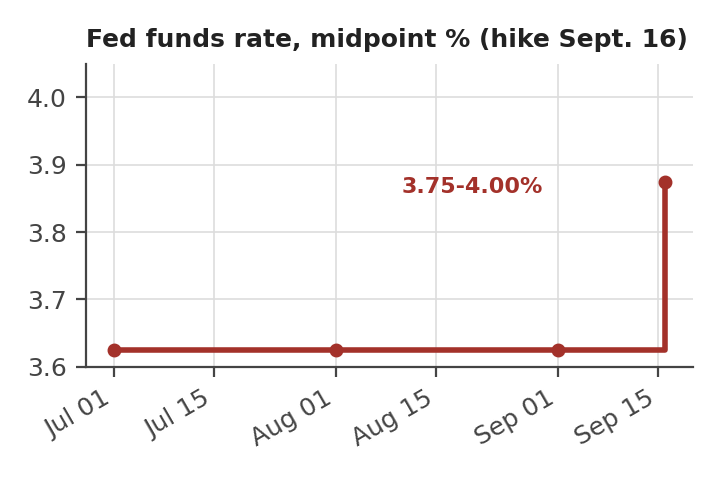
- The Fed hiked 25bp to 3.75-4.00% Wednesday, unanimous, with 16 of 18 officials projecting another hike this year.
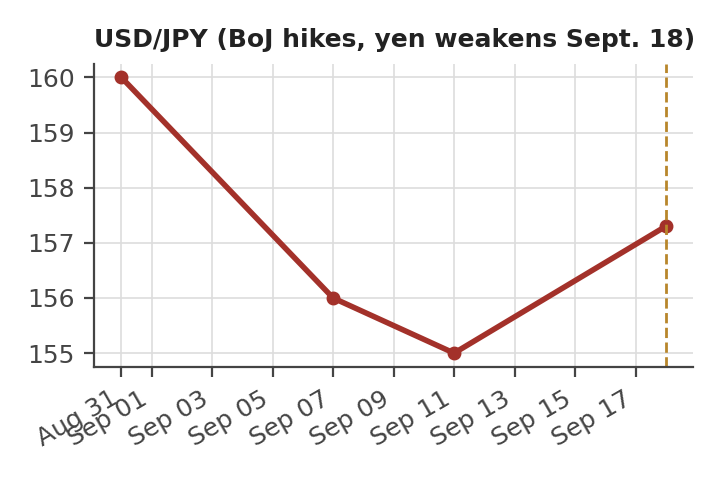
- The BoJ hiked 25bp to 1.25%, a 31-year high, but split 7-2; the yen weakened past 157 rather than extending its gain.
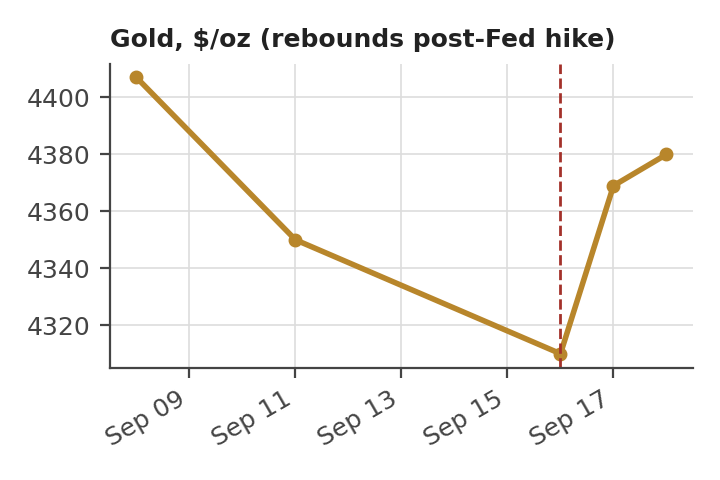
- Gold rallied to about $4,380, its best week in a month, as yields corrected and oil eased after the Fed decision.
- Canada's Investment Summit landed roughly $500 billion in committed capital toward Carney's $1 trillion, five-year target.
Market snapshot
| TTF gas€80.97/MWh+25% MTDNear 2022 highs; September peak was €84 | EU gas storage68%-17pp vs avgGermany lowest at ~56% |
| Brent crude$103-3% wkPipeline strike Sept. 9, partial workaround since | Fed funds3.75-4.00%+25bpFirst hike since 2023; 16 of 18 see another |
| BoJ rate1.25%+25bp31-yr high, split 7-2 vote | Gold$4,380+2% wkBest week in a month, post-hike rebound |
| USD/JPY~157+1% wkWeakened despite BoJ hike on split vote | USD/CAD~1.387flat wkOil and Summit inflows offsetting Fed-BoC gap |
Levels are as at Friday, September 18, 2026. Change windows vary by data availability and are week over week unless noted (TTF is month to date; storage is against the seasonal average). Figures are as reported in the source material and have not been independently verified.
How our view changed this issue
Nothing in the standing house view moves this week. The Fed and BoJ hikes were priced, not a regime surprise. Full weightings are reassessed at month-end rather than every issue.
| Theme | Change this issue | Why |
|---|---|---|
| European gas stays structurally elevated through Q1 2027 65-70% weighting, new | New this issue | The bear case needs Qatar's force majeure to lift and a mild winter at the same time; the bull case needs only one of those two to fail. See On our radar. |
| Debasement tail scenario, 18-month clock 25-30% weighting (Axis 2, structural) | Unchanged | Gold's rally this week tells us nothing about the debasement thesis that its decline didn't already argue against last issue. A rate-driven bounce over a few sessions is not evidence either way. |
| Fed and BoJ rate path | Unchanged | Both decisions landed close to the base case we set out last issue, each with one wrinkle: a hawkish dot plot at the Fed, a split vote at the BoJ. |
| CUSMA and the Canadian dollar | Unchanged | The Investment Summit turns Canada's diversification from a stated preference into a funded one, but leaves the CUSMA standoff itself untouched. |
The entries above describe how ArcStone Financial Pulse's own house view changed between issues. They are not ratings, recommendations, or price targets in respect of any security, and none should be inferred from them. The weightings above are ArcStone Financial Pulse's own house view as at the publication date. They are not market-implied probabilities, forecasts of any particular outcome, or targets.
Tracking, not weighting: BoC Governor Macklem speaks Monday, Xi's state visit to the US begins Thursday alongside a cluster of central bank decisions, and Moody's and Scope Ratings review the EU and Italy Friday. NATO's elevated Baltic and eastern-flank readiness, plus US intelligence reportedly flagging possible Russian testing this fall, adds another live risk to the same week. None of these moves the house view yet; all are worth watching for spillover into it.
On the calendar: week of September 21
| Date | Event | Impact |
|---|---|---|
| Mon 21 | BoC Governor Macklem speaks. Germany reportedly planning a 14-cent-per-litre gasoline tax cut. | Medium |
| Tue-Wed 22-23 | US ADP employment, global flash PMIs. The Fed's Williams, Jefferson and Barkin all speak. | Medium |
| Thu 24 | Xi's state visit to the US begins. Riksbank, SNB, Norges Bank and Banxico all decide on rates the same day. | High |
| Fri 25 | Moody's and Scope Ratings review the EU and Italy. US durable goods. | Medium |
On our radar
1. Winter is coming, and Europe just lost its workaround
Saudi Arabia's East-West pipeline, the Hormuz bypass we described building out back in Issue No. 4, was struck by drone attacks on September 9 and shut down entirely. The pipeline carried up to 7 million barrels a day specifically so Saudi crude could reach the Red Sea without transiting the Strait of Hormuz. Aramco has now told European refiners, including Poland's Orlen, that they'll receive zero crude in October. A canceled month, not a delayed one.
The pipeline was the workaround. The problem it was built to work around hasn't gone anywhere: the Strait of Hormuz remains largely closed to commercial shipping, with only a handful of vessels tracked transiting most days against dozens in a normal month. Qatar's LNG exports, the supply Europe leaned on hardest after 2022, are still under force majeure tied to conflict damage, cutting capacity by roughly 17% and now extended into November. Scheduled maintenance on Norwegian gas facilities is trimming pipeline flows to Europe at the same time, for an entirely unrelated reason. Three supply chains, three unrelated causes, hitting in the same month.
The numbers show the squeeze. European gas storage sits around 68% full, 16 to 20 points below the seasonal average and short of the EU's own 80% target for December, with Germany the most exposed at roughly 56%. TTF gas is trading near €80 per megawatt-hour, close to its highest since 2022.
Standard Chartered's framing of the winter is the useful one. Its bear case, around €50, needs both Qatar to normalize and a mild winter at the same time. Its bull case, up to €210, needs only one of those to fail. Oil, oddly, eased into the weekend: Brent slipped from a four-month high near $106 to about $103 as traders priced in Saudi workarounds, ship-to-ship transfers moving crude around the strait, and word that Aramco expects to restore roughly half the pipeline's flow soon. That's a genuine easing at the margin. It doesn't change what Europe's refiners were just told about October.
Ukraine adds a second front to the same squeeze. The country's own generating capacity has fallen from roughly 38 gigawatts before the invasion to around 14 today, and domestic gas production is down close to 60% after repeated strikes on Naftogaz facilities. Kyiv now needs roughly 30% more gas imports to get through winter, drawn from the same regional pool that's already 16 to 20 points short. Russia's Defense Ministry has signaled plans for what it calls a response to Ukrainian strikes, timed for a season when Ukraine is down to roughly a third of its Patriot interceptor stock. None of this is new in kind. What's new is the timing: landing on top of the Hormuz and Saudi disruption rather than instead of it.
NATO's own posture belongs alongside this story. The alliance has run a continuous, elevated eastern-flank readiness posture since Russian drones and aircraft violated NATO airspace in September 2025, an open-ended operation it hasn't maintained since the Cold War. The Wall Street Journal reported in August that US intelligence flagged a possible limited Russian incursion this fall, and Baltic leaders have warned about risk to critical infrastructure tied to the European power grid, the same grid this issue's gas story is stretching thin. Baltic intelligence assessments this month call an actual incursion unlikely near-term given Russia's manpower constraints in Ukraine; the risk they flag instead is miscalculation in an already crowded environment, and Moscow has a documented history of getting that calculation wrong.
The comparison to 2022 is the one everyone reaches for, and it undersells this year. In 2022, gas was the shock, with oil, fiscal policy and Asian demand slack as offsets. This time gas, crude, diesel and wholesale power are all under pressure at once, and two of those offsets, oil supply and Asian LNG slack, are compromised too. Spain has already doubled its diesel tax cut; Germany is reportedly planning a 14-cent fuel tax cut of its own. The fiscal response that helped in 2022 is starting again, which tells you how policymakers are already reading this one.
There's a beneficiary in this: North American manufacturing. Energy reliability and cost have become the top site-selection factor for new industrial investment, ahead of labor and tax incentives, and that was true before this week's pipeline strike widened the gap further. A European manufacturer facing €80 gas, with Standard Chartered's bull case at €210 this winter, is looking at a very different calculus than a plant sited in Texas or Ontario. The reshoring wave already underway on CHIPS Act money, tariffs and China-decoupling gets a second tailwind from an energy-cost gap that's opening on its own.
2. The central banks did what they said, and Canada cashed a check
Both decisions we flagged last issue landed close to the base case, each with one wrinkle. The Fed hiked 25bp to 3.75-4.00% Wednesday, unanimous at 12-0; the harder part is what comes next, with 16 of 18 officials projecting at least one more hike this year, four projecting two, and markets pricing October odds between 53% and 60%. That's the hawkish dot-plot scenario we flagged as the bigger risk to financing-sensitive equities. The 10-year eased about 5bp right after the decision rather than spiking, a fully priced hike removing more uncertainty than conviction.
The BoJ hiked 25bp to 1.25%, a 31-year high, and delivered the disappointment scenario instead of the confirmation one. The vote split 7-2, with two dissents against a hike markets had priced at close to 89% consensus. USD/JPY, which had already run from 160 to the mid-150s pricing in the hike, weakened back past 157 on the split vote rather than extending its gain. Bessent's public pressure got Tokyo to move, but not with conviction, and the yen traded that gap rather than the headline.
Gold did something that looked backward: it rallied on the hike, up to roughly $4,380 by Friday, its best week in a month, as yields corrected lower and oil eased at the same time. We're applying the same discipline here that we applied last issue when gold fell: a rate-driven bounce over a few sessions doesn't tell us anything about the structural debasement case any more than the decline did. The thesis stays where it was, a 25-30% weighting on an 18-month clock, unmoved by either week's price action.
Canada's Investment Summit produced a hard number this time. Carney's government came away with close to $500 billion in committed capital toward a $1 trillion, five-year target: roughly $100 billion from pension and institutional investors, $325 billion in new bank financing commitments, and over $14 billion from investment funds, including a $4 billion AI-focused vehicle from Radical Ventures. That's the diversification theme we've been tracking since the CUSMA addendum, turning from a stated preference into a funded one, even though it leaves the CUSMA standoff itself untouched.
The Summit's own prospectus flagged East Coast LNG as well positioned to serve exactly the European demand this issue is about, and that's not wrong, but it's also not close to built. Every tonne of Canada's roughly 50 million tonnes of committed LNG capacity sits on the Pacific coast; the East Coast has zero operating export terminals, and every proposal keeps hitting the same wall: moving Western Canadian gas several thousand kilometres to the Atlantic costs more than the economics can bear without a new pipeline nobody has committed to build. The nearest practical answer, per an opinion piece that ran this week, may not be a new-build at all: Repsol's existing Saint John, New Brunswick terminal was built to import gas nobody needs anymore, and converting it to export would skip the pipeline problem that has killed every prior East Coast proposal. It's smaller than the $23 billion transcontinental pitches on the table, but it doesn't need a decade or a pipeline route that doesn't exist yet.
Disclosures
ArcStone Financial Pulse Inc. is owned by the same parent entity (ArcStone Securities and Investments Corp.) that owns ArcStone Securities, LLC. This common ownership, together with the joint operating relationship between ArcStone Securities, LLC and Kingswood Capital Partners, LLC under the ArcStone Kingswood DBA OSJ banner, represents a structural conflict of interest. Issuers referred to in ArcStone Financial Pulse content may be current or former clients of ArcStone or any of its subsidiaries and affiliates. Where ArcStone or its subsidiaries and affiliates have received or have been promised consideration for services provided to such an issuer, such consideration may include cash, stock, stock options, warrants, and/or Restricted Stock Units (RSUs) for the provision of corporate advisory, investor relations, digital media, or capital markets consulting services. This relationship represents a potential conflict of interest. The principals, directors, officers, employees, and related entities of ArcStone and its affiliates may, from time to time, own, buy, or sell securities or derivatives of such issuers or their affiliates.
The information contained herein is provided by ArcStone Financial Pulse Inc. ("ArcStone Financial Pulse"), a subsidiary of ArcStone Securities and Investments Corp. ("ArcStone"), for informational purposes only. It is not, and under no circumstances should it be construed as, an offer to sell or a solicitation of an offer to buy any securities or other financial instruments in any jurisdiction. This content is not a research report within the meaning of FINRA Rules 2241 or 2242 and does not constitute a research report under any applicable securities laws.
Certain statements contained herein may constitute "forward-looking statements" within the meaning of applicable Canadian and U.S. securities laws. Forward-looking statements are based on current expectations, estimates, and assumptions that involve known and unknown risks and uncertainties which may cause actual results or developments to differ materially from those expressed or implied. These statements often include words such as "anticipate," "believe," "expect," "intend," "may," "plan," "project," "should," "target," or similar expressions. Readers are cautioned not to place undue reliance on such statements, which speak only as of the date made. Except as required by law, ArcStone undertakes no obligation to update or revise any forward-looking information.
This content is not intended as investment advice or a recommendation to buy or sell any security and does not take into account the investment objectives, financial situation, or needs of any individual. Investors should consult their own professional advisors before making any investment decisions.
ArcStone Securities and Investments Corp. is not a registered broker-dealer and does not provide investment advice or recommendations. All registrable activities in the United States are conducted through ArcStone Securities, LLC (CRD# 306029) and/or Kingswood Capital Partners, LLC (CRD# 288898), both FINRA-registered broker-dealers, members SIPC. ArcStone Canada Inc. is not registered as a dealer in any Canadian jurisdiction; registrable dealing activities in Canada are conducted through appropriately registered affiliates.
ArcStone Kingswood is a DBA Office of Supervisory Jurisdiction (OSJ) of Kingswood Capital Partners, LLC (Member FINRA/SIPC) under which registered representatives of ArcStone Securities, LLC (Member FINRA/SIPC) and registered representatives of Kingswood Capital Partners, LLC conduct joint capital markets and investment banking activities. ArcStone Securities, LLC and Kingswood Capital Partners, LLC are parties to a written agreement governing the sharing of fees on transactions in which registered representatives of both firms participate. All securities transactions and investment banking services conducted by ArcStone are conducted exclusively through ArcStone Securities, LLC and/or Kingswood Capital Partners, LLC; "ArcStone Kingswood" itself is not a registered broker-dealer or separate legal entity.
This commentary has been prepared and published by ArcStone Financial Pulse Inc. ("ArcStone Financial Pulse") for informational purposes only. It addresses economic, monetary, energy, commodity and currency conditions generally, specifically the September 9, 2026 strike on Saudi Arabia's East-West pipeline and its effect on European crude and gas supply heading into winter, European gas storage and TTF gas prices, Ukraine's energy position and NATO's eastern-flank posture, the September 2026 rate decisions of the U.S. Federal Reserve and the Bank of Japan, the gold price, and Canada's Investment Summit and East Coast LNG export options. Nothing here constitutes an offer, solicitation, or recommendation to buy or sell any security, commodity, or instrument, nor investment, legal, tax, or accounting advice, and it is not tailored to the investment objectives, financial situation, or needs of any individual.
The views expressed have not been influenced by any pending or existing investment banking, advisory, or distribution relationship, and no part of any preparer's compensation is tied to the views expressed.
This commentary assigns no rating, recommendation, or price target in respect of any security, and none should be inferred from any statement, chart, table, or figure in it. ArcStone Financial Pulse maintains no rating system, no coverage universe, and no distribution of ratings. The weightings and entries under "How our view changed this issue", including the European gas weighting and the debasement tail scenario, reflect ArcStone Financial Pulse's house view as at the publication date and are not market-implied probabilities, forecasts of any particular outcome, or targets.
Client relationships and consideration. No company named in this commentary is a current or former client of ArcStone or any of its subsidiaries and affiliates, and no consideration has been paid or promised to ArcStone or any of its subsidiaries or affiliates in connection with this commentary. Saudi Aramco, Orlen, Naftogaz, Standard Chartered, The Wall Street Journal, Moody's, Scope Ratings, Radical Ventures and Repsol are named only to report their own public disclosure, published views, reporting, or publicly observable market data, and no view is expressed on their securities.
ArcStone Financial Pulse Inc. is affiliated with entities that provide advisory and capital markets services to issuers, including issuers in the energy, oil and gas, natural gas and precious metals sectors discussed in this commentary, and those entities receive fees for those services. This commentary does not recommend, and is not intended to promote, any issuer to which ArcStone or its affiliates provide services.
This commentary contains forward-looking statements and forecasts, including the third-party winter gas price scenarios of Standard Chartered as cited, and the scenario framing described above, which reflects ArcStone Financial Pulse's house view and not a market-implied distribution. These involve significant risk and uncertainty and actual results may differ materially. Market levels are as at September 18, 2026 as reported in the source material, and have not been independently verified by ArcStone Financial Pulse. The Brent chart plots selected Brent crude observations from September 1 to September 18, 2026. The TTF chart plots selected TTF European gas observations from August 20 to September 18, 2026. The storage chart compares EU gas storage in mid-September 2026 with the five-year seasonal average. The Fed funds chart plots the midpoint of the target range from July 1 to September 16, 2026. The USD/JPY chart plots selected observations from August 31 to September 18, 2026. The gold chart plots selected gold price observations from September 8 to September 18, 2026. Data sources for the chart series are not stated in the source material, and none of the charts contains an ArcStone Financial Pulse estimate. Figures including pipeline capacity, Hormuz transit counts, Qatari LNG capacity loss, gas storage levels, Ukrainian generating capacity and gas production, Fed projections and market-implied rate odds, BoJ vote and pricing, Investment Summit commitments, and Canadian LNG capacity are as reported by the sources cited and are not ArcStone Financial Pulse calculations. Reports that Germany is planning a fuel tax cut, that U.S. intelligence flagged a possible Russian incursion, and that Aramco expects to restore roughly half the pipeline's flow are as reported and have not been independently verified. Past performance is not indicative of future results. Commodity, currency and securities prices are volatile and subject to rapid change from factors outside ArcStone Financial Pulse's control.
Sources: Saudi Aramco communications to European refiners, as reported (September 2026); QatarEnergy force majeure notifications (as extended into November 2026); EU gas storage data (mid-September 2026); ICE TTF gas prices (to September 18, 2026); Standard Chartered winter gas scenarios (September 2026); The Wall Street Journal (August 2026); Baltic intelligence assessments (September 2026); U.S. Federal Reserve FOMC statement and Summary of Economic Projections (September 16, 2026); Bank of Japan monetary policy decision (September 18, 2026); Government of Canada Investment Summit announcements (September 2026); opinion commentary on Saint John, New Brunswick LNG conversion (September 2026); central bank and economic calendars for the week of September 21, 2026.
© 2026 ArcStone Financial Pulse Inc. All rights reserved. May be redistributed in full and unaltered with attribution.