Three Premiums, One Week: Oil, AI and Ottawa's Deficit

Week of November 9, 2026. Issue No. 14.
ArcStone View
Oil lost its war premium and AI lost its growth premium, and gold took the money. Brent fell 16% in its worst week since 2020. Washington's politics, not a deal with Tehran, took out the premium, and the physical shortage is still there. The Nasdaq had its worst day in 19 months, down 5.5% on AI regulation risk and a China chip probe. The Dow, though, lost under 1% for the week, and the money went to metals rather than cash. Gold rose 4.6%, its best week since August, off a one-year low. In Ottawa, a government sold as fiscally conservative tabled a C$62.3 billion deficit for 2026-27, bigger than any Trudeau deficit outside the pandemic. It landed a week after the Bank of Canada's first hike since 2023, and most of the improvement since April is an oil windfall that just shrank.
Since last issue: what actually moved
- Senate: our view was wrong. We had weighted Republicans holding the Senate at 55%, and Democrats flipped seven seats. A midterm penalty on this scale is familiar: Clinton in 1994 and Obama in 2010 took similar hits, and both won second terms. What matters now is the market read, covered under On our radar.
- Oil: a miss by one day. Our pre-vote scenario had WTI settling below US$90 before November 3. It settled at US$96.09 that day and US$88.12 the next. We had the right direction and the right catalyst but the wrong date, so it goes in the book as a miss.
- Canada-US deal: open. Washington says a deal is close. Ottawa says the midterms do not change its approach and that some US demands have been dropped. Nothing is signed.
- Ukraine deal: open. Working-level trilateral talks are set for November 10-11 in Abu Dhabi. There is no ceasefire, and Russia stepped up strikes on Kyiv ahead of the talks.
- Standing weightings: unchanged. The rotation and debasement weightings are unchanged, and rotation got stronger evidence this week. A full recap of the weightings follows at month-end.
Market snapshot
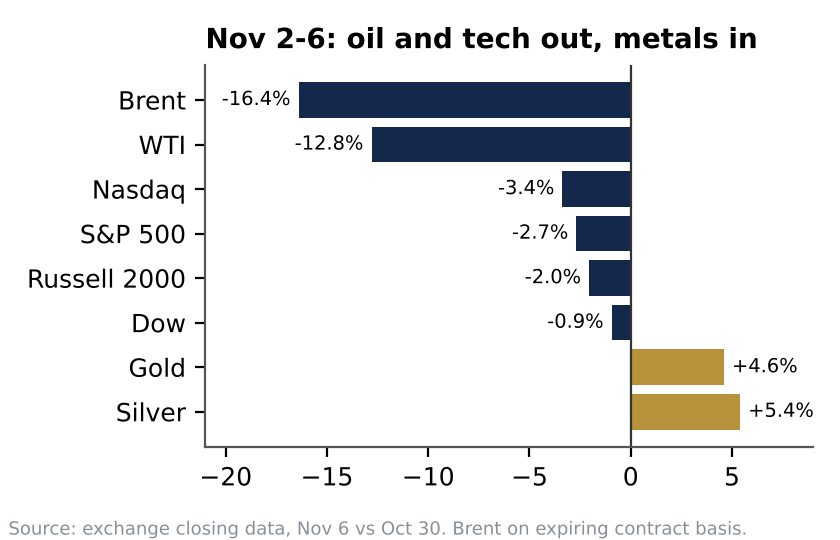
Oil and technology led the declines on the week, the broader indices fell less, and gold and silver gained.
| S&P 5007,376.86-2.7% on the week | Nasdaq24,579-3.4% on the week | US 10-year4.86%-8bp on the week | Dec Fed hike~75%Priced in futures |
| Brent$98.32-16% on the week | WTI$90.83-13% on the week | Gold~$4,075+4.6% on the week | Canada jobless6.7%October, from 6.5% |
Levels are as at the close on Friday, November 6, 2026 unless stated, with weekly changes measured against Friday, October 30. Gold and the December Fed hike pricing are approximate. Brent's weekly change runs from the expiring December contract to the January contract. No figure in the dashboard is an ArcStone estimate.
How our view changed this issue
| Theme | Change this issue | Why |
|---|---|---|
| Rotation over a valuation top (Axis 1) | Unchanged, evidence strengthened | Thursday's selling hit the AI leaders. The Dow held, and metals took the flows. |
| Debasement scenario (Axis 2) | Unchanged | A softer Fed path and pressure on the yen help the case. |
| Pre-vote oil scenario | Closed: a miss by one day | WTI settled US$96.09 on November 3 and US$88.12 on November 4, a day late. |
| Structural oil tightness into 2027 | Unchanged | US distillate stocks are the lowest since 2003, and the Strategic Petroleum Reserve is the lowest since 1982. |
| US Senate control | Closed: our weighting was wrong | It was a familiar midterm penalty. The market impact runs through oversight, not policy. |
| Gold, short-term tactical view | Closed this issue | The forced selling we described in October appears to have run its course. Gold rose about 4.6% on the week. |
| Canada-US deal after the midterms | Unchanged, still open | Talks continue, and nothing is signed. |
| Ukraine deal | Unchanged, still open | Talks are set for Abu Dhabi on November 10-11. |
| December Fed hike | New this issue: weighted below the ~75% priced | Base effects and falling gasoline weaken the case. |
| Canadian banking cycle | New risk added, monitoring | US dollar-clearing pressure sits alongside credit and housing. See On our radar, item 3. |
The entries above describe how ArcStone Financial Pulse's own house view changed between issues. They are not ratings, recommendations, or price targets in respect of any security, and none should be inferred from them.
On the calendar
| Date | Event | Why it matters |
|---|---|---|
| Ongoing | Mississippi and Alaska Senate counts | These set the size of the Democratic majority. |
| Tue Nov 10 | US October CPI | This decides whether the December hike pricing holds. |
| Nov 10-11 | US-Russia-Ukraine talks, Abu Dhabi | This tests our open view on a Ukraine deal. |
| Mon Nov 16 | Canada October CPI | This sets up the December 9 Bank of Canada decision. |
| Wed Nov 18 | Nvidia CEO closed-door House briefing | China chip sales and export policy |
| Wed Dec 9 | Bank of Canada decision | We expect a hold at 2.50%. |
| Dec 14-15 | G20 summit, Miami | Putin's attendance is still unconfirmed. |
| January | War Powers push on Hormuz | This is the Democrats' first lever on the Iran war. |
On our radar
1. Three premiums, one week
Oil: politics moved first. Oil did not fall on a peace deal. It fell on politics. Brent dropped from US$117.64 to US$94.62 in three sessions, including a fall of 8.7% on the day after the vote. That move came once the Vice President said the war had cost his party the election and Democrats signalled a War Powers vote on Hormuz in January. Traders read both as a time limit on US involvement.
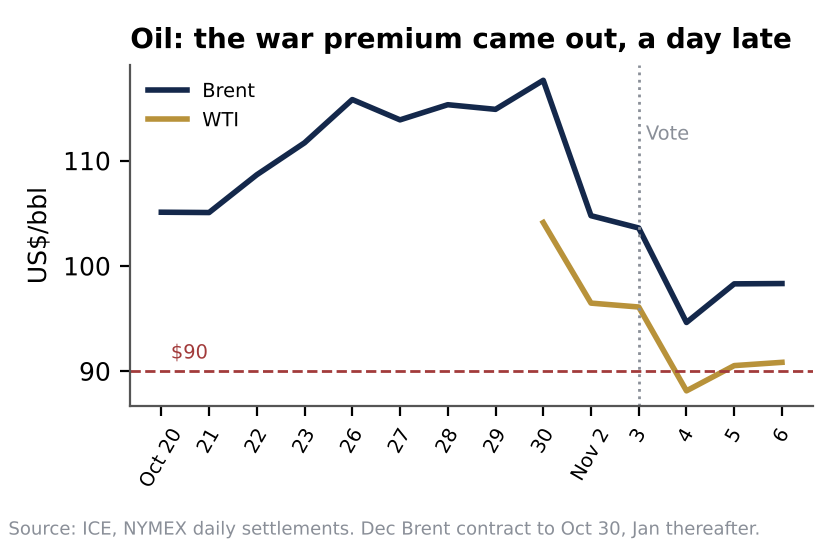
We would be careful with that read. Nothing is agreed with Tehran, tankers were still being hit late in the week, and the physical market is still tight. US distillate stocks are the lowest since 2003, and the Strategic Petroleum Reserve is the lowest since 1982. That is why Brent bounced almost 4% on Thursday. The premium came out faster than the shortage did, so our view of structural tightness into 2027 stands. So does our lens: Hormuz is an Asian and European supply problem first.
The Nasdaq: the AI trade gets a policy problem. The Nasdaq's 5.5% fall on Thursday was its worst day in 19 months and left it more than 10% off its October record. The selling hit chips and the AI build-out, and the best explanation is policy: a Congress elected partly on data-centre and power-cost politics is a risk the sector had not priced. Then the weekend brought press reports, based on a US intelligence memo, that Chinese intelligence had targeted Nvidia's chief executive through an executive at an Asian cloud partner. We have not verified those reports, and nobody has accused Nvidia of wrongdoing. The follow-through is what weighs on the sector. It includes a closed-door congressional briefing on November 18, a Senate investigation, and a reported freeze on a planned deal to sell high-end chips to China. Add the financing strain we flagged in October, and the AI build-out now carries three separate weights: policy, the China probe and financing. A company-by-company breakdown belongs in a company-level piece, not a macro issue, so this stays at the mechanism level on purpose.
That is why we are sticking with rotation over a market top. A top looks like everything falling together, with credit cracking behind it. This week the Dow lost under 1% while the Nasdaq lost 3.4%, and the money went into gold, silver and the miners. The signal we are watching for confirmation is set out under The house framework, reassessed.
Gold: forced selling over, patience required. Gold had its best week since late August, rising about 4.6% to roughly $4,075 from a one-year low near $3,870. Last month we described the drop as liquidation to cover losses elsewhere, as in 2008, and expected that selling to run its course once the vote had passed. That read held, and the miners outperformed the metal, which is typical early in a rotation. We would still keep expectations measured. Gold is working off January's spike, and corrections after a move that far above long-term averages take time as well as price. Our short-term gold view was tactical and is now closed. The debasement scenario runs on its own 18-month clock, and a choppy winter would not break it.
Rates: we weight a December hike below market pricing. After a strong US jobs report, futures price about a three-in-four chance of a Fed hike in December. We think that is too high, for three reasons. Gasoline is falling with crude, and short-dated inflation breakevens dropped sharply this week. Much of 2026's price spike also came from tariffs and energy, which fall out of the year-over-year numbers in 2027 on their own. Hiking into an AI-led correction and a falling oil price risks tightening into a slowdown. Watch Japan as well. The yen weakened again as money moved into dollars, and any return to intervention or easing there is another tailwind for gold.
2. The vote: what it means for markets
We got the Senate wrong. In context, though, it is a familiar midterm penalty. Clinton in 1994 and Obama in 2010 lost seats on a similar scale, and both went on to win second terms. The verdict on 2028 is a long way off. For markets, the question is narrower.
The levers that matter most did not change hands. Tariffs, sanctions and the Iran war are executive powers. That is why Treasury could sanction Canadian firms within days of the vote, and why Ottawa says its trade approach is unchanged. With a presidential veto on the table, we expect gridlock on spending and taxes, which markets priced on Wednesday with the Dow's best day of the year. What Congress can reach is oversight: investigations, appropriations, data-centre and power-cost politics, and a War Powers vote on Hormuz in January. Those are the channels that hit the AI trade and took the war premium out of oil.
3. Canada: fiscal expansion into a tightening cycle
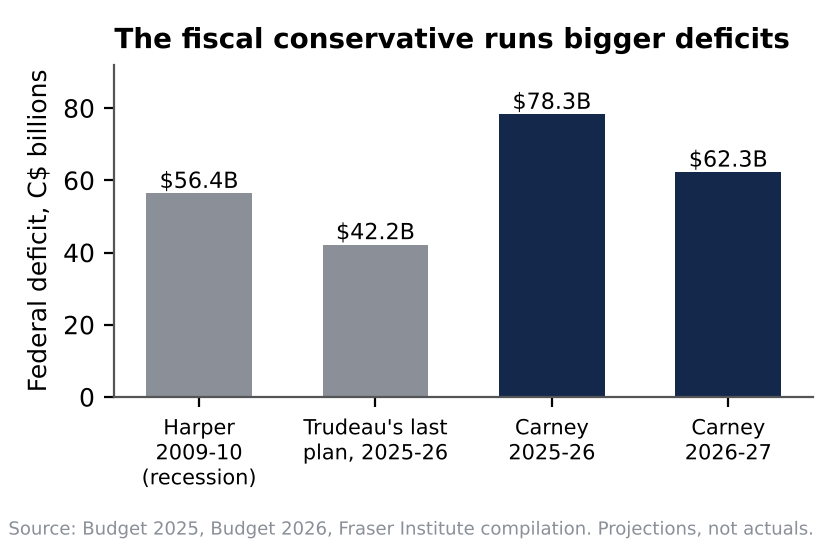
Carney came to office as the fiscal adult in the room. The numbers do not back that up. His first budget set a C$78.3 billion deficit for 2025-26, close to double the C$42.2 billion that Trudeau's last plan had pencilled in for the same year. This one projects C$62.3 billion for 2026-27, larger than any Trudeau deficit outside the pandemic years, and roughly C$289 billion of cumulative deficits over five years. It also lands a week after the Bank of Canada's first rate hike since 2023. Ottawa is pressing the accelerator while the central bank taps the brake, and the bill shows up in debt service. Last year's plan already had public debt charges passing C$76 billion by 2029-30, more than the federal health transfer.
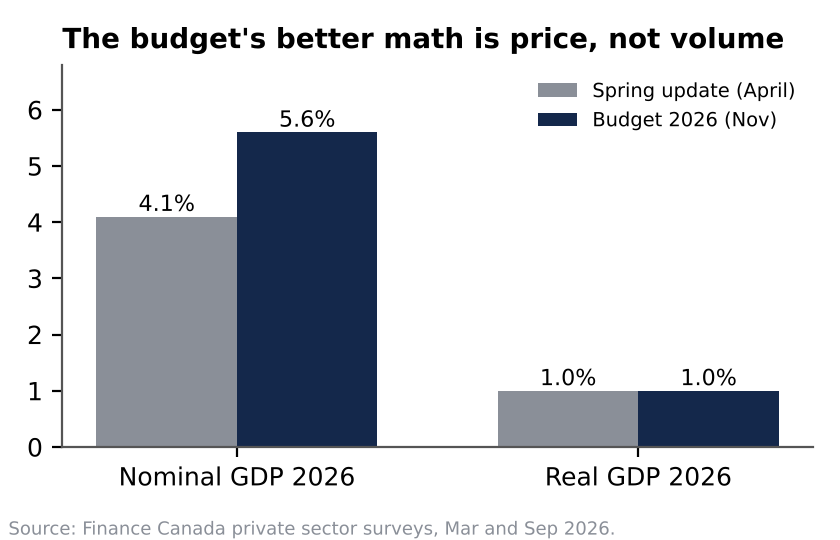
This year's improvement looks fragile. The deficit is C$3 billion better than April's estimate, but the gain comes from prices, not volume. Private forecasters now expect nominal GDP growth of 5.6% this year, up from 4.1% in the spring, while real growth stays at 1%. That gap is the oil windfall, and the budget landed in the week Brent fell 16%.
Underneath, the economy is weakening. Canada has lost roughly 114,000 jobs since August. In October, private employers cut 52,500 jobs while government added 49,600. Public hiring into a private slowdown, funded by an oil price that just dropped, is a weak base for a C$62 billion deficit.
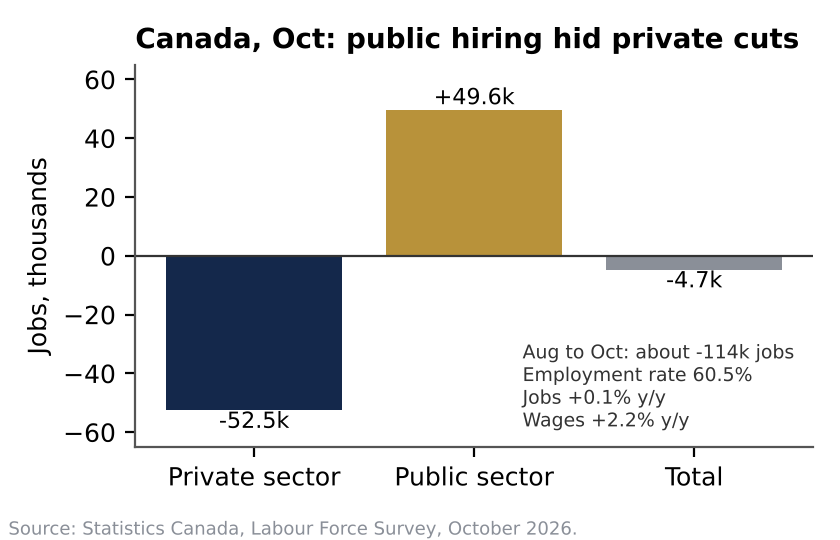
With unemployment up to 6.7% from 6.5%, we expect the Bank of Canada to hold on December 9.
For the sectors this issue discusses, the budget is better than the backdrop. Mining gets the clearest win. The 15% Mineral Exploration Tax Credit and the 30% Critical Mineral Exploration Tax Credit were both due to expire in March 2027. They are extended to March 2032, with antimony added to the critical list, at a cost of about C$956 million over five years. That removes the 2027 cliff from flow-through financing and supports the year-end funding window for junior explorers. Another C$2.3 billion goes to critical minerals, including a renewed national strategy. The budget adds little new on permitting, which is where most projects actually stall.
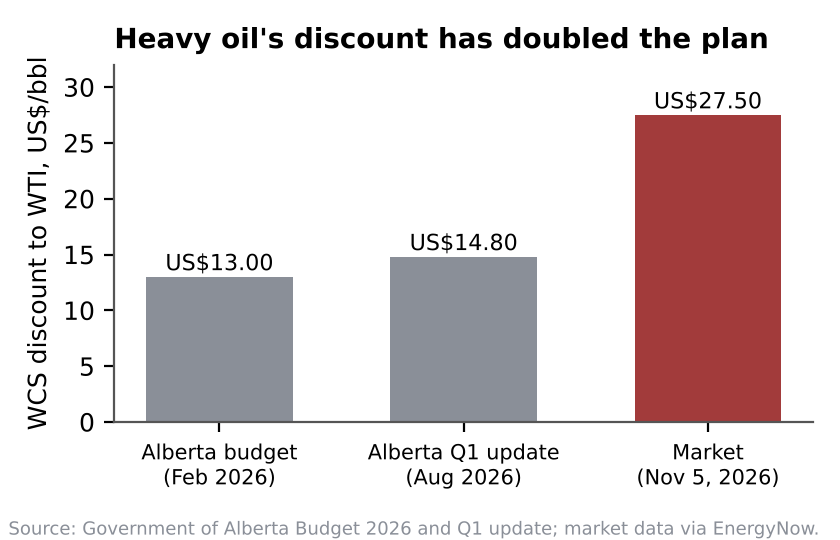
Oil and gas get help on costs, not on price. The Productivity Mega Deduction cuts the marginal effective tax rate on new business investment from about 13% to 6.4%, which favours equipment, processing and pipeline spending. The budget backs a proposed million-barrel-a-day oil line to the West Coast and a second phase of LNG Canada, though neither has reached a final investment decision. Helium exploration costs will be treated like conventional oil and gas, a small but useful change. The catch is price. WCS traded about US$27.50 under WTI on November 5, more than double Alberta's budget assumption, and a West Coast outlet that would narrow that discount is years away. Until then, producers get cheaper capital spending and weaker realized prices at the same time.
Power is the third beneficiary. Clean technology and clean electricity credits now run to 2040, and nuclear gets C$518.5 million.
Immigration is where the budget's framing and its numbers diverge most. The permanent resident target is flat at 380,000. However, a one-time measure moves up to 200,000 people already in Canada to permanent residence in 2027, which could take grants past the 2024 record of 483,655. Our read is that this is mostly retention. It stops departures among people already working here. It also lets Ottawa meet its pledge to bring temporary residents below 5% of the population on paper, without anyone leaving. It props up headline population while jobs stall. With rates rising and private hiring weakening, our view that Toronto and Vancouver home prices have further to fall is unchanged.
The other lever: Canada's banks. On Friday, the US Treasury sanctioned eight Canadian money services businesses in Ontario and British Columbia for helping Iranian entities evade sanctions, in coordination with FINTRAC. FINTRAC says it has revoked 161 money-services registrations so far this year, more than in the previous three years combined. We see this as the opening of a pressure campaign on Canada's financial system that runs alongside the trade talks. Treasury warned in August that institutions facilitating Iranian commerce, even unknowingly, could face secondary sanctions, including loss of access to US dollar clearing. Money-services businesses are the channel FINTRAC has long flagged for Iranian funds entering Canada, and the banks sit one step behind them as correspondents. Nobody has alleged that a Canadian bank did anything wrong. The risk is that Washington does not need proof to apply pressure, and the banks are the heaviest weight in the TSX. Ottawa's co-operation with FINTRAC suggests it wants to keep this at the money-services level. The new Congress cannot change it, since sanctions are executive authority. We are adding US dollar-clearing access to the risks in our view of the Canadian banking cycle, alongside credit and housing. A bank-by-bank breakdown belongs in a company-level piece, not a macro issue, so this stays at the mechanism level on purpose.
The house framework, reassessed
Axis 1 weighs rotation against a valuation top over the near term. This week strengthened the rotation case without changing the weighting.
| Axis 1 scenario | House weighting | What this week showed |
|---|---|---|
| Rotation, not a valuation top | 60%, base case, unchanged | The Dow lost under 1% on the week against 3.4% for the Nasdaq, and flows went to gold, silver and the miners. |
| Valuation top | Not restated this issue; full recap at month-end | A top would look like everything falling together, with credit cracking behind it. This week did not look like that. |
Axis 2 is the debasement tail. It is weighted at 25-30% on its own 18-month clock and is unchanged this issue. A softer Fed path and renewed pressure on the yen help that case, and closing our short-term gold view does not touch it.
The ratio we are watching is the Nasdaq against the S&P 500. It has trended up for two decades and has just been pushed back onto that trend. It last broke for good in 2000, when tech lagged for years while value and hard assets led. A break now would be the clearest confirmation yet of the rotation case. The historical statistics doing the rounds on what follows a 4% down day come in bullish and bearish versions, and both pick their samples. Leadership matters more than the index level.
The weightings above are ArcStone Financial Pulse's own house view as at the publication date. They are not market-implied probabilities, forecasts of any particular outcome, or targets.
What is still open
- Whether the oil shortage reasserts itself. The war premium came out faster than the shortage. Nothing is agreed with Tehran, tankers were still being hit late in the week, and US distillate and Strategic Petroleum Reserve levels remain at multi-decade lows.
- The size of the Senate majority. The Mississippi and Alaska counts are still under way.
- December Fed pricing. US October CPI on November 10 decides whether the roughly three-in-four hike pricing holds.
- The AI policy overhang. The open items are the November 18 House briefing, the Senate investigation, and the reported freeze on high-end chip sales to China. The reports concerning Nvidia's chief executive rest on a US intelligence memo we have not seen or verified.
- The Canada-US deal and the Ukraine talks. Neither is signed. The Abu Dhabi talks run November 10-11.
- How far Treasury's pressure on Canada's financial system goes. The question is whether it stays at the money-services level or reaches the banks' US dollar clearing.
- Whether the budget's energy backing becomes investment. Neither the West Coast oil line nor a second phase of LNG Canada has reached a final investment decision, and the WCS discount remains more than double Alberta's assumption.
- January's War Powers vote on Hormuz, and whether Putin attends the G20 summit in Miami on December 14-15.
Disclosures
ArcStone Financial Pulse Inc. is owned by the same parent entity (ArcStone Securities and Investments Corp.) that owns ArcStone Securities, LLC. This common ownership, together with the joint operating relationship between ArcStone Securities, LLC and Kingswood Capital Partners, LLC under the ArcStone Kingswood DBA OSJ banner, represents a structural conflict of interest. Issuers referred to in ArcStone Financial Pulse content may be current or former clients of ArcStone or any of its subsidiaries and affiliates. Where ArcStone or its subsidiaries and affiliates have received or have been promised consideration for services provided to such an issuer, such consideration may include cash, stock, stock options, warrants, and/or Restricted Stock Units (RSUs) for the provision of corporate advisory, investor relations, digital media, or capital markets consulting services. This relationship represents a potential conflict of interest. The principals, directors, officers, employees, and related entities of ArcStone and its affiliates may, from time to time, own, buy, or sell securities or derivatives of such issuers or their affiliates.
The information contained herein is provided by ArcStone Financial Pulse Inc. ("ArcStone Financial Pulse"), a subsidiary of ArcStone Securities and Investments Corp. ("ArcStone"), for informational purposes only. It is not, and under no circumstances should it be construed as, an offer to sell or a solicitation of an offer to buy any securities or other financial instruments in any jurisdiction. This content is not a research report within the meaning of FINRA Rules 2241 or 2242 and does not constitute a research report under any applicable securities laws.
Certain statements contained herein may constitute "forward-looking statements" within the meaning of applicable Canadian and U.S. securities laws. Forward-looking statements are based on current expectations, estimates, and assumptions that involve known and unknown risks and uncertainties which may cause actual results or developments to differ materially from those expressed or implied. These statements often include words such as "anticipate," "believe," "expect," "intend," "may," "plan," "project," "should," "target," or similar expressions. Readers are cautioned not to place undue reliance on such statements, which speak only as of the date made. Except as required by law, ArcStone undertakes no obligation to update or revise any forward-looking information.
This content is not intended as investment advice or a recommendation to buy or sell any security and does not take into account the investment objectives, financial situation, or needs of any individual. Investors should consult their own professional advisors before making any investment decisions.
ArcStone Securities and Investments Corp. is not a registered broker-dealer and does not provide investment advice or recommendations. All registrable activities in the United States are conducted through ArcStone Securities, LLC (CRD# 306029) and/or Kingswood Capital Partners, LLC (CRD# 288898), both FINRA-registered broker-dealers, members SIPC. ArcStone Canada Inc. is not registered as a dealer in any Canadian jurisdiction; registrable dealing activities in Canada are conducted through appropriately registered affiliates.
ArcStone Kingswood is a DBA Office of Supervisory Jurisdiction (OSJ) of Kingswood Capital Partners, LLC (Member FINRA/SIPC) under which registered representatives of ArcStone Securities, LLC (Member FINRA/SIPC) and registered representatives of Kingswood Capital Partners, LLC conduct joint capital markets and investment banking activities. ArcStone Securities, LLC and Kingswood Capital Partners, LLC are parties to a written agreement governing the sharing of fees on transactions in which registered representatives of both firms participate. All securities transactions and investment banking services conducted by ArcStone are conducted exclusively through ArcStone Securities, LLC and/or Kingswood Capital Partners, LLC; "ArcStone Kingswood" itself is not a registered broker-dealer or separate legal entity.
Subject matter. This issue discusses the following: the fall in Brent and WTI crude oil prices around the November 3, 2026 US midterm elections; the Nasdaq's November 5 decline and US policy risk to the AI and semiconductor sectors, including press reports concerning Nvidia; the gold and silver markets; futures pricing of a December 2026 US Federal Reserve rate decision; the market implications of the US Senate result; Canada's federal Budget 2026 and its measures for mining and critical minerals, oil and gas, power and immigration; Statistics Canada's October 2026 Labour Force Survey; the Western Canadian Select discount to WTI; and US Treasury sanctions on eight Canadian money services businesses, together with possible pressure on Canada's banking system.
Independence. The views in this issue are ArcStone Financial Pulse Inc.'s own. They were not influenced by any investment banking, advisory or other business relationship of ArcStone or any of its subsidiaries or affiliates. No part of the compensation of anyone who prepared this issue is tied to the views expressed in it.
No ratings. ArcStone Financial Pulse Inc. does not maintain a rating system, a coverage universe or a distribution of ratings, and this issue assigns no rating, recommendation or price target to any security. The following are ArcStone Financial Pulse's own house view about macro regimes and events, as at the publication date: the entries in 'How our view changed this issue', the scenario weightings in 'The house framework, reassessed', and the closed Senate weighting referred to in 'Since last issue'. They are not market-implied probabilities, forecasts of any particular outcome or targets. The US$90 WTI level appears only to score a closed scenario and is not a target.
Affiliate sector exposure. ArcStone affiliates, including ArcStone Canada Inc., may provide or seek to provide services to issuers in sectors discussed in this issue, including mining and critical minerals exploration, oil and gas, power, technology and financial services. Readers should assume ArcStone has commercial interests in these sectors. This issue makes no statement about positions held by ArcStone, its affiliates or its principals.
Third-party sources and forecasts cited. Growth forecasts are the private-sector forecasts compiled in Finance Canada's private sector surveys of March and September 2026. Federal deficit comparisons use the Fraser Institute's compilation of Budget 2025 and Budget 2026 figures. Alberta's WCS assumptions are from the Government of Alberta's Budget 2026 and its Q1 update. The market WCS discount is from EnergyNow. December Fed hike odds reflect futures market pricing. Policy and trade positions are as reported from the US Treasury, FINTRAC, and US and Canadian officials.
Price basis and as-of date. Market levels are as at the close on Friday, November 6, 2026 unless stated. Weekly changes compare November 6 with October 30, 2026, and the WCS discount is as at November 5, 2026. Gold and the December Fed hike pricing are approximate. Brent's weekly change runs from the expiring December contract to the January contract. All levels and figures were carried from the source document and were not independently re-verified by ArcStone Financial Pulse Inc.
Charts. Figure 1 plots Brent and WTI daily futures settlements from October 20 to November 6, 2026 (WTI from October 30), using the December Brent contract to October 30 and January thereafter. Its US$90 line scores a closed scenario. Figure 2 shows percentage changes from October 30 to November 6, 2026, calculated from exchange closing data, with Brent on an expiring-contract basis. Figure 3 shows October 2026 employment changes by sector from Statistics Canada's Labour Force Survey. Figure 4 shows federal deficits from Budget 2025, Budget 2026 and a Fraser Institute compilation; its source labels these projections, not actuals. Figure 5 shows nominal and real 2026 GDP forecasts from Finance Canada private sector surveys of March and September 2026. Figure 6 shows the WCS discount to WTI as assumed by the Government of Alberta in February and August 2026 and as traded on November 5, 2026. None of the six charts contains an ArcStone estimate.
As-reported figures. The following figures are as reported and are not ArcStone calculations: Canadian labour market figures (Statistics Canada); federal deficits, cumulative deficits, public debt charges, tax credit terms and costs, program amounts and immigration targets (the Government of Canada's budget documents); Alberta's WCS assumptions (the Government of Alberta); the money services business sanctions (the US Treasury); and registration revocations (FINTRAC). Percentage changes in market prices are calculated from exchange closing data.
Unverified claims. Reports that Chinese intelligence targeted Nvidia's chief executive come from press reporting of a US intelligence memo that ArcStone has not seen or verified, and no wrongdoing by Nvidia has been alleged. The reported Senate investigation and the reported freeze on a planned sale of high-end chips to China are likewise unverified press reports. Statements attributed to the US Vice President and to US and Canadian officials on the trade talks are as reported. Neither the proposed West Coast oil line nor a second phase of LNG Canada has reached a final investment decision.
No company named in this commentary is a current or former client of ArcStone or any of its subsidiaries and affiliates, and no consideration has been paid or promised to ArcStone or any of its subsidiaries or affiliates in connection with this commentary. Companies are named only to report their own scheduled reporting dates or publicly observable market data, and no view is expressed on their securities.
Sources: ICE, Brent crude futures daily settlements (December contract to October 30, January thereafter), October 20 to November 6, 2026; NYMEX, WTI crude futures daily settlements, October 30 to November 6, 2026; Exchange closing data for the S&P 500, Nasdaq, Dow, Russell 2000, gold, silver and the US 10-year Treasury yield, November 6, 2026 versus October 30, 2026; Futures market pricing of the December 2026 Federal Reserve decision, as at November 6, 2026; Statistics Canada, Labour Force Survey, October 2026; Government of Canada, Budget 2025 and Budget 2026 (November 2026); Finance Canada, private sector economic surveys, March and September 2026; Fraser Institute, compilation of federal deficit figures from Budget 2025 and Budget 2026; Government of Alberta, Budget 2026 (February 2026) and Q1 update (August 2026); EnergyNow, WCS market data, November 5, 2026; US Department of the Treasury, sanctions on eight Canadian money services businesses, November 6, 2026, and secondary sanctions warning, August 2026; FINTRAC, money services business registration revocations, 2026 year to date; Press reports citing a US intelligence memo concerning Nvidia's chief executive (unverified), weekend before publication.
© 2026 ArcStone Financial Pulse Inc. All rights reserved. May be redistributed in full and unaltered with attribution.